深圳溯源
Couldn't load pickup availability
衣服尺寸:
胸围/腰围/臀围:80/76/88 厘米
衣长:104 厘米
细节描述:
一、衣上繁花:针线里的盛世隐喻
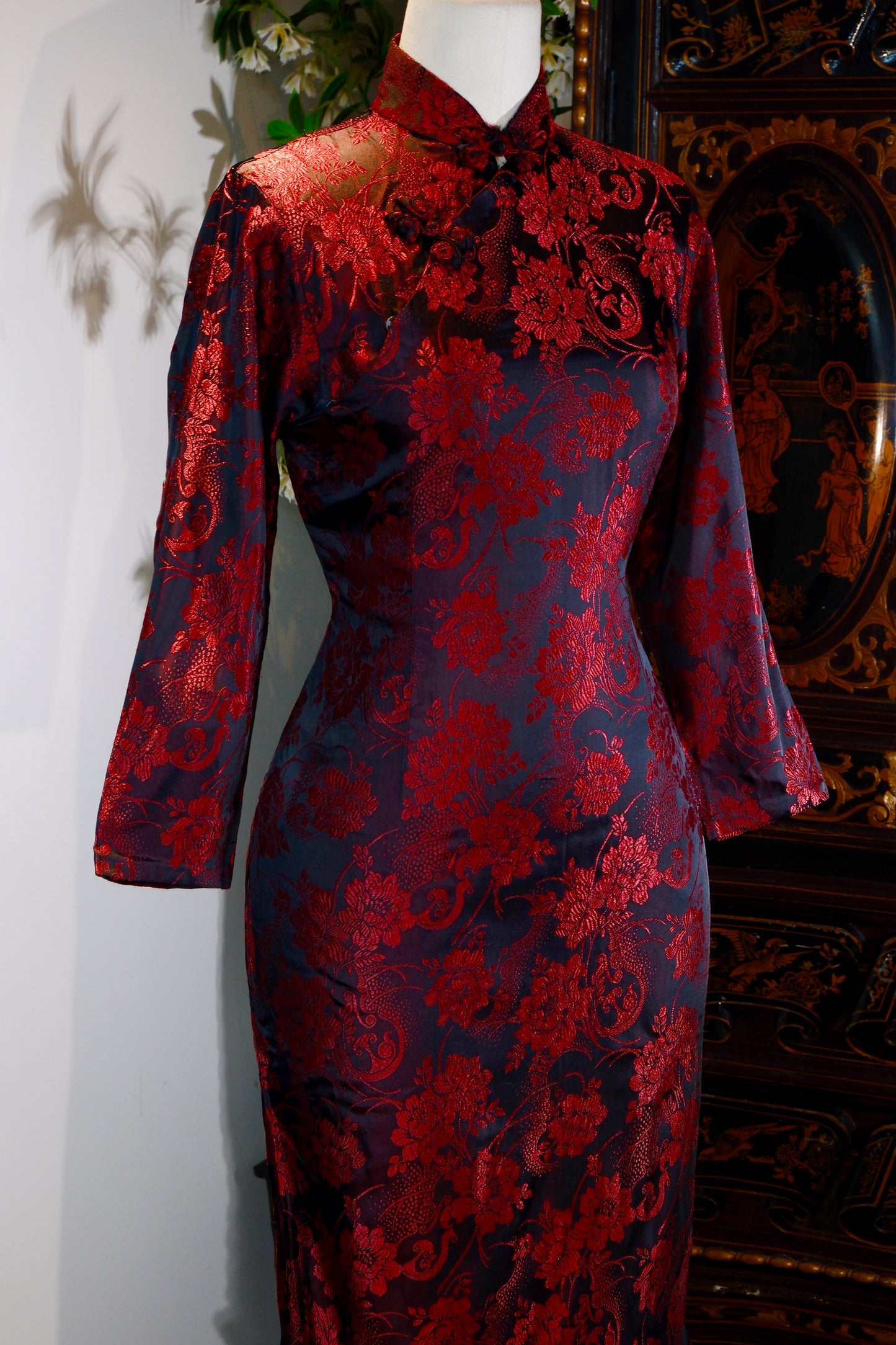
这件上世纪六十年代的香港产古董旗袍,以暗红与墨蓝交织的提花面料为骨,将“国色天香”的牡丹化作流动的华章。细观纹样,大朵牡丹如云霞般铺展于衣身,花瓣层叠处似有晨露凝光;缠枝卷草蜿蜒其间,既承袭了传统“缠枝莲”的吉祥寓意,又以西洋绘画的透视感赋予花朵立体生机——这是六十年代香港时装业“中西合璧”的典型印记:匠人们用进口提花机复刻东方意象,让牡丹在经纬间既保留《本草纲目》里“群芳之首”的雍容,又透出好莱坞黄金时代的华丽光泽。
二、时光密码:一件旗袍里的城市史诗
六十年代的香港,是旗袍从“闺阁雅物”蜕变为“都市战袍”的关键场域。彼时,张爱玲笔下的“葱绿配桃红”已化作更克制的暗红与墨蓝,契合战后女性对“低调奢华”的追求;而香港作为远东时尚枢纽,汇聚了上海裁缝的精湛技艺与西方工业化的生产效率——这件旗袍的七分袖设计(兼顾优雅与行动便利)、收腰剪裁(贴合人体工学的改良),正是那个时代“摩登与传统共生”的缩影。它或许曾陪某位名伶穿梭于中环茶餐厅与舞厅之间,在霓虹灯下折射出属于香港女性的坚韧与风情。
三、典籍证道:从《诗经》到张爱玲的审美传承
牡丹入衣,自古便是华夏美学的“顶级符号”。《诗经·郑风》有“有女同车,颜如舜华”,虽未直言牡丹,却奠定了“以花喻美人”的传统;至唐代,刘禹锡“唯有牡丹真国色,花开时节动京城”将其推至文化神坛。而这件旗袍的妙处,在于它用现代工艺重构了古典意象——提花的肌理如宋锦般细腻,色彩的碰撞又暗合明代“青出于蓝而胜于蓝”的染织智慧。正如张爱玲所言:“衣服是一种言语,随身带着一种袖珍戏剧。”这件旗袍的每一寸花纹,都是穿在身上的“东方叙事诗”。
四、稀缺之珍:不可复制的时光孤品
如今,能完整保存六十年代香港产提花旗袍者,已是凤毛麟角。彼时的提花面料多依赖手工调校机器,产量极低;加之历经半个多世纪,多数同类衣物或因战乱流散,或因材质老化损毁。这件旗袍不仅保留了原始的光泽与版型,更承载着“香港制造”的黄金记忆——它是研究二十世纪中叶东亚服饰史的活标本,更是收藏家眼中“可触摸的历史”。
结语:穿在身上的文明对话
当我们凝视这件旗袍,看到的不仅是牡丹的盛放,更是一个时代的呼吸:它是传统与现代的和解,是东方与西方的拥抱,是无数无名匠人用针线写就的“生活史诗”。若你有幸拥有它,便拥有了与六十年代香港对话的权利——在每一个穿上它的瞬间,你都在续写这段关于美、关于时间、关于文明的传奇。
Measurements / Size Guide:
Bust / Waist / Hips: 80/76/88 cm
Total Length: 104 cm
Detailed Description:
Constructed over a structural jacquard chassis where deep dark red and ink blue filaments interlace, this 1960s Hong Kong-produced antique qipao transforms the traditional majesty of the peony into a fluid visual symphony. Close inspection of the pattern layout reveals massive peony blossoms expanding across the garment body like shifting spring clouds, their cascading petals appearing to capture and reflect ambient light. Winding scrolling foliage extends between the roundels, inheriting the traditional auspicious concepts of the ancestral "interlocking lotus" motif while integrating a Western painterly sense of perspective to endow the blossoms with three-dimensional vitality.
This layout stands as a defining technical marker of the "East-meets-West" philosophy that characterized the 1960s Hong Kong fashion sector: master weavers utilized imported jacquard machinery to replicate classic Eastern iconography. This allowed the peony to preserve its ancestral status as the "queen of a hundred blossoms" while broadcasting the spectacular, high-tier luster reminiscent of Hollywood's golden age.
Hong Kong during the 1960s operated as a critical arena where the qipao completed its historic transformation from a restrictive heirloom into an expressive, capable "urban battle dress" (战袍). During this window, the vibrant contrasting palettes famously cataloged by Eileen Chang transitioned into a more disciplined, reserved pairing of dark red and ink blue, perfectly aligning with the post-war woman's pursuit of understated luxury.
As the premier fashion hub of the Far East, mid-century Hong Kong uniquely fused the peak bespoke techniques of migrated Shanghainese master tailors with Western industrial production efficiencies. The three-quarter sleeve configuration of this qipao—balancing absolute elegance with seamless physical mobility—paired with its ergonomic waist reduction, serves as a pristine miniature of the coexistence of tradition and modernism. It may have once accompanied a prominent starlet navigating the path between Central district tea cafes and cosmopolitan ballrooms, its woven motifs shifting under neon lights to reflect the resilient grace and absolute composure of Hong Kong women.
The incorporation of the peony into apparel design has long functioned as a premier symbol within Chinese material culture. While the classical verse from The Book of Songs • Zheng Wind—"A maiden rides in the same carriage, her face is as radiant as the hibiscus blossom"—does not explicitly name the peony, it established the foundational literary tradition of using flora as a metaphor for feminine grace. By the Tang dynasty, the poet Liu Yuxi permanently elevated the blossom into a cultural icon with his famous line: "Only the peony is true peerless beauty, its blossoming moves the entire capital."
The exceptional triumph of this qipao resides in its ability to reconstruct these classical concepts via modern mid-century technology. The tactile texture of the jacquard weave yields a refinement akin to traditional Song dynasty brocades, while its chromatic contrast secretly references historical dyeing wisdom. As Eileen Chang famously observed: "Clothes are a language, a pocket theater carried around with oneself." Every single inch of pattern across this garment functions as a wearable epic of Eastern narrative poetry.
In contemporary fashion circles, authentic 1960s Hong Kong-produced jacquard qipaos preserved in unblemished structural integrity have become an absolute rarity. The specialized jacquard yardage of that era required master technicians to manually calibrate mechanical looms, yielding incredibly low production runs. Furthermore, spanning more than half a century of natural timeline, the vast majority of matching archival pieces have either been scattered by historical migration or lost to natural fiber aging.
This specific specimen not only retains its original material luster and pristine pattern draft but encapsulates the golden memory of vintage Hong Kong manufacturing. It stands as an irreplaceable, living specimen for studying mid-twentieth-century East Asian costume history—an item conservators rightly classify as "tangible, living history."
Gazing upon this qipao reveals far more than the blossoming of the peony; it captures the living breath of an entire generation. It stands as a peaceful reconciliation between ancestral tradition and urban modernity, a beautiful embrace between East and West, and a physical epic of lifestyle written by anonymous master tailors using fine filaments. To step into its structural matrix is to claim a direct, personal dialogue with the golden era of 1960s Hong Kong—with every single wear, you actively continue a timeless legend of craft, lineage, and Eastern grace.
Suyuan Archival Textile Registry — Documenting the material culture, preserving the technical lineage of ancestral craft.