深圳溯源
Couldn't load pickup availability
衣服尺寸:
胸围/腰围/臀围:78/80/90 厘米
衣长:82 厘米
细节描述:
【图案解析】经纬之间的秩序美学
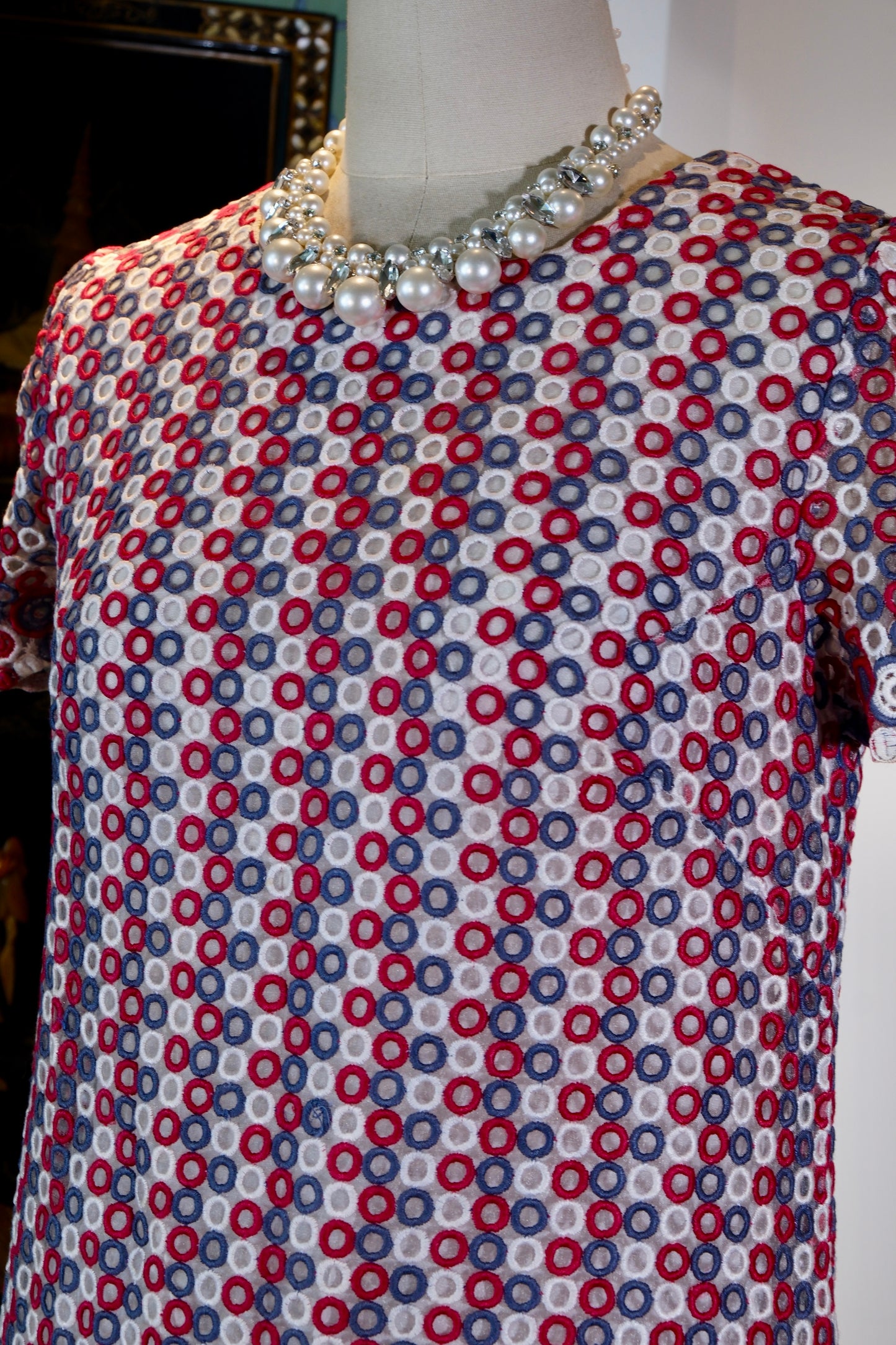
凝视这件古董裙,首先映入眼帘的是其极具现代主义色彩的几何纹样。不同于传统蕾丝对花卉藤蔓的自然模仿,这件作品采用了上世纪中叶盛行的“欧普艺术”(Op Art)风格变体。
- 色彩构成:红、白、蓝三色的棉线交织,不仅呼应了法兰西国旗的经典配色,更在视觉上构建了一种明快而理性的节奏感。红色热烈而不艳俗,蓝色深沉且具知性,白色则作为留白,赋予了面料呼吸的空间。
- 形态语言:无数个规整的圆形镂空(Eyelet)排列成严谨的矩阵。这种重复的圆形结构,既像是机械时代的齿轮隐喻,又带有某种波普艺术的趣味。圆环内部并非空洞,而是通过精密的机绣锁边,形成了虚实相生的视觉张力。
- 下摆变奏:最为精妙之处在于裙摆处的图案处理。原本垂直排列的几何圆环,在接近底边时逐渐演变为更为繁复的同心圆靶心状纹样,仿佛是乐曲终章的高潮,打破了通体直线的单调,为整体造型增添了稳重的压脚感。
【历史溯源】香江制造与巴黎风尚的跨海对话
这不仅仅是一件衣服,它是冷战时期全球化贸易的一个缩影,是东西方时尚工业碰撞出的火花。
- 法国设计的灵魂:20世纪60年代,正值伊夫·圣罗兰(Yves Saint Laurent)等设计师推动成衣革命的年代。法国时尚界开始追求更年轻、更具活力的设计语言。这款裙子的剪裁——经典的A字廓形(Shift Dress),正是那个时代女性解放身体束缚的象征。它摒弃了50年代紧身胸衣的繁琐,强调直线与舒适,正如可可·香奈儿所言:“时尚不仅仅是存在于服装之中,时尚是在天空中,在街道上,时尚与观念、生活方式息息相关。”
- 香港制造的匠心:60年代的香港正处于纺织业腾飞的黄金时代,被誉为“东方巴黎”。当时的香港工厂以承接欧美高端订单闻名,尤其是这种高难度的机绣棉线蕾丝工艺。法国提供设计图纸与审美标准,香港工匠则以精湛的技艺和极高的效率将其转化为实物。这种“前店后厂”的模式,造就了这件裙子独一无二的混血基因——既有法式的浪漫慵懒,又有东方的精细做工。
【学术考证】稀缺性与艺术价值
从服装史的角度审视,此裙具有极高的研究样本价值。
- 材质的断代特征:这种厚重的棉线蕾丝(Cotton Guipure Lace或Broderie Anglaise的工业化变体)在60年代中期极为流行,但因其透气性不如后来的合成纤维,且洗涤保养难度大,存世量远少于同期的尼龙或涤纶制品。能保存至今且色泽如新、无破损者,实属凤毛麟角。
- 工艺的绝唱:请注意观察袖口与领口的细节,这种高密度的电脑刺绣前身——早期多针头机绣工艺,需要极高精度的制版。随着70年代快时尚的兴起,这种不计成本、追求极致纹理感的重工蕾丝逐渐被廉价的印花化纤取代。因此,这件裙子代表了传统纺织工艺向现代工业化过渡时期的最高水准。
【结语】穿在身上的博物馆
《诗经》有云:“岂曰无衣?与子同袍。”衣物不仅是御寒之物,更是文化的载体。
当你穿上这件六十年代的法式港产蕾丝裙,你穿上的是一段关于自由、关于贸易、关于东西方文化交融的历史。那红白蓝的几何圆环,如同时间的年轮,记录着那个摩登时代的优雅与从容。它不仅是一件稀缺的古董,更是一首用针线谱写的、跨越半个世纪的无声诗歌。
Measurements / Size Guide:
Bust / Waist / Hips: 78/80/90 cm
Total Length: 82 cm
Detailed Description:
Gazing upon this antique dress, the eye is immediately arrested by a highly modernist geometric motif. Shifting decisively away from the literal botanical mimicry of traditional floral and tendril laces, this piece implements a sophisticated manifestation of the "Op Art" (Optical Art) movement that reigned supreme during the mid-twentieth century.
Chromatographic Architecture: The interweaving of red, white, and blue cotton filaments not only registers an overt homage to the classical tricolor palette of the French republic, but visually engineers a crisp, highly rational rhythmic cadence. The red values operate with immense fervor without fracturing into vulgarity; the blue is deep, calculated, and intellectual; while the white functions as mandatory structural negative space, granting the textile matrix a vital dimension of breathability.
Morphological Language: Countless, mathematically uniform openwork circular punch-holes (Eyelets) are distributed across a rigorous matrix. This repeating circular geometry performs simultaneously as a mechanical-era metaphor for interlocking gears and a playful expression of mid-century Pop Art. The interiors of these circular voids are far from vacant; they are fortified via high-density mechanical satin-stitch binding (锁边), yielding a profound visual tension born of the dialogue between physical transparency and dense structural boundaries (Xushi Xiangsheng).
Hemline Modulation: The most brilliant piece of design engineering is localized at the terminal hemline of the dress skirt. The strictly vertical alignment of the geometric rings transitions dynamically as it approaches the lower boundary, evolving into a highly complex, concentric target-like pattern matrix. Operating like the ultimate crescendo of a musical movement, this structural intervention shatters the potential monotony of the all-over verticality, endowing the total silhouette with a grounding, weighted equilibrium.
This artifact transcends its utility as a luxury garment to serve as a vital primary physical document—a microcosm of Cold War-era globalized trade networks and the magnificent spark ignited when Eastern and Western design systems collided.
The Soul of French Design: The 1960s witnessed the definitive zenith of the ready-to-wear revolution (Prêt-à-Porter), spearheaded by avant-garde couturiers like Yves Saint Laurent. The French apparel apparatus pivoted aggressively toward a younger, intensely kinetic design language. The blueprint of this specific dress—the iconic, architectural A-line shift silhouette (Shift Dress)—stands as the absolute material signifier of the mid-century emancipation of the female anatomy. It permanently relinquished the restrictive, multi-layered corset architectures of the 1950s to advocate for linear clarity and organic comfort, flawlessly echoing Coco Chanel’s definitive doctrine: "Fashion is not something that exists in dresses only. Fashion is in the sky, in the street, fashion has to do with ideas, the way we live, what is happening."
The Precision Craftsmanship of Hong Kong: During the 1960s, Hong Kong’s textile and apparel manufacturing sector entered a historic golden boom, earning the international moniker of "The Paris of the East." The regional production apparatus was celebrated globally for executing elite, high-specification Western commissions, specifically high-difficulty mechanical embroidery on heavy cotton cords. In this cross-continental paradigm, France supplied the structural design schematics and rigorous aesthetic criteria, while Hong Kong’s master artisans deployed peerless technical execution and supreme efficiency to materialize the flat concepts into physical dimensions. This "front-atelier, back-foundry" synthesis endowed the garment with a unique hybrid lineage—marrying the effortless nonchalance of French romance with the absolute precision and material discipline of Eastern craftsmanship.
Appraised through the rigorous analytical lens of costume history, this dress operates as an invaluable holotype specimen for mid-century material culture research.
Chronological Material Indicators: This heavy-gauge cotton cord lace—operating as a heavy industrial variant of Cotton Guipure Lace or advanced mechanical Broderie Anglaise—reached an absolute fever pitch of popularity during the mid-1960s. However, because its atmospheric breathability and structural elasticity are significantly less forgiving than the synthetic polymers that followed, and given its intense vulnerability to cleaning and environmental duress, its global survival yield is profoundly lower than contemporary nylon or polyester clothing. For a specimen of this material composition to survive to the contemporary era with its chromatographic saturation entirely untarnished and structural matrix intact is an extreme statistical anomaly.
The Decommissioned Peak of Mechanical Artistry: Critical attention must be directed toward the micro-details of the cuff and neckline junctions. This high-density embroidery represents the absolute apex of the early multi-needle mechanical loom apparatus—the direct precursor to modern computer-automated embroidery—which demanded an extraordinary tier of precision pattern-punching and mechanical calibration. Following the sweeping triumph of fast-fashion industrialization in the 1970s, this labor-intensive, cost-blind devotion to extreme tactile texture was systematically phased out in favor of cheap, flat surface-printed petrochemical textiles. Consequently, this dress stands as a monument documenting the highest technical capabilities achieved during the transition from heritage textile craft to modern automation.
The ancient Classic of Poetry (Shijing) records: "How can you say you have no clothes? I shall share my robes with you." Garments have never functioned merely as passive instruments for shielding the anatomy; they operate as the primary material epidermis of culture.
When one steps into the architecture of this 1960s French-designed, Hong Kong-manufactured lace dress, they are quite literally donning a live historical narrative centered on human freedom, globalized trade, and cross-cultural aesthetic reconciliation. Those red, white, and blue geometric roundels perform as the literal growth rings of time, permanently archiving the poise, dignity, and confidence of an unrepeatable modern era. It transcends its status as a rare antique asset to operate as a silent, magnificent sonnet composed in thread and needle across more than half a century of time.