深圳溯源
Couldn't load pickup availability
衣服尺寸:
胸围/腰围/臀围/衣长:92/78/98/98 厘米
细节描述:
引言:衣香鬓影中的时代注脚
张爱玲曾言:“对于不会说话的人,衣服是一种语言,随身带着的是袖珍戏剧。”当我们凝视这件诞生于上世纪六十年代的香港古董旗袍时,我们看到的不仅是一件衣物,更是一段被织物封存的流金岁月。那是香港作为“东方之珠”崛起的年代,中西文化在维多利亚港畔激烈碰撞又完美融合,而这件旗袍,正是那个时代女性独立意识觉醒与审美现代化的最佳见证。
一、 纹样解码:从“具象”到“心象”的色彩突围
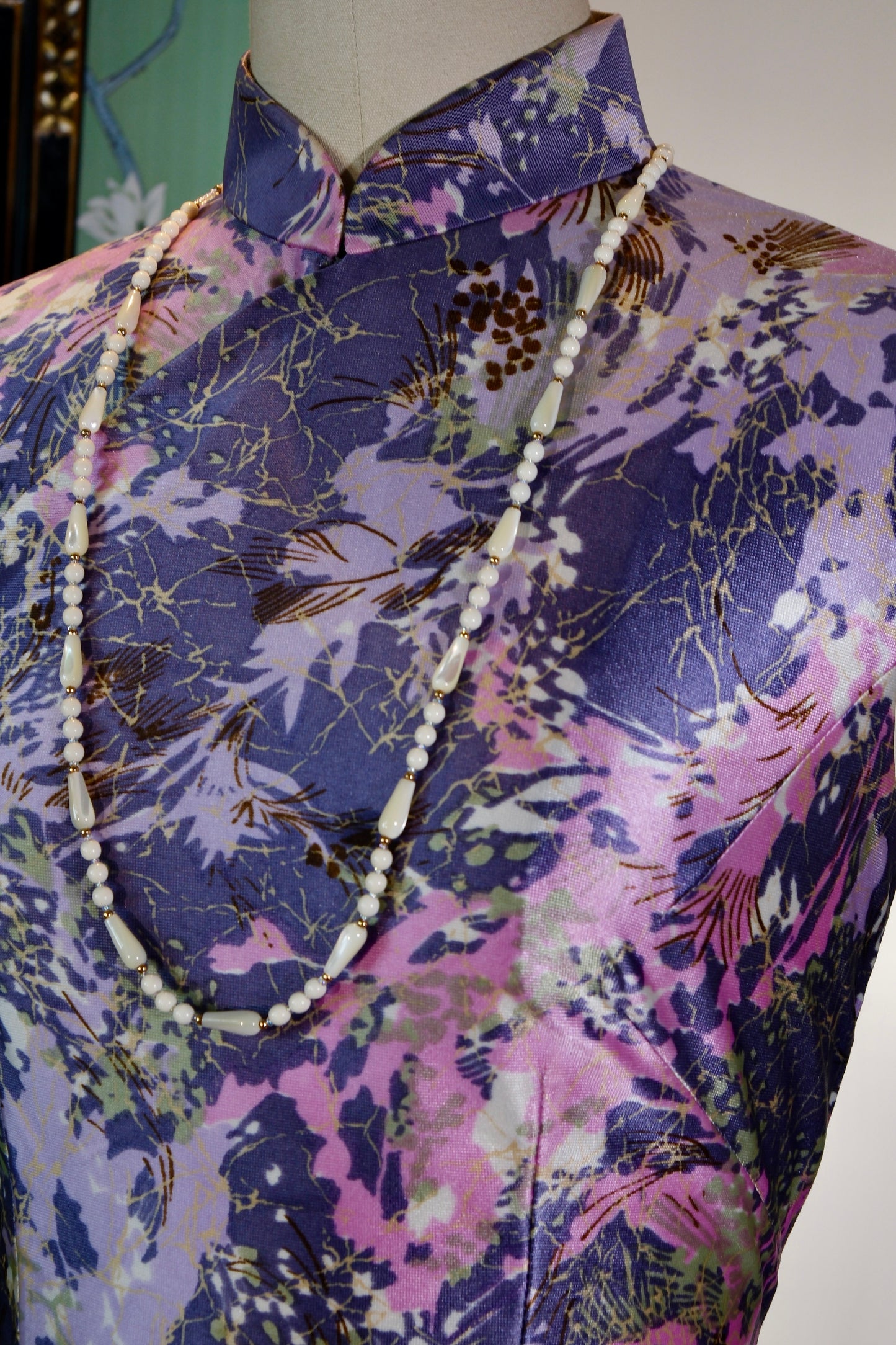
这件旗袍最引人入胜之处,在于其大胆而前卫的面料设计。不同于传统旗袍钟爱的具象牡丹或龙凤呈祥,它采用了一种极具现代主义色彩的抽象印花(Abstract Print)。
* 色彩美学: 主色调选用了高贵神秘的黛紫与藕荷色交织,间以玫瑰粉晕染,仿佛暮色四合时的晚霞映在深潭之上。这种配色在当时极为罕见,它摒弃了传统的高饱和度正红大绿,转而追求一种印象派画作般的光影流动感。
* 图案肌理: 仔细观察面料上的纹理,那并非传统的花鸟虫鱼,而是类似泼墨山水与西方抽象表现主义的结合。深褐色的线条如枯藤老树般苍劲有力,穿插在柔和的色块之间,打破了画面的宁静,赋予了布料一种动态的张力。这种图案设计深受当时西方波普艺术(Pop Art)和欧普艺术(Op Art)的影响,体现了六十年代香港纺织业在设计上“西体中用”的大胆尝试。
二、 剪裁与工艺:海派余韵与港式改良的巅峰
从服装史的角度审视,这件旗袍的形制是典型的六十年代港式改良旗袍。
* 立体剪裁的胜利: 此时的旗袍已完全脱离了清末民初的平面剪裁,全面引入了西方的省道(Darts)技术。请注意观察腰部的收省与胸部的立体处理,它精准地勾勒出了女性的S型曲线,强调了人体的自然美。这种对身体的自信展示,标志着女性从封建礼教的束缚中彻底解放出来。
* 无袖设计的摩登感: 削肩无袖的设计(Sleeveless),露出了女性圆润的肩头与手臂线条,这在当时是极度时髦且需要勇气的穿着方式。它不仅适应了香港亚热带的气候,更是一种社交场合的礼仪表达——干练、清爽、不拖泥带水。
三、 稀缺性与收藏价值:不可复制的孤品
在古董衣收藏界,六十年代的合成纤维或混纺印花旗袍往往被低估,但这件藏品却因其独特的艺术性而显得尤为珍贵。
1. 时代的绝唱: 六十年代是香港成衣业腾飞的起点,但这件衣服显然出自高级 tailor shop(裁缝店)而非流水线工厂。随着七十年代后廉价成衣的泛滥,这种讲究面料独特性和手工 fitting 的定制旗袍逐渐消失。
2. 保存状况: 历经半个多世纪,面料色泽依然鲜亮,无明显褪色或破损,且原配的珍珠项链(虽然后期搭配,但风格高度契合)增添了完整的造型感,实属难得。
3. 审美超前性: 它的抽象花纹即便放在今天,依然符合当代时尚界对于“复古未来主义”的追求。它不是那种只能挂在博物馆里的“老古董”,而是一件可以穿进现代美术馆看展的艺术品。
结语:
《诗经》有云:“岂曰无衣?与子同袍。”这件旗袍,穿越了六十载的风尘,静静地等待着它的新主人。它不仅是一件遮体的衣物,更是一把打开六十年代香港风情画卷的钥匙。穿上它,你便穿上了那个时代的优雅、独立与不羁。
Measurements / Size Guide:
Bust / Waist / Hips / Total Length: 92/78/98/98 cm
Detailed Description:
Eileen Chang once observed: "For those who cannot speak, clothes are a language, a pocket theater carried upon the body." When we gaze upon this antique Hong Kong qipao born in the 1960s, we behold not merely a garment, but a golden era sealed within the fabric. This was the era when Hong Kong rose as the "Pearl of the Orient," where Eastern and Western cultures clashed intensely yet merged flawlessly along the shores of Victoria Harbour. This qipao stands as the ultimate testament to the awakening of female independence and the modernization of aesthetics during that time.
The most captivating aspect of this qipao lies in its bold and avant-garde fabric design. Departing from the realistic peonies or auspicious dragons and phoenixes favored by traditional qipaos, it employs a highly modernist abstract print.
Color Aesthetics: The primary palette features an interweaving of noble, mysterious dark purple and lotus-root pink, interspersed with washes of rose pink, mimicking the evening glow reflecting on a deep pool at dusk. This color scheme was exceptionally rare at the time, discarding traditional high-saturation reds and greens to pursue the shifting play of light and shadow characteristic of Impressionist paintings.
Pattern Texture: A close inspection of the fabric's pattern reveals that it is not conventional flora, fauna, birds, or fish, but rather a synthesis of traditional Chinese splash-ink landscape painting and Western Abstract Expressionism. Deep brown lines, as vigorous and powerful as withered vines and ancient trees, weave through the soft color blocks, breaking the stillness of the composition and endowing the textile with dynamic tension. This pattern design was deeply influenced by the Western Pop Art and Op Art movements of the era, reflecting a bold "Western form for Eastern utility" attempt by the Hong Kong textile industry in the 1960s.
Viewed through the lens of dress history, the structure of this qipao represents the classic modified Hong Kong qipao of the 1960s.
The Triumph of Three-Dimensional Tailoring: By this time, the qipao had completely broken away from the flat-pattern drafting of the late Qing Dynasty and early Republican era, fully integrating Western darting techniques. Observe the precise execution of the waist and bust darts; they accurately trace the female S-curve, emphasizing the natural beauty of the human form. This confident display of the body marked the complete liberation of women from the shackles of feudal decorum.
The Modernity of the Sleeveless Design: The sleeveless, cutaway shoulder design reveals the soft, rounded contours of the shoulders and arms. At the time, this was an exceptionally fashionable styling choice that required social courage. It not only suited Hong Kong's subtropical climate but also served as a polite expression in social settings—sleek, refreshing, and efficient.
In the antique clothing collecting community, 1960s synthetic fiber or blended print qipaos are often undervalued; however, this piece stands out as uniquely precious due to its extraordinary artistic merit.
Swan Song of an Era: The 1960s marked the take-off point for Hong Kong's ready-to-wear garment industry, yet this piece clearly originated from an elite tailor shop rather than an assembly-line factory. With the proliferation of cheap mass-produced garments after the 1970s, custom-made qipaos emphasizing fabric uniqueness and hand-fitting gradually vanished.
State of Preservation: Spanning over half a century, the fabric colors remain remarkably vibrant, free of significant fading or structural damage. The addition of the pearl necklace (though styled later, it perfectly aligns with the aesthetic) completes the look, making this a rare find.
Aesthetic Avant-gardism: Even by today's standards, its abstract pattern beautifully aligns with the contemporary fashion world's pursuit of "retro-futurism." It is not an "old relic" destined solely for museum display, but a wearable work of art fit for an exhibition in a modern art gallery.
The Book of Odes states: "How can you say you have no clothes? I will share my robes with you." Having journeyed through sixty years of historical dust, this qipao quietly awaits its new owner. It is far more than a garment to cover the body; it is a key that unlocks the vibrant tapestry of 1960s Hong Kong life. To wear it is to drape yourself in the elegance, independence, and rebellious spirit of that era.