溯源
Couldn't load pickup availability
【前言:时代的侧影】
张爱玲曾言:“对于不会说话的人,衣服是一种语言,随身带着的是袖珍戏剧。”当我们凝视这件诞生于20世纪40年代的黑色拼接连衣裙时,仿佛能听到那个动荡年代里,女性内心深处最优雅而坚韧的低语。它不仅仅是一件衣裳,它是战火与繁华交织岁月里,一份关于尊严与美的无声宣言。
【形制考据:实用主义下的浪漫突围】
从服装史的角度审视,这件作品是典型的1940年代“Utility Style”(实用风格)与“New Look”前夜审美的完美过渡标本。
* 领口的诗意: 视线首先被领口处那枚硕大的蝴蝶结(Pussy Bow)所吸引。这种设计源于维多利亚时代的男士领巾,而在40年代,它被赋予了女性的柔美与力量。它打破了深色面料的沉闷,如同沈从文笔下“风日里长养”的清澈眸子,在严谨的剪裁中透出一丝俏皮的呼吸感。缎面翻领的光泽与衣身哑光面料形成微妙的材质拼接(Fabric Blocking),这是当时高级成衣为了在物资受限下追求视觉层次的常用巧思。
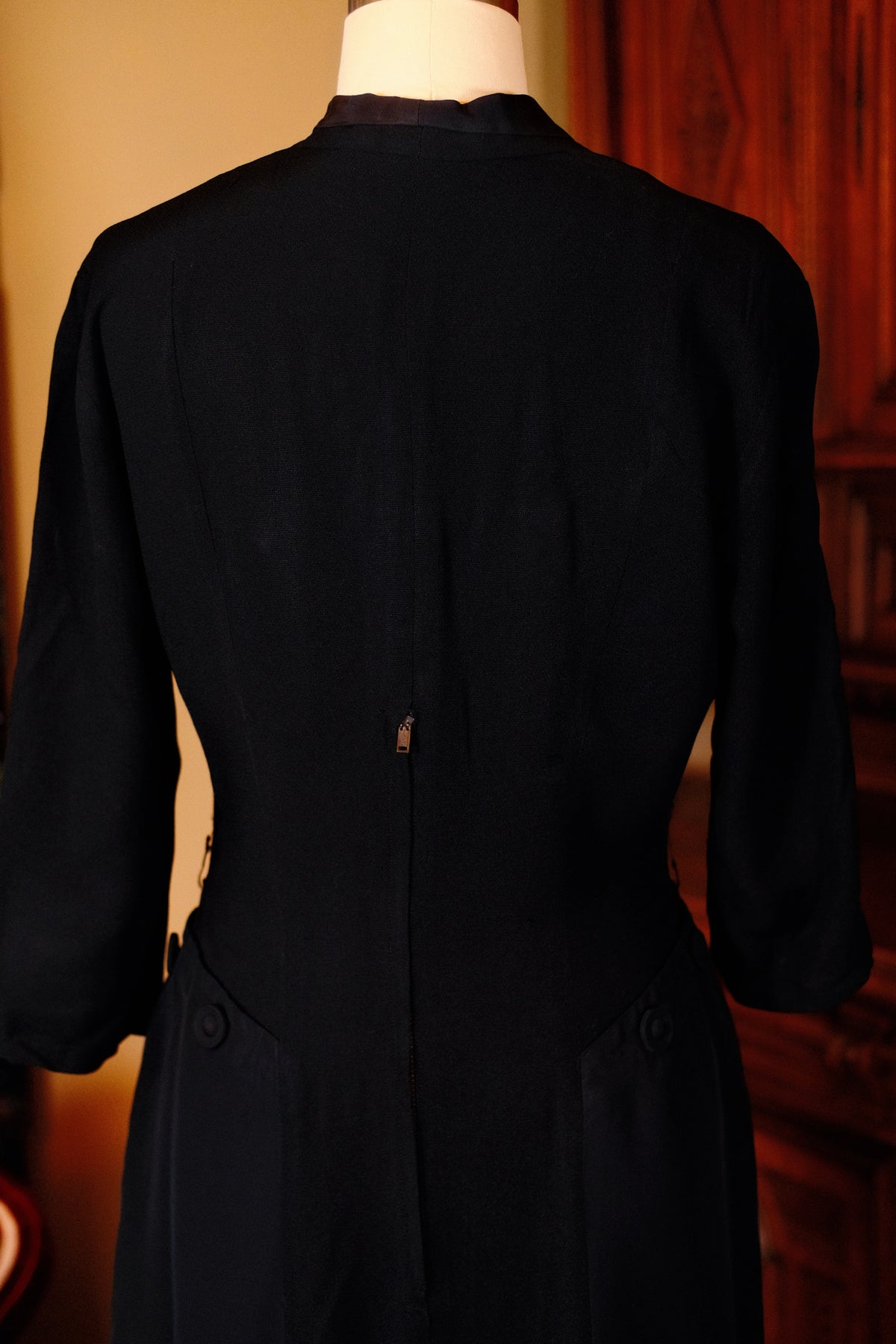
* 腰身的建筑感: 请注意那极具辨识度的高腰拼接设计。腰线并未顺应自然人体曲线,而是略微上提,并通过V字形的裁片分割,在视觉上重塑了比例。这种类似“巴斯克式(Basque)”腰线的变体,既保留了战时服装利落、干练的工装遗风,又通过两侧装饰性的包布扣,暗示了战后女性对曲线美的回归渴望。
* 袖长的克制: 七分袖(Three-quarter sleeves)的设计,是40年代职业女性的标配。它露出手腕最纤细的部分,既方便劳作,又在举手投足间流露出一份含蓄的性感,正如《倾城之恋》中白流苏那般,于不动声色中拿捏着分寸。
【工艺与面料:沉默的匠心】
这件藏品的面料推测为重磅人造丝或者真丝混纺。在那个尼龙尚未普及、真丝昂贵的年代,这种面料挺括而有垂坠感,能够完美支撑起裙摆的A字廓形。
背部的隐形拉链工艺精湛,走线笔直如尺,见证了那个时代裁缝对“天衣无缝”的极致追求。黑色的选择,既是战时配给制下的无奈之举,也是 Coco Chanel 所言“黑色包容一切,白色亦然”的经典诠释——它低调,却拥有吞噬一切喧嚣的力量。
【结语:穿在身上的文学】
这不仅仅是一条裙子,它是那个时代女性精神的缩影。它既有林徽因式知性冷静的理智,又有阮玲玉式风情万种的哀愁。
如果你拥有它,你拥有的不仅是一段历史,更是一种在这个浮躁世界中,保持优雅、独立与清醒的能力。愿你在穿上它的那一刻,能感受到那份穿越八十载光阴而来的温柔力量,步步生莲,不负韶华。
Eileen Chang once observed: "Clothing is a language—a pocket drama carried on one's person." Gazing upon this black contrast-panel dress born in the 1940s, we can almost hear the most elegant yet resilient whispers stirring within women’s hearts during that turbulent era. It is far more than a garment; it is a silent manifesto of dignity and beauty woven through a period where wartime trials and urban prosperity intertwined.
Viewed through the lens of fashion history, this piece serves as a textbook transitional specimen bridging 1940s "Utility Style" and the pre-dawn aesthetics of the post-war "New Look."
The Poetic Neckline: The eye is immediately drawn to the oversized pussy bow resting at the collar. Originating from Victorian-era neckties, this detail was imbued with both feminine grace and inner strength during the 1940s. It shatters the gloom of the dark textile, resembling the clear, sunlit eyes found in Shen Congwen’s prose—breathing a playful vitality into rigorous tailoring. The satin lapel's sheen forms a subtle fabric blocking against the matte body of the dress, reflecting a clever design ingenuity employed by mid-century haute ready-to-wear to achieve visual dimensionality amidst material shortages.
Architectural Waistline: Observe the highly distinctive high-waist panel construction. Rather than following the body's natural anatomical curve, the waistline is subtly elevated, utilizing V-shaped panel partitioning to visually reshape body proportions. This variant of a Basque-style waist preserves the crisp, capable military-workwear legacy of wartime fashion while utilizing decorative fabric-covered buttons along the sides to signal the post-war woman’s surging yearning for a return to bodily curves.
Restraint of Sleeve Length: The three-quarter sleeves stand as a defining standard of 1940s professional womenswear. Exposing the slenderest part of the wrist, they offered practicality for movement while exuding a restrained sensuality with every gesture—much like Bai Liusu in Love in a Fallen City, mastering proportion and composure entirely without fanfare.
The fabric of this collectible is hypothesized to be heavyweight rayon or a silk blend. In an era when nylon remained scarce and true silk was costly, this textile offered both crisp structure and fluid drape, effortlessly supporting the dress's A-line skirt contour.
The hidden rear zipper is executed with exquisite precision, its stitching as straight as a ruler, bearing witness to the period's ultimate pursuit of seamless perfection. The choice of black was simultaneously a pragmatic necessity under wartime rationing and a classic illustration of Coco Chanel’s dictum that "black encompasses everything, and white does too"—low-profile, yet possessing the power to swallow all clamor.
This is far more than a dress; it is an epitome of the female spirit during that era. It encapsulates both the intellectual composure of Lin Huiyin and the multifaceted, enchanting pathos of Ruan Lingyu.
To possess it is to hold not merely a piece of history, but the capacity to maintain elegance, independence, and clarity within a restless world. May you, the moment you slip into it, feel that gentle strength traversing eighty years of time—moving with lotus grace, living every fleeting moment to its absolute fullest.