深圳溯源
Couldn't load pickup availability
衣服尺寸:
胸围/腰围/臀围:82/68/92 厘米
衣长:84 厘米
细节描述:
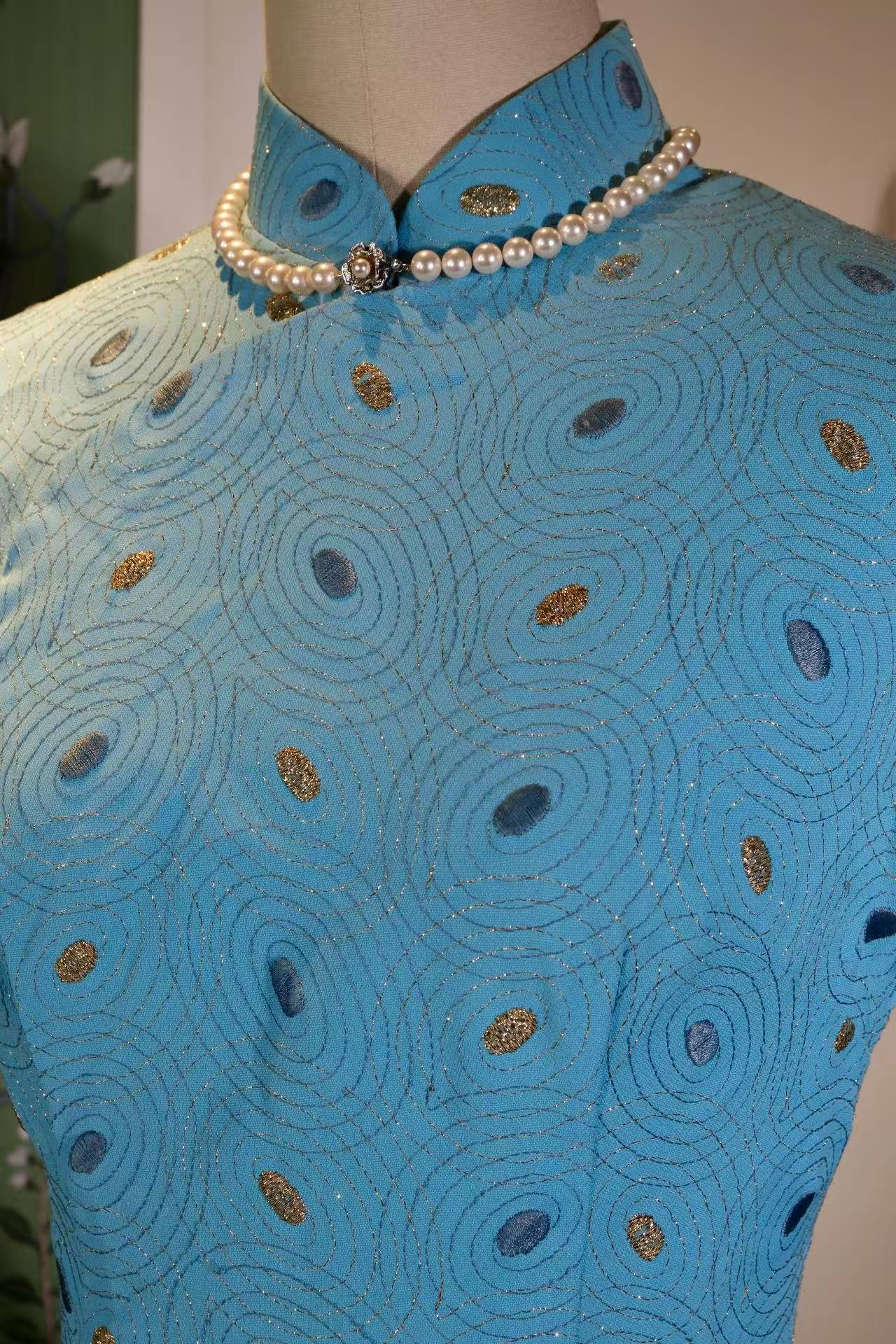
【图案解码】涟漪生金,雀羽藏锋
这件旗袍最摄人心魄之处,在于其面料上繁复而精密的“孔雀翎眼纹”(Peacock Eye Pattern)。这并非简单的印花,而是上世纪五十年代极为罕见的重工刺绣工艺。
- 视觉肌理:以天青色为底,仿佛雨后初霁的天空。无数同心圆构成的“翎眼”如同水面的涟漪般层层荡开,寓意着生生不息的生命力。
- 材质对话:每一个“翎眼”的中心,都镶嵌着深邃的蓝紫色丝绒或缎面,周围则用细密的欧洲进口金线进行刺绣。这种金线在当时属于昂贵的舶来品,光泽感极强,即便历经七十余载岁月,依然在光线下闪烁着低调而奢华的微芒。
- 构图美学:图案排列错落有致,既遵循了传统纹样的秩序感,又打破了刻板,随着旗袍的立体剪裁在人体曲线上流动,宛如一只正在开屏的孔雀栖息于身侧。
【历史溯源】香江旧梦,西风东渐的绝唱
这件旗袍诞生于1950年代的香港,那是一个特殊的时空节点。彼时,大量上海裁缝与纺织精英南迁至港,将海派旗袍的精湛技艺带到了维多利亚港畔。
- 东西方交汇的产物:请注意它的剪裁——虽然保留了立领的中式元素,但其收腰极其合体,省道(Darts)的运用非常西式,这是典型的“海派旗袍”在香港的延续与改良。它不再像清代旗装那样宽大平直,而是极力勾勒女性的S型曲线,受到当时好莱坞电影明星着装风格的影响。
- 稀缺的工艺标本:在五十年代,能够使用欧洲进口金线进行大面积满绣的旗袍,绝非普通市民的日常衣着。它极可能出自当时香港中环或尖沙咀的高级定制裁缝店(Bespoke Tailor),甚至是某位名媛为了出席重要晚宴而专门定制的礼服。这种重工刺绣耗时耗力,是那个时代“慢时尚”的极致体现。
【文化互文】翠袖金缕,衣以载道
《诗经·卫风》有云:“有匪君子,如切如磋,如琢如磨。”这件旗袍正是这种工匠精神的织物化身。
- 色彩心理学:在中国传统文化中,蓝色象征着沉静与永恒,所谓“青出于蓝”。而这件旗袍选用的天青色,正如宋徽宗梦中所见“雨过天青云破处”,极具文人雅士的清贵之气。
- 吉祥寓意:孔雀在佛教与世俗文化中皆是吉祥、尊贵与美丽的象征。张爱玲在《更衣记》中曾写道:“对于不会说话的人,衣服是一种语言,随身带着的是袖珍戏剧。”穿上这件缀满金线孔雀纹的旗袍,便如同穿在身上了一出关于富贵与优雅的无声戏剧。
- 传世价值:古董衣不仅是衣物,更是凝固的时间。这件旗袍上的每一针金线,都记录着五十年代香港纺织业的辉煌;每一处时光的痕迹,都是穿着者在那个流金岁月里留下的体温。它不仅是一件收藏品,更是一段可以触摸的历史,见证了东方美学在世界舞台上的高光时刻。
结语:
这不仅是一件衣服,这是一首用金线和丝绸写成的十四行诗。它等待着下一位懂得欣赏它的主人,续写这段跨越半个多世纪的优雅传奇。
Measurements / Size Guide:
Bust / Waist / Hips: 82/68/92 cm
Total Length: 84 cm
Detailed Description:
The most mesmerizing attribute of this qipao resides in the complex and precise "Peacock Eye Pattern" (Peacock Eye Pattern) arrayed across its surface. This is no basic flat surface printing; it represents a highly rare example of heavy-work couture embroidery from the 1950s.
Visual Texture: Set against a cerulean-azure grounding chassis reminiscent of the clear sky immediately after rain, countless concentric circles form "eyespots" that ripple outward like waves on a water surface, semiotically implying an unbroken, perpetual vitality.
Material Dialogue: At the nucleus of each individual eyespot sits an inlay of deep blue-violet silk velvet or satin, outlined by dense embroidery using fine, European imported gold filigree threads. This type of metallic wire operated as an exceptionally costly import during that timeline, commanding an intense luster. Even after traversing more than seventy years of temporal decay, it steadfastly glints under illumination with a disciplined, understated luxury.
Compositional Aesthetics: The motif typography is arranged with rhythmic variation, simultaneously honoring the structural order of traditional ornamentation while breaking away from rigid monotony. As it follows the three-dimensional ergonomic pattern drafting of the qipao, the pattern flows fluidly across the anatomical curves of the human figure, mimicking a magnificent peacock in full display resting beside the wearer.
This qipao was birthed within the 1950s in Hong Kong—a highly unique spatio-temporal juncture. During this timeline, a massive southward migration of Shanghainese master tailors and textile elites relocated to Hong Kong, transplanting the supreme drafting skills of the Shanghai Style (Haipai) to the shores of Victoria Harbour.
The Matrix of East-West Convergence: Notice the pattern architecture: while strictly preserving heritage Chinese anchors like the standing collar, the waist reduction is mapped with extreme form-fitting precision. The deployment of bodice and waist darts (Darts) follows an explicitly Western pattern-drafting methodology, marking the definitive continuation and Hong Kong adaptation of the modified Haipai qipao. It completely relinquishes the wide, flat, two-dimensional construction of Qing Dynasty heritage robes to forcefully outline the anatomical S-curve of the female silhouette, heavily conditioned by the costume styling of contemporary Hollywood cinema icons.
A Scarcity Specimen of Craftsmanship: Within the socio-economic context of the 1950s, a qipao featuring an all-over, heavy surface embroidery executed with European imported gold filigree was fundamentally removed from the daily wardrobe of average citizens. It almost certainly emerged from an elite haute couture atelier (Bespoke Tailor) in Central or Tsim Sha Tsui, or served as custom-tailored formal regalia commissioned by a prominent socialite for a high-profile evening gala. This caliber of heavy-work embroidery demanded immense artisan hours, standing as the ultimate manifestation of "slow fashion" from that epoch.
The ancient Classic of Poetry · Odes of Wei (Shijing) famously states: "Look at that elegant gentleman; he is like cutting bone, like filing ivory, like carving jade, like polishing stone." This qipao stands as the literal textile incarnation of that exact artisanal spirit.
Color Psychology: Within Chinese semiotic traditions, blue symbolizes tranquility and eternity, as captured in the classical idiom "green originates from blue, yet surpasses it." The specific azure selected for this chassis evokes the mythical hue dreamed of by Emperor Huizong of the Song Dynasty: "the color of the sky through a rift in the clouds after rain," exuding the refined, aristocratic dignity of the scholarly elite.
Auspicious Iconography: The peacock functions across both secular and Buddhist iconography as the ultimate emblem of auspiciousness, nobility, and majestic beauty. Eileen Chang immaculately noted in The Record of Changing Clothes: "To those who cannot speak, clothes are a language; what one carries with them is a pocket drama." Stepping into this qipao, with its dense gold-threaded peacock embroidery, is equivalent to stepping into a silent, material performance centered on sovereign wealth and elegance.
Curatorial and Enduring Value: Antique apparel extends far beyond basic clothing; it represents frozen time. Every single pass of the golden needle archived across this matrix documents the crowning glory of Hong Kong’s 1950s textile apparatus; every trace of natural aging registers the residual body heat of its historical keeper during that golden timeline. It commands immense value not merely as a collectible art piece, but as a tangible primary document witnessing the high-light moment of Eastern aesthetics on the global stage.
This masterpiece transcends its utility as a garment to operate as a wearable sonnet, authored in silk and gold filigree. It waits for its next rightful custodian—one who truly decodes its structural language—to continue this magnificent, cross-generational narrative of timeless elegance.