深圳溯源
Couldn't load pickup availability
衣服尺寸:
胸围/腰围/臀围:78/64/90 厘米
衣长:130 厘米
细节描述:
一、图案考释:缠枝牡丹里的盛世繁华
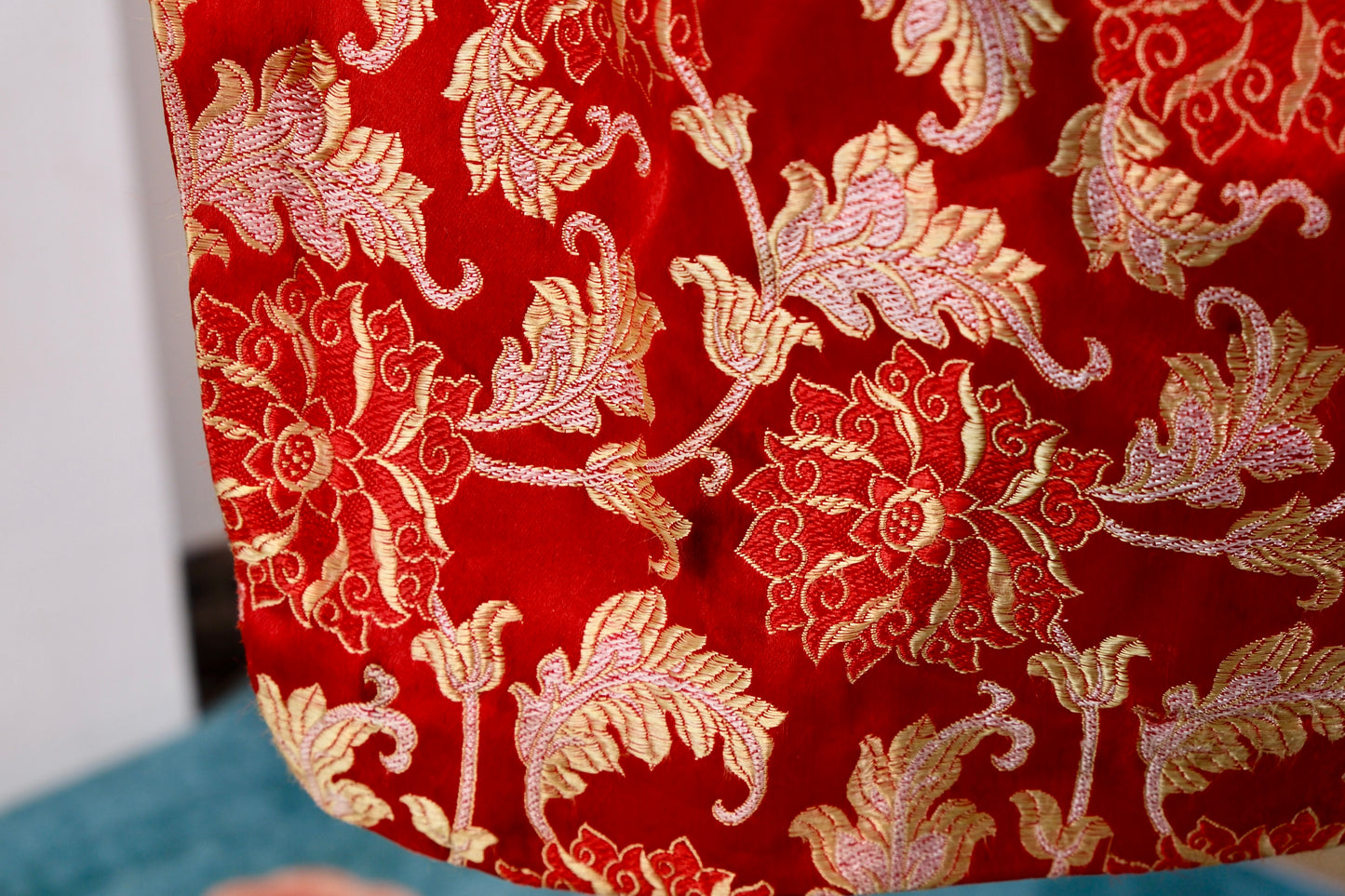
此件旗袍最引人入胜之处,在于其面料的精湛工艺与纹样的吉祥寓意。从微距镜头下可见,面料为典型的“红地金线缠枝牡丹纹织锦缎”。
- 底色之正:采用了极具中国传统审美意趣的“中国红”作为底纬,色泽饱满沉稳,历经半个多世纪依然鲜亮如初,象征着生命力与喜庆。
- 纹样之雅:图案主体为“缠枝莲/牡丹”变体。花头硕大,花瓣层叠繁复,采用了类似“退晕”的配色手法,由深红过渡至金黄,再辅以银白丝线勾勒轮廓,使得花朵在光线下呈现出浮雕般的立体感。枝叶卷曲缠绕,连绵不断,这种“缠枝纹”在明清织物中极为常见,寓意“生生不息、万代绵长”。
- 工艺之精:仔细观察,可以清晰地看到经纬线的交织结构。这是传统提花织造工艺的结晶,金银线与蚕丝交织,不仅增加了面料的光泽度,更赋予了衣物挺括的骨架感,使其能完美贴合人体曲线而不软塌。
二、形制溯源:西风东渐下的海派余韵
这件旗袍诞生于上世纪六十年代的香港,那是旗袍发展史上的一个特殊转折期。
- 剪裁的演变:此时的旗袍已完全褪去了清代旗装的宽大平直,深受西方立体剪裁的影响。我们可以看到其装袖设计(区别于传统的连肩袖),肩部线条圆润挺括;无袖削肩的设计大胆展示了女性手臂的线条美,这在当时是摩登与开放的象征。
- 廓形的极致:收腰极度合体,胸省与腰省的运用使得衣身如第二层肌肤般包裹身体,勾勒出S型的女性曲线。这种对身材的极致修饰,体现了六十年代香港社会在战后经济腾飞背景下,女性自信、独立且追求时尚的精神面貌。
三、典故引证:锦衣华服的文化注脚
古人云:“锦绣衣裳,不仅是御寒之物,更是礼乐文明的载体。”
- 《诗经·秦风》有云:“锦衣狐裘,颜如渥丹。”虽言先秦,但这抹红色的传承从未断绝。这件旗袍的红,正是东方女性端庄与热情的完美平衡。
- 张爱玲曾在《更衣记》中写道:“对于不会说话的人,衣服是一种语言,随身带着的是袖珍戏剧。”这件六十年代的香港旗袍,便是一出关于“融合”的戏剧。它既有苏杭织锦的传统底蕴,又有好莱坞电影明星式的性感剪裁。它是那个时代名媛闺秀出席晚宴、重要场合的“战袍”,见证了香江两岸的流金岁月。
注释:瑕疵特价
Measurements / Size Guide:
Bust / Waist / Hips: 78/64/90 cm
Total Length: 130 cm
Detailed Description:
Within the technical domains of textile conservation, structural design history, and material culture analysis, an exceptional historical garment functions as an active social text. It documents a precise intersection of ancestral handcraft and localized modernization.
This magnificent 1960s Hong Kong-produced, foliated peony silk brocade qipao (红地金线缠枝牡丹纹织锦缎旗袍) stands as a pristine physical testament to that rare mid-century golden era. It materializes a complex sartorial dialogue where traditional mainland loom-work converges with Westernized, highly disciplined pattern architecture. For curators, textile historians, and institutional archives, this specimen preserves a critical chapter in the evolution of the iconic Hong Kong silhouette.
The pattern drafting of this qipao represents an advanced calibration of structural symmetry and tailored tension, separating true master-tailored commissions from commercial period mass production.
The 1960s Hong Kong qipao chassis utilizes a moderate Mandarin collar with a stiffened structural core to ensure an unyielding vertical posture. This architectural foundation breaks into a modern, sleeveless set-in shoulder design (装袖与削肩设计) that departs entirely from traditional continuous cut-on sleeves. The bodice is shaped into a highly articulated waist and hip field through rigorous internal bust and waist darting (胸省与腰省), flowing cleanly into a structured, mid-length columnar hem that retains the firm tension of the heavy silk brocade weave.
Western Tailoring Integration: By abandoning the flat, two-dimensional construction of early mainland garment cutting, this piece utilizes sophisticated multi-dart manipulation. This creates a highly dimensional silhouette that sculpts to the body like a second skin, eliminating fabric buckling under the bust and around the lower back.
Anatomical Expression: The deliberate narrowing of the shoulder line combined with the sleeveless armhole scye serves to elongate the neck and arms, projecting a poised, modern athletic elegance that mirrored the rising independence of post-war Hong Kong women.
The visual and material character of this artifact depends heavily on its high-spec textile foundation: a high-density, structural jacquard silk brocade (提花织锦缎) utilizing complex metallic thread integration.
The Chromatic Ground: The primary color field consists of a vibrant, deeply saturated "China Red" base. Far from catching light in cheap, scattered reflections, the high-density warp threads absorb and roll ambient illumination across the garment’s curves in deep, low-refraction crimson waves, imbuing the piece with authoritative, ceremonial weight.
The Metallurgical Weft and Ombré Weaving: The surface iconography features a complex variation of the classic "intertwining branch" pattern, rendering large peony blossoms (缠枝牡丹纹). Under micro-lens evaluation, the petals exhibit a complex color degradation techinque (退晕) where deep reds blend into golden yellows, outlined sharply by fine silver thread filament. This creates a low-relief, three-dimensional sculptural effect on the surface.
Cultural Metaphors: The continuous, unbroken loops of the winding stems symbolize longevity and endless generation (生生不息、万代绵长), while the peony blossoms represent high nobility and prosperity, a timeless motif favored by elite merchant families and high society alike.
To appreciate the rarity of this qipao is to understand the socio-industrial topography of 1960s Hong Kong—a unique historical enclave where traditional mainland tailoring met a rapidly modernizing global market.
The Ateliers of Migrant Master Tailors: Following the geopolitical transformations on the mainland during the mid-century period, elite master tailors from Shanghai migrated to Hong Kong, establishing small, highly exclusive ateliers. This qipao is a direct relic of that migratory genius, blending regional Suzhou and Hangzhou weaving heritage with Western construction.
The Shift to Modern Mobility: As noted by Eileen Chang (张爱玲) in her seminal essay Chronicle of Changing Clothes (更衣记), clothing operates as a silent, portable theater of human transition. In the 1960s, Hong Kong's fast-paced urban lifestyle prompted the classic qipao to shed its sleeves and shorten its hemline to adopt Western-influenced structural lines. This garment serves as a "battle dress" (战袍) for the mid-century elite, channeling both traditional cultural literacy and Hollywood-esque silver-screen glamour.
To properly situate this artifact within the broader text of material culture, its aesthetics can be cross-referenced with foundational Chinese literature and historical manufacturing manuals:
The Metaphor of Brilliance: The overarching visual weight of the gown mirrors the celebratory language found in the Book of Odes (诗经·秦风): "锦衣狐裘,颜如渥丹" (Brocade robes and fox furs, a countenance as radiant as cinnabar), capturing a timeless, luminous red presence that does not diminish with age.
The Technical Precision: The structural crispness (骨架感) of this garment is entirely due to the raw silk and metallic fiber density. It resists the sagging typical of lesser synthetic period replicas, ensuring the architectural drape remains preserved even over a sixty-year archival storage horizon.
As an irreplaceable, non-renewable piece of historical textile art, this qipao transcends standard vintage classifications, advancing directly into institutional and museum-grade collection spheres.
Collection Compatibility: This artifact is ideally spec'd for inclusion in institutional fashion archives, dedicated museum collections focusing on regional textile histories, high-end fine art auctions, or elite private collections.
Preservation Mandate: To ensure the longevity of the gold-wrapped threads and the silk core, the garment must be maintained under strict climate-controlled parameters (temperature 18°C–22°C, relative humidity 45%–55%), shielded entirely from direct ultraviolet exposure to prevent fiber breakdown.
Suyuan Archival Textile Registry — Documenting the material culture, preserving the technical lineage of ancestral craft.
Note: As-Is Special Pricing