深圳溯源
Couldn't load pickup availability
衣服尺寸:
胸围/腰围/臀围/衣长:96/86/106/106 厘米
细节描述:
【引言:衣冠载道,岁月留痕】
张爱玲曾言:“对于不会说话的人,衣服是一种语言,随身带着的是袖珍戏剧。”当我们凝视这件上世纪六十年代的香港产织锦旗袍时,我们看到的不仅仅是一件衣物,更是一段被丝线封存的流动历史。作为服装史的研究者,我深知在那个东西方文化剧烈碰撞与交融的香江畔,旗袍完成了它从传统走向现代的华丽蜕变。这件藏品,正是那个黄金时代最生动的注脚。
一、纹样解码:几何秩序中的东方韵律
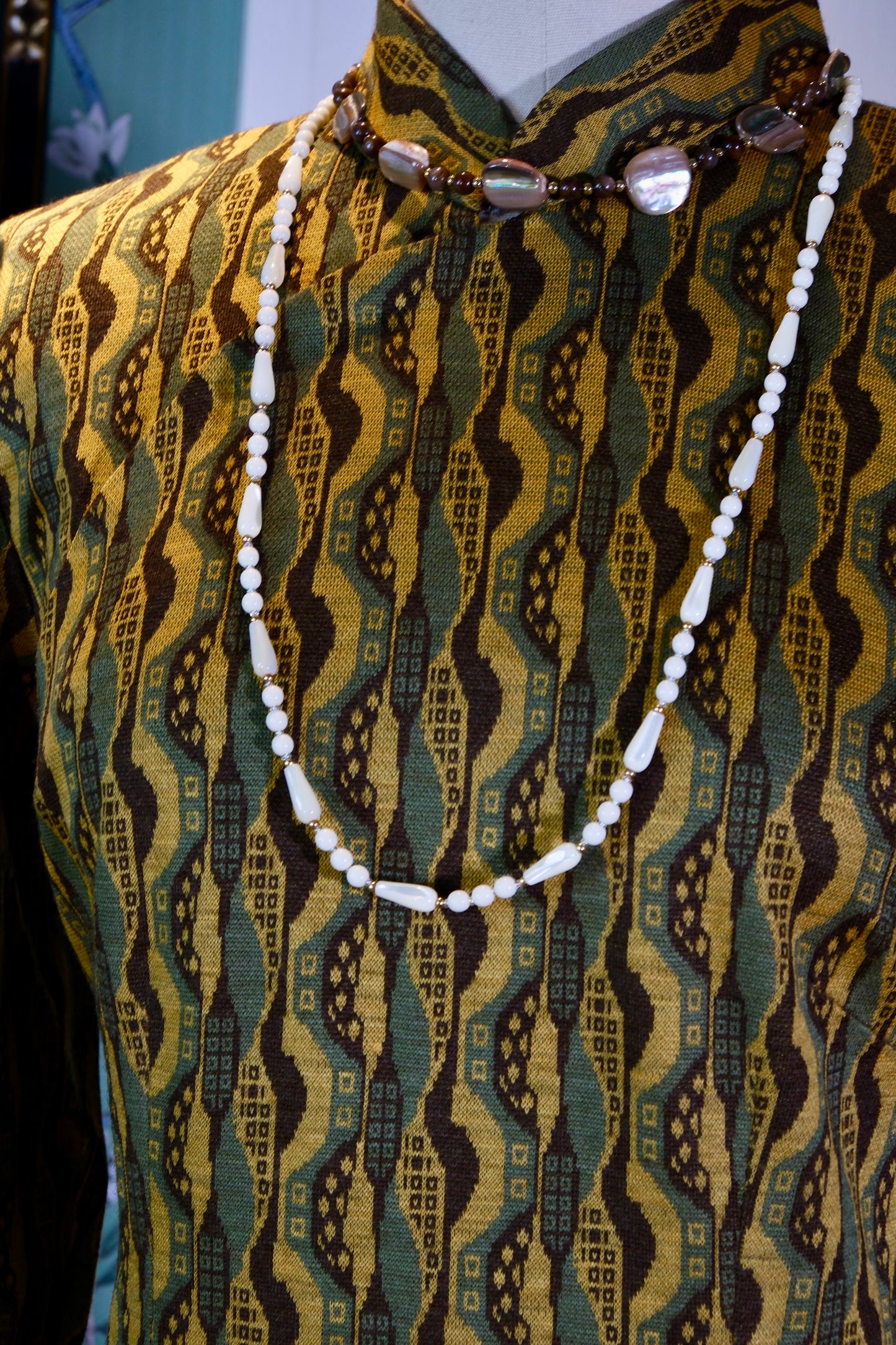
这件旗袍最引人入胜之处,在于其面料纹样的独特性。不同于传统旗袍常见的牡丹、凤凰等具象吉祥图案,它采用了一种极具现代构成主义美感的抽象几何回纹。
1. 色彩的交响: 面料以沉稳的橄榄绿为底,交织着明艳的芥末黄与深邃的古铜色。这种配色方案既保留了中式传统的典雅(如青铜器般的质感),又融入了六十年代波普艺术(Pop Art)兴起时对高饱和度与对比色的大胆尝试。
2. 线条的律动: 图案由连续的波浪形线条与菱形方块嵌套而成,形成一种垂直向下的视觉引导。这种设计在视觉上极大地拉长了身形,不仅符合力学美感,更暗合了中国传统美学中“气韵生动”的追求。波浪象征着流水的柔韧,而其中的几何方块则代表了秩序与理性,刚柔并济,寓意着穿着者在动荡时代中寻求内心平衡的渴望。
二、剪裁叙事:海派余韵与西式立体构成的结合
从形制上看,这件旗袍是典型的六十年代“港式旗袍”风格,它见证了旗袍工艺的巅峰。
- 立领与归拔: 领口依然坚守着传统的高立领设计,紧扣喉部,含蓄而禁欲。但在胸腰部位,明显运用了西式的省道(Darts)处理和“归拔”工艺,使得衣身如同第二层皮肤般贴合人体曲线。这种对女性身体曲线的自信展示,标志着女性意识在那个年代的觉醒。
- 袖型的演变: 注意看它的袖子,并非传统的平直连袖,而是带有轻微装袖结构的七分袖或长袖。这种设计让肩部线条更加挺括圆润,赋予了穿着者一种干练、独立的职业女性气质,这与六十年代香港女性逐渐走出家庭、投身社会的时代背景不谋而合。
三、稀缺性与艺术价值:不可复制的织锦工艺
在学术界,我们常将六十年代的香港旗袍称为“最后的贵族”。
- 织锦的绝唱: 图中的面料呈现出明显的提花织锦质感。这种面料在当时造价不菲,且随着七十年代后成衣工业化生产的普及,这种需要复杂工序、由老匠人手工或半手工织造的厚重织锦面料已近乎失传。如今的印花丝绸虽轻薄,却再也无法复刻这种由于经纬线交织而产生的浮雕般的立体光泽感。
- 时间的包浆: 经过六十载岁月的沉淀,面料表面的火气已褪,泛起一层温润的哑光。这不仅是物理上的氧化,更是历史的包浆。每一处细微的磨损,都是时光抚摸过的痕迹。
四、结语:穿在身上的文学
《诗经》有云:“岂曰无衣?与子同袍。”衣裳,从来不仅仅是遮体之物,它是文化的载体,是身份的认同。
这件六十年代的织锦旗袍,以其独特的几何美学、精湛的立体剪裁和不可再生的面料工艺,成为了一件博物馆级别的艺术品。它不仅属于过去,更属于未来。拥有它,便是拥有了一段关于优雅、关于独立、关于东方美学在现代转型期最迷人的记忆。
在这个快时尚泛滥的年代,愿这件历经半个多世纪风雨的锦衣,能为懂得欣赏的你,带来一份穿越时空的宁静与高贵。
Measurements / Size Guide:
Bust / Waist / Hips / Total Length: 96/86/106/106 cm
Detailed Description:
As Eileen Chang famously remarked in her seminal sartorial essay Chronicle of Changing Clothes: "To those who are systematically denied a voice, clothes function as a sovereign vernacular; they carry a pocket drama wherever they go." When gazing upon this 1960s Hong Kong-manufactured brocade qipao, we encounter far more than an article of clothing; we confront a fluid history vacuum-sealed in silk filaments. As a historian of dress, I recognize that it was precisely along the shores of the Fragrant Harbour—where Eastern and Western design systems clashed and converged with generative intensity—that the qipao completed its magnificent structural metamorphosis from a traditional garment to a vehicle of modernism. This specific specimen stands as the most vital material footnote to that golden era.
The most compelling dimension of this qipao resides in the absolute uniqueness of its textile iconography. Characterized by a radical departure from the literal, representational auspicious motifs—such as peonies or phoenixes—ubiquitous in traditional Chinese dress, it deploys an abstract, geometric meander pattern heavily charged with modernist Constructivist aesthetics.
The Chromatic Symphony: The foundational matrix utilizes a restrained olive green baseline, intricately interwoven with vibrant mustard yellow and deep bronze metallic threads. This palette successfully safeguards the solemn elegance of traditional Chinese antiquity (recalling the mottled, unctuous patination of archaic ritual bronzes) while structuralizing the bold, high-saturation contrast-blocking strategies pioneered by the rise of mid-century Western Pop Art.
The Kinetics of Linework: The composition is dictated by continuous, undulating wavy lines nested alongside diamond-shaped tessellations, engineering a vertical, downward visual vector. This layout achieves a profound optical elongation of the silhouette, a manifestation that satisfies both mechanical ergonomics and the pursuit of "vital resonance" (Qiyun Shendong) central to traditional Chinese aesthetic theory. The wave formations symbolize the fluid resilience of running water, while the interior geometric blocks represent structural order and rationality. This synthesis of rigidity and suppleness archives the wearer's internal psychological desire for equilibrium during an era of profound societal transition.
In terms of morphology, this garment stands as a definitive archetype of the 1960s Hong Kong-style qipao, a silhouette marking the historical zenith of Chinese tailoring technology.
The Mandarin Collar and Material Manipulation: The neckline strictly maintains the traditional high standing Mandarin collar architecture, closing flush against the throat to project a restrained, cloistered modesty. Conversely, the thoracic and waist axes introduce rigorous Western-style anatomical darting combined with the traditional Shanghai master technique of "Gui-Ba" (the selective stretching and shrinking of fabric using heat and moisture manipulation). This advanced textile engineering forces the garment to adhere to the biological topography of the female form like a secondary epidermis. This self-assured articulation of the anatomical S-curve marks the material awakening of modern female corporeal consciousness during this decade.
The Evolution of Sleeve Architecture: A technical inspection of the sleeve junction reveals a structural departure from the traditional flat-plane integrated sleeve (Lianshi Xiu); it implements instead a subtle, low-bulk set-in sleeve architecture terminating at a three-quarter length. This pattern-drafting choice yields a highly tailored, rectilinear definition at the shoulder line, imbuing the wearer with the crisp, independent stance of a modern working professional—mirroring the historical reality of 1960s Hong Kong, where women increasingly transitioned out of domestic isolation and into the corporate socioeconomic sphere.
Within academic discourse, 1960s Hong Kong-tailored qipaos are frequently classified as "the final aristocracy" of modern dress history.
The Swan Song of Brocade Weaving: The textile surface exhibits the dense, structural relief of premium jacquard brocade weaving. The production cost of such a material was exceptionally high during the mid-century period. Following the post-1970s mechanization and wholesale automation of industrial ready-to-wear, these heavy brocade matrices—requiring highly complex warp-and-weft programming and execution by veteran master weavers on semi-manual looms—declined into near-total obsolescence. Contemporary printed silks, while lightweight, are utterly incapable of replicating the sculptural, relief-like multidirectional luster engineered by the physical interlacing of these metallic and silk threads.
The Patina of Deep Time: Having traversed a sixty-year historical trajectory, the raw, aggressive chemical flash of the fresh silk and metallic fibers has completely receded, giving rise to an unctuous, sub-lustrous matte finish. This phenomenon represents more than mere physical oxidation; it is the physical accumulation of historical patina. Every instance of microscopic textile abrasion stands as a material trace of time's passage across the object's epidermis.
As the ancient Book of Songs (Shijing) famously proclaims: "Who can say we lack vestments? We shall share the same robes with you." Clothing has never operated merely as a utility for thermal protection; it functions as the primary material repository of culture and the absolute anchor of identity.
This 1960s brocade qipao, through its highly individual geometric language, its masterfully integrated three-dimensional tailoring, and its non-renewable textile engineering, elevates itself to an art object of museum-grade importance. It belongs not strictly to the landscape of the past, but functions as a blueprint for the future. To command this specimen is to possess a pristine material memory of elegance, autonomy, and the most captivating transitional moment of Eastern aesthetics entering the modern world. In a contemporary global market saturated by the disposable velocities of fast fashion, may this historic vestment—having weathered over half a century of cultural and political shifts—grant the discerning connoisseur a profound sense of timeless composure, serenity, and sovereign nobility.