溯源
Couldn't load pickup availability
一、 时代剪影:克制下的繁华
若将时光的指针拨回上世纪四十年代,那是一个硝烟与繁华并存、极度浪漫与极端克制共生的特殊年代。在二战的阴云笼罩下,服装史进入了“实用主义”与“装饰主义”的博弈期。1940年代中前期的时尚,因战时物资匮乏而不得不“做减法”,裙摆变短、省道收紧。然而,当战火渐熄,人们压抑已久的对美好生活的渴望,便化作了对波点(Polka Dots)与轻盈廓形的狂热追逐。这套两件套,正是那个时代“废墟上开出的花”,它见证了女性从战时的工装束缚中解脱,重拾优雅与端庄的动人瞬间。
二、 面料与工艺:薄如蝉翼的雪纺叙事
从纺织工艺学角度审视,此套服装选用了极具年代感的合成纤维或雪纺(Chiffon/Georgette)面料。这种面料轻薄透光,悬垂感极佳。在1940年代的工业背景下,这种带有哑光质感的合成雪纺,是当时科技进步与平民时尚的完美结合。
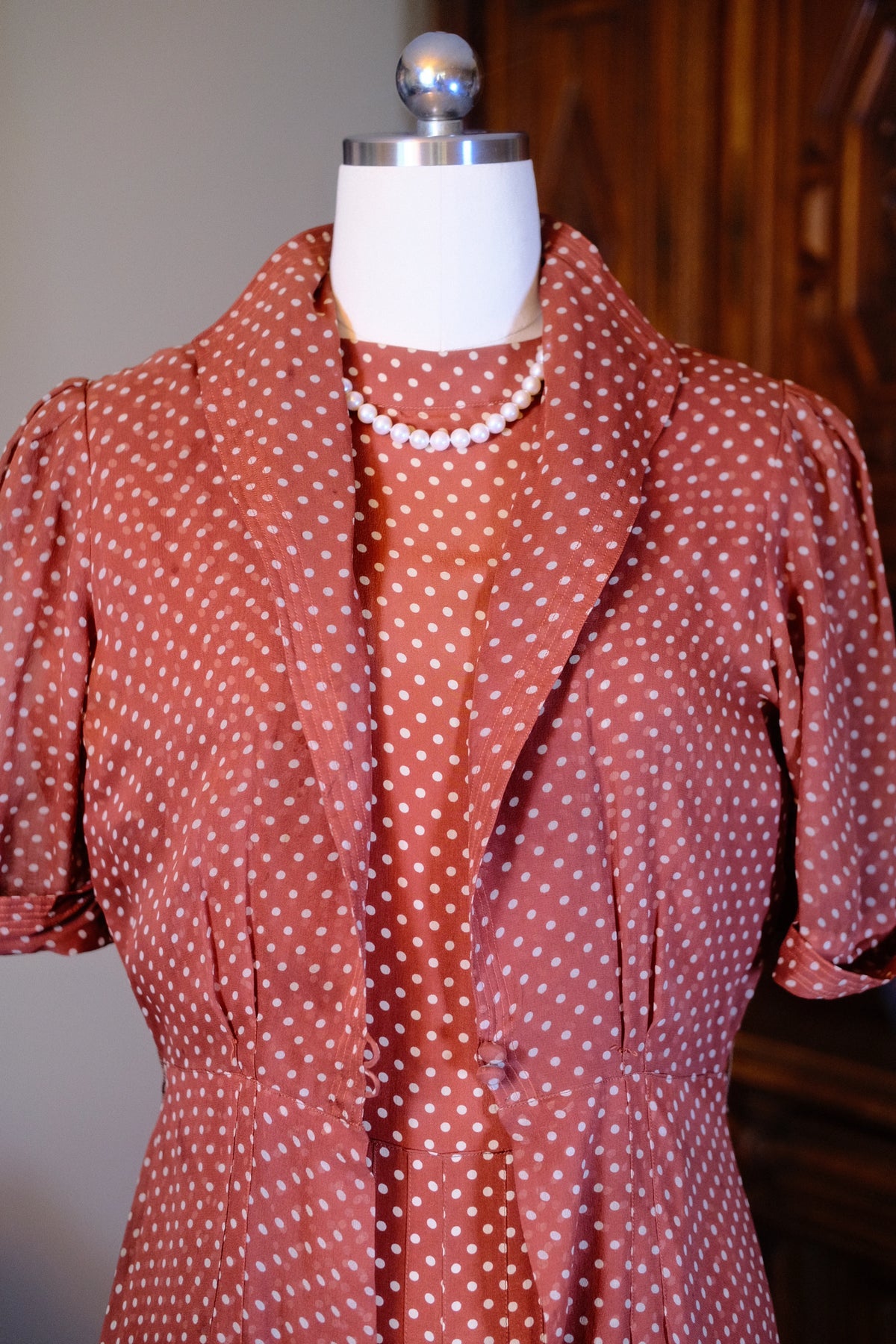
经典的“波点”元素,在服装心理学中象征着活泼与俏皮。设计师选用了低饱和度的“铁锈红”或“赤陶色”作为底色,既规避了战时鲜艳色彩带来的张扬,又比黑灰多了几分温度与生命力。白色的波点如散落的珍珠,在铁锈红的底色上跳跃,呈现出一种历经岁月沉淀后的静好与从容。
三、 版型解构:沙漏形轮廓的经典复刻
1. 内搭连衣裙(The Slip Dress):
* 领口与肩部: 采用了优雅的圆领或微立领设计,配以典型的40年代泡泡袖(Puff Sleeves)或垫肩设计。这种微耸的肩部线条,是对30年代“好莱坞黄金时代”宽肩审美的延续,既修饰了女性的头身比,又在无形中赋予了女性一种挺拔、自信的力量感。
* 腰部设计: 采用自然收腰剪裁,通过精细的省道(Darts)贴合人体曲线。腰部点缀两颗同色系的布包扣,这不仅是视觉上的收束,更是对40年代“沙漏型(Hourglass)”身材的极致赞美。
* 裙摆: 下半身采用刀锋褶(Knife Pleats)或自然垂荡的A字廓形。这种设计既保证了穿着者行走时的飘逸感,又在静态时呈现出如同古典油画般的庄重与秩序美。
2. 配套外套(The Bolero Jacket):
* 外套采用经典的翻领设计,衣长不过腰,与内搭连衣裙形成完美的比例分割。外套的袖口微微翻折,展现出40年代特有的严谨与考究。
* 这件外套的存在,不仅是功能上的保暖,更是一种“仪式感”的构建。它让这套服装能够从容应对从白昼的午后茶会到夜晚的微凉晚宴,完美诠释了1940年代女性“一衣多穿”的实用时尚哲学。
四、 细节考究:针脚里的温情
翻开这件衣物,背部采用隐形拉链与一排精致的布扣相结合的设计。布包扣与面料浑然一体,体现了当时高级成衣(Ready-to-wear)向高级定制(Haute Couture)看齐的严谨态度。裙身的褶皱在灯光下折射出岁月的光泽,每一道压线都透露出手工艺者的匠心。
五、 结语:穿越岁月的优雅
张爱玲曾写道:“生命是一袭华美的袍。”这件40年代的波点两件套,便是那袭袍子最生动的注脚。它没有50年代迪奥(Dior)“New Look”那种极致的张扬,却多了一份大时代背景下,女性独有的温婉、坚韧与自持。
穿上它,仿佛能听到老上海百乐门里的爵士乐,或是看见伦敦街头撑着黑伞的摩登女郎。它不仅仅是一件衣服,更是一段被织物封存的历史,一首关于爱、战争与和平的无声诗篇。
If we turn the hands of time back to the 1940s, we encounter a singular era where gunsmoke and grandeur coexisted, a symbiotic pairing of extreme romanticism and profound self-restraint. Under the looming shadow of World War II, the history of fashion entered a period of negotiation between "pragmatism" and "decorative art." Fashion of the mid-to-early 1940s was forced to subtract due to wartime material shortages, resulting in shortened hems and tightened darts. Yet as the fires of war gradually subsided, people's long-suppressed yearning for a beautiful life erupted into a passionate pursuit of polka dots and lightweight silhouettes. This two-piece ensemble stands precisely as a "flower blooming upon the ruins," bearing witness to the moving moment when women emancipated themselves from the constraints of wartime utility wear to reclaim elegance and decorum.
Viewed through the lens of textile engineering, this outfit utilizes synthetic fibers or chiffon (Chiffon/Georgette) possessing a profound period character. This fabric is lightweight, translucent, and exhibits an exceptional, fluid drape. Within the industrial context of the 1940s, such matte-finished synthetic chiffon represented the perfect synthesis of technological progress and civilian fashion.
The classic "polka-dot" element symbolizes playfulness and vivacity in the psychology of clothing. The designer selected a low-saturation "rust red" or "terracotta" as the base tone, successfully avoiding the loud ostentation of wartime brights while imparting far more warmth and vitality than black or gray. White polka dots scatter like fallen pearls across the rust-red ground, presenting a sense of tranquil serenity born of time-tested grace.
The Slip Dress (The Inner Dress):
Neckline & Shoulders: Features an elegant round neckline or micro-standing collar, paired with quintessential 1940s puff sleeves (Puff Sleeves) or shoulder pads. This slightly elevated shoulder line extends the wide-shoulder aesthetic of the 1930s Hollywood Golden Age, simultaneously refining the wearer's proportion and instilling an upright, confident aura of strength.
Waist Construction: Adopts a natural waist-cinching cut, contouring the body's curves via precision darts (Darts). Two matching fabric-covered buttons accent the waistline—serving not only as a visual anchor, but as an ultimate tribute to the 1940s hourglass (Hourglass) silhouette.
Skirt Hem: The lower half utilizes knife pleats (Knife Pleats) or a naturally flowing A-line contour. This design guarantees fluid grace when the wearer is in motion, while projecting the solemnity and architectural order of a classical oil painting when static.
The Bolero Jacket (The Companion Jacket):
Structure: The jacket adopts a classic lapel design cut short of the waist, establishing a flawless proportional division alongside the inner slip dress. The cuffs are subtly turned back, exhibiting the strict rigor and refinement characteristic of the 1940s.
Functionality: The presence of this jacket provides not merely thermal utility, but the construction of "ceremonial decorum." It allows the ensemble to transition effortlessly from daytime afternoon teas to the cooling breeze of evening banquets, perfectly interpreting the practical fashion philosophy of "versatility in a single wardrobe" practiced by 1940s women.
Unfastening the garment reveals a center-back concealed zipper combined with a neat row of fabric-covered buttons (Fabric-Covered Buttons). The self-fabric buttons merge seamlessly with the body fabric, embodying the rigorous attitude of ready-to-wear (Ready-to-wear) striving to match the standards of haute couture. The folds of the skirt refract the luster of time beneath the lights, with every single press-line testifying to the artisan's dedicated mastery.
Eileen Chang once wrote: "Life is a magnificent robe studded with lice." This 1940s polka-dot two-piece serves as the most vivid footnote to that magnificent robe. Eschewing the extreme theatricality of Dior's 1950s "New Look," it retains a unique brand of feminine tenderness, resilience, and self-possession forged against the backdrop of a grand historical epoch.
Slipping into it evokes the strains of jazz drifting through an old Shanghai Paramount lounge, or modern women holding black umbrellas along London streets. This transcends ordinary apparel to become a piece of history sealed within textiles—a silent poem dedicated to love, war, and peace.