溯源
Couldn't load pickup availability
“翩若惊鸿,婉若游龙。”
古人以蝶喻美人,因其灵动,因其绚烂。而这袭诞生于上世纪五十年代香江的百蝶织锦缎旗袍,便恰似一阕凝固的宋词,将那份属于东方的婉约与绮丽,封存于这抹温润的青碧之中。
衣身乃五零年代经典的杭产织锦缎。锦缎之妙,在于“锦”字的厚重与“缎”的流光。这种面料在光影流转间,会呈现出一种如同古画绢帛般的哑光质感,却又在褶皱起伏时,折射出如月光般温润的金属光泽。那抹清雅的苔绿(或是豆绿、竹青),不似春草之张扬,却如雨后青苔般静谧,透着一股历经岁月沉淀的沉静与从容。
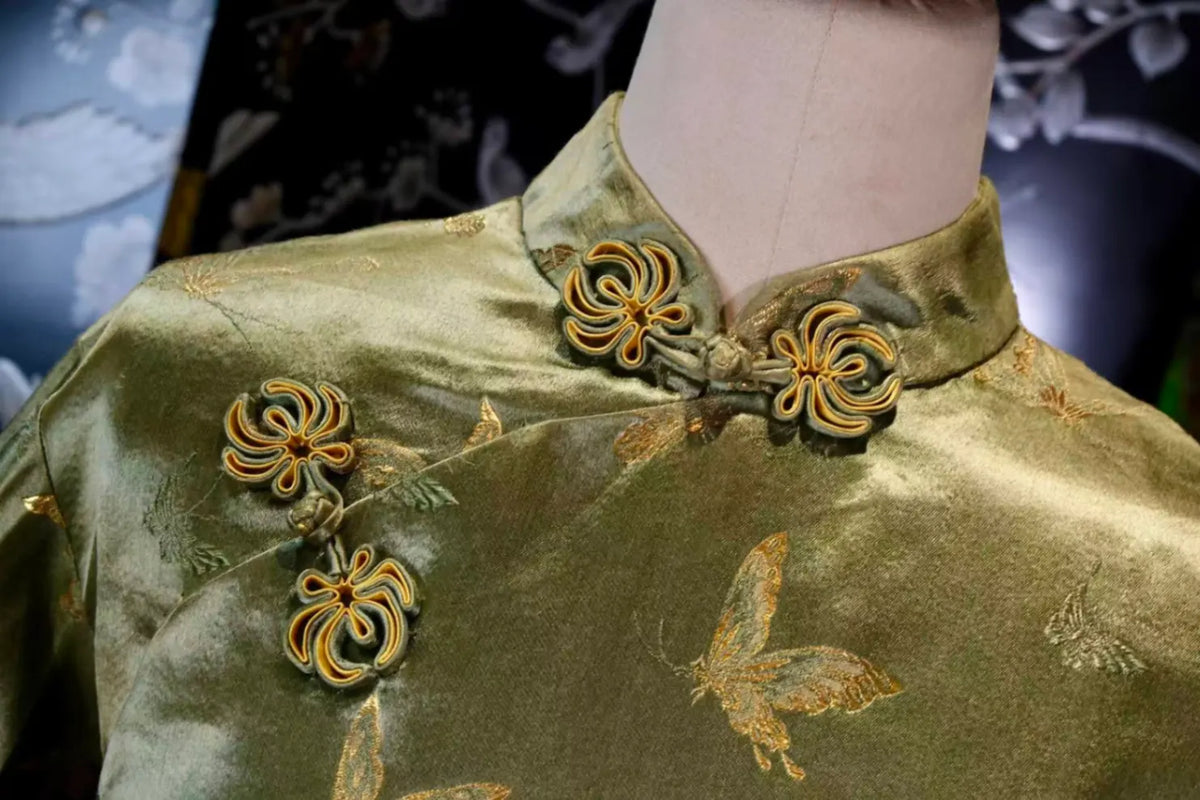
旗袍之上,金丝与绿丝交织,织就了百蝶穿花的繁复纹样。蝴蝶在中华传统文化中,是“耄耋(mào dié)”的谐音,寓意长寿与福气;在文学意象里,它又是庄子笔下“物我两忘”的自由灵魂。
你看这些金线绣成的蝶,或翩然欲上,或款款低飞,姿态各异,栩栩如生。它们不是生硬的贴花,而是从锦缎的经纬中“生长”出来的。随着穿着者的呼吸与步履,金蝶便在青碧的底色上微微颤动,宛如庄周梦蝶,虚实难辨,平添了几分“穿花蛱蝶深深见”的灵动与神秘。
最引人注目的,莫过于襟前的这组手工盘扣。
这是典型的“如意菊花扣”或称“风车扣”。盘扣,是旗袍的灵魂,也是裁缝指尖上的乾坤。这组盘扣以青碧色的缎条为骨,金丝线为筋,层层叠叠,盘绕成花。它不仅仅是一枚扣子,更像是一朵盛开在胸前的花,又像是一汪凝固的涟漪。
这种手工盘扣在五六十年代的香港裁缝界极为盛行,彼时的香港,聚集了来自上海的顶尖裁缝,他们将海派的精致与港岛的摩登融合,创造了独属于那个时代的“香江旗袍”。每一针、每一折,都是时光的刻度,是机器无法替代的温度。
这件旗袍的版型,是五十年代最经典的“收腰直筒”或“微A摆”改良版。它褪去了三四十年代海派旗袍的极度修身与暴露,转向了一种更为内敛、含蓄的优雅。
它不刻意强调身体的曲线,而是通过精妙的剪裁,让面料自然贴合,随着人体的动作流动。领口微高,盘扣精巧,袖口适中,既有传统女性的端庄,又不失现代女性的独立与自信。这是一种“克制的性感”,是“犹抱琵琶半遮面”的东方美学。
这不仅仅是一件衣服,它是一段被织物封存的历史。
它见证了香江那个流金溢彩的年代,见证了无数名媛淑女的悲欢离合。它身上有檀香,有脂粉,有老上海的霓虹,也有维多利亚港的海风。
穿上它,你不是在穿一件衣服,你是在穿一段时光,穿一个关于东方的、永恒的梦。
"Graceful like a startled swan, supple like a gliding dragon." — Cao Zhi
The ancients likened a beautiful woman to a butterfly for her kinetic grace and brilliant coloration. Born along the shores of Hong Kong during the 1950s, this "Hundred Butterflies" brocade Qipao reads precisely like a frozen Song-dynasty lyric, sealing the quiet elegance and resplendence of the East within its warm, moss-green embrace.
The bodice is crafted from quintessential 1950s Hangzhou-origin brocade (Hangzhou Brocade). The beauty of brocade lies in the substantive weight of jin paired with the fluid luster of duan. Under shifting light, this textile projects a matte texture reminiscent of ancient silk painting scrolls, yet as folds rise and fall, it refracts a metallic sheen as soft and mellow as moonlight. That refined hue of moss green (or pea green and bamboo teal) eschews the clamorous green of spring grass; instead, it mirrors post-rain moss—serene, deep, and redolent of quiet composure weathered by time.
Across the Qipao, gold and green threads intertwine to render the complex motif of butterflies weaving through blossoms. In traditional Chinese culture, the butterfly (hudie) homophones with eighty to ninety years of age (maodie), symbolizing longevity and fortune; within literary imagery, it is Zhuangzi’s free spirit ("losing distinction between self and things").
Observe these gold-threaded butterflies: some ascend in flight, others hover in gentle descent, each assuming unique, lifelike postures. Far from stiff appliqués, they appear to "grow" directly from the warp and weft of the brocade. With the wearer’s breath and stride, these golden butterflies tremble lightly against the green ground—evoking Zhuangzi dreaming of a butterfly, where reality and illusion blur to impart the lively, mysterious charm of "butterflies deep among the blossoms."
The most arresting detail resides in the handcrafted set of frog fastenings (Frog Buttons) adorning the placket.
These are classic "Ruyi chrysanthemum buttons" (Ruyi Chrysanthemum Buttons) or wind-wheel knots. Frog closures serve as the soul of a Qipao and a universe commanded by a tailor’s fingertips. Structured with moss-green satin strips as a skeleton and fine gold thread as sinew, these buttons fold layer upon layer to blossom into a floral knot. They transcend mere utilitarian hardware, resembling a flower blooming across the chest or a pool of frozen ripples.
Such handmade knotting flourished intensely within the tailoring circles of 1960s Hong Kong. Gathering master tailors from Shanghai, the island fused Shanghainese refinement with Hong Kong's burgeoning modernity to birth a distinct "Hong Kong Qipao" epoch. Every single stitch and fold measures the cadence of time—bearing a human warmth irreplaceable by machines.
The pattern of this Qipao represents the quintessential 1950s "cinched-straight" or "micro-A-line" modernized evolution. Stepping back from the extreme skin-tight exposure of 1930s and 1940s Shanghainese styles, it pivots toward a more introverted, implicit elegance.
Rather than aggressively forcing bodily contours, it relies on precise tailoring to let the fabric drape naturally, flowing in harmony with human movement. The collar stands moderately high, the frog buttons are exquisite, and the sleeves are balanced—preserving traditional feminine decorum while retaining modern female independence and self-assurance. This is a manifestation of "restrained sensuality," a physical embodiment of the Eastern aesthetic principle of "half-hidden behind a pipa."
This transcends mere apparel; it is a chapter of history preserved in textile.
It bears witness to the golden epoch of Hong Kong, echoing the joys and sorrows of countless high-society ladies and socialites. It carries the scent of sandalwood, face powder, the neon glow of old Shanghai, and the sea breeze of Victoria Harbour.
Slipping into it is not merely wearing a dress—it is wearing a passage of time, an eternal Eastern dream.