深圳溯源
Couldn't load pickup availability
衣服尺寸:
胸围/腰围/臀围/衣长:90/74/100/105 厘米
细节描述:
在服装史的浩瀚长河中,二十世纪六十年代的香港旗袍,无疑是一颗璀璨而独特的遗珠。它既承袭了老上海的精致余韵,又在中西文化剧烈碰撞的香江之畔,生长出一种更为利落、摩登且极具生命力的美学形态。今日我们要审视的这件藏品,便是一件极为罕见的六十年代港产提花织锦缎古董旗袍。它不仅是一件衣物,更是一段被丝线封存的流动历史。
一、 纹样解码:巴洛克式的东方绮梦
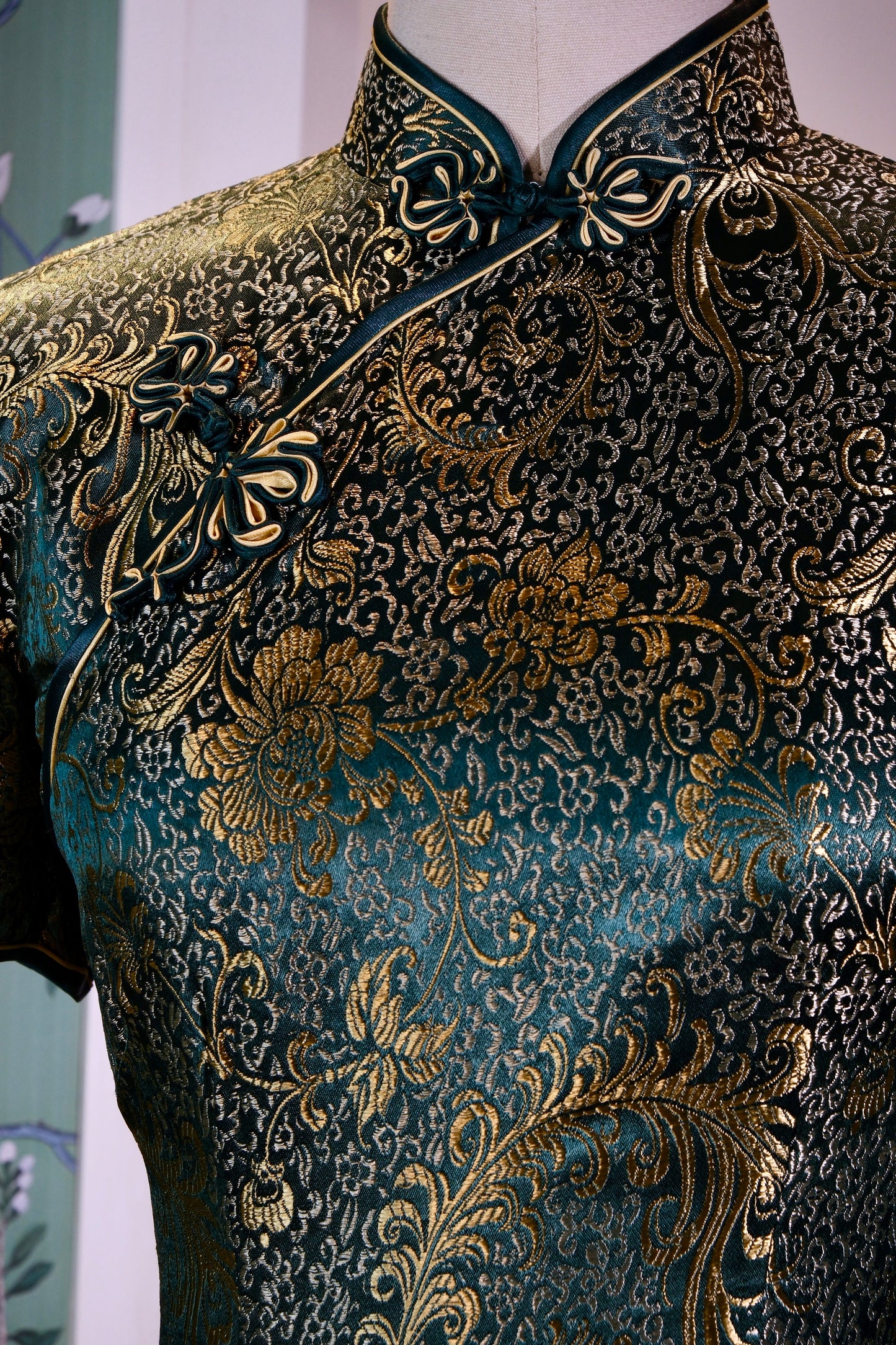
初见此衣,最摄人心魄的莫过于其面料上繁复而华丽的纹样。这并非传统意义上留白写意的中式花鸟,而是一种典型的“中西合璧”式视觉语言。
从图案构成来看,设计师大胆采用了类似西方巴洛克或洛可可风格的卷草纹与缠枝莲纹相结合的构图。金色的线条如藤蔓般在深邃的孔雀蓝底色上肆意蔓延,这种连续的、S型的曲线结构,打破了传统旗袍纹样的对称与端庄,赋予了织物一种强烈的律动感与扩张力。
细看那盛开的金色花卉,既有牡丹的雍容,又似西番莲的异域风情。这种纹样在纺织史上被称为“大提花”,需要极其复杂的织造工艺。金线与丝线的交织,在光线下呈现出一种浮雕般的立体感。正如《长物志》中所言:“随方制象,各有所宜”,这种纹样在当时不仅是为了装饰,更是为了迎合六十年代那种追求奢华、渴望在国际舞台上展示东方富丽堂皇形象的时代心理。
二、 剪裁与形制:黄金时代的最后绝唱
从形制上断代,这件旗袍保留了六十年代中期典型的特征。
1. 领型与袖口: 它的领口高度适中,既非民国的高耸,也非后期的极简,而是恰到好处地衬托颈部线条。袖口为经典的短袖设计,边缘滚边细致入微,深蓝色的包边如同画框一般,锁住了金色的张扬。
2. 归拔工艺: 请注意腰臀部的曲线。六十年代的香港裁缝深受西式立体剪裁的影响,讲究“归拔”——即通过高温熨烫使平面的布料产生立体的弧度。
3. 盘扣细节: 领口的琵琶扣做得极为精巧,色泽与面料浑然一体,起到了画龙点睛的作用,含蓄而内敛。
三、 材质之美:织锦缎的辉煌与脆弱
这件旗袍的面料是典型的“织锦缎”。这是一种高经密度的丝织品,质地紧密厚实,手感滑爽。
在色彩学上,这种深邃的孔雀蓝(Teal)配以古铜金,属于高级的互补色搭配。蓝色象征着沉静与深远,如深海,如夜空;而金色象征着尊贵与光明。两者相遇,正如李商隐诗云:“沧海月明珠有泪,蓝田日暖玉生烟。”这种配色在视觉上极具冲击力,却又因为金色的沉稳而不显俗艳。
然而,织锦缎也是娇贵的。历经六十载岁月,真丝蛋白难免会有自然的氧化与脆化,但这件藏品的保存状态堪称奇迹,光泽依旧流转,仿佛昨日的华灯初上。
四、 稀缺性与收藏价值:不可再生的时光标本
首先,“港产”标签的特殊性。六十年代的香港是世界的成衣工厂,但那是针对出口的大众市场。真正为本地名媛、影星量身定制或高端 boutique 出品的精品,存世量极少。这件衣服的做工之精细,绝非流水线产物,极有可能出自当时香港某位知名红帮裁缝或苏广成衣局老师傅之手。
其次,面料的不可再生性。这种老式提花织机早已大多被淘汰,取而代之的是效率更高但质感稍逊的机器。这种带有强烈时代印记的“富贵气”面料,如今已难觅踪迹。
最后,品相的完整性。古董衣最怕虫蛀与霉变,尤其是丝织品。这件旗袍能从六十年代完好地穿越时空来到我们面前,本身就是一个概率极低的事件。
结语
张爱玲曾说:“衣服是一种言语,随身带着的一种袖珍戏剧。”
这件六十年代的提花织锦缎旗袍,就是一出无声的戏剧。它见证了那个年代女性在东西方文化夹缝中绽放的自信与优雅。它不仅仅是一件用来穿着的衣服,更是一件值得被博物馆级对待的艺术品。拥有它,便是拥有了一段触手可及的、流光溢彩的旧梦。
Measurements / Size Guide:
Bust / Waist / Hips / Total Length: 90/74/100/105 cm
Detailed Description:
Within the vast river of dress history, the 1960s Hong Kong qipao is undoubtedly a radiant and unique heritage pearl. It not only inherited the refined lingering charms of old Shanghai, but also nurtured a cleaner, more modern, and highly vital aesthetic form along the shores of the Fragrant River (Xiangjiang), where Eastern and Western cultures intensely collided. The collection piece we are examining today is an exceptionally rare 1960s Hong Kong-manufactured jacquard brocade antique qipao. It exists not merely as an article of clothing, but as a segment of fluid history sealed within silken threads.
Upon first encountering this garment, the most breathtaking attribute is the complex and magnificent patterning across its fabric surface. This layout is by no means a conventional Chinese flower-and-bird design characterized by minimalist negative space (liubai), but rather a textbook example of a hybrid "East meets West" visual language.
Looking at the pattern composition, the designer boldly adopted a layout that fuses Western Baroque or Rococo style trailing vine scrolls with traditional Chinese interlocking lotus motifs. Golden lines spread expansively like creeping vines across a deep, profound peacock blue background substrate. This continuous, S-shaped curvilinear structure breaks away from the rigid symmetry and stately decorum of conventional qipao patterns, endowing the textile with a powerful sense of rhythmic motion and expansive energy.
Examining the blooming golden florals closely, they capture both the opulent majesty of the peony and the exotic allure of the passionflower (xifanlian). This type of pattern layout is known in textile history as "large jacquard" (da tihua), requiring an exceptionally complex weaving process. The interlacing of metallic gold threads and premium silk strands projects a relief-like three-dimensional depth under light. As the classic text Changwu Zhi (Treatise on Superfluous Things) states: "Forming images according to the orientation, each finding its proper suitability," this motif design was deployed not merely for decoration back then, but to cater precisely to the mid-century psychology of the 1960s—a period that chased luxury and yearned to showcase a magnificent, grand image of the East on the international stage.
Dating the garment through its structural form, this qipao firmly retains the characteristic hallmarks of the mid-1960s.
Collar Style and Cuffs: The height of its collar is perfectly calculated, steering clear of both the towering necklines of the Republican era and the hyper-minimalism of later decades, elegantly framing the neck contours. The cuffs implement a classic short-sleeve design featuring meticulous edge-piping; the deep blue piping borders the structural lines like a picture frame, securely locking in the expressive flamboyance of the gold.
The Gui-Ba Craftsmanship: Observe the precision of the contours across the waist and hips. Hong Kong master tailors of the 1960s were deeply influenced by Western three-dimensional pattern cutting, placing immense value on Gui-Ba (stretching and shrinking)—a rigorous technique of using high-temperature iron-pressing to force flat fabric into three-dimensional anatomical curves.
Pipa Knot Details: The pipa style frog closures (pankou) along the neckline are exquisitely crafted, their coloration blending seamlessly with the primary fabric substrate to provide a crowning touch of traditional understatement and restraint.
The fabric of this qipao is a classic "jacquard brocade" (zhijinduan). This is a heavy, high-density silk textile possessing a tightly packed structure and a flawlessly smooth, slick hand-feel.
In color theory, this profound peacock blue (Teal) paired with antique bronze gold forms a highly sophisticated complementary color composition. Blue symbolizes composure and deep expansiveness, akin to the deep sea or the night sky, while gold denotes supreme nobility and illumination. The meeting of the two beautifully invokes the poetic imagery written of by Li Shangyin: "In the vast sea under a bright moon, pearls shed tears; in the warm sun at Lantian, jade engenders mist." This color palette delivers an immense visual impact without ever sliding into commercial vulgarity, safely anchored by the grounded weight of the bronze gold.
However, jacquard brocade is inherently delicate. Having journeyed across sixty years of time, natural oxidation and the gradual brittleness of the silk proteins are inevitable. Yet, the preservation state of this specific archival piece is nothing short of a miracle—its luster remains fluid and shifting, as if the evening lights of yesterday had only just begun to flicker.
First, consider the historical specificity of the "Hong Kong-Manufactured" provenance label. While Hong Kong in the 1960s operated as a major global garment manufacturing hub, that output was overwhelmingly directed toward the mass export market. High-end masterworks specifically bespoke-tailored for local socialites and film icons, or produced by elite boutiques, survived in exceptionally low absolute numbers. The structural refinement and meticulous workmanship of this piece prove it is by no means a product of an industrial assembly line; it was, in all probability, commissioned from a prominent Hong Kong Hongbang tailor or an old master of the Suzhou-Guangzhou garment guild.
Second, note the absolute non-renewable nature of the material. These old-school mechanical jacquard looms have almost universally been decommissioned, replaced by modern machinery that offers higher efficiency but noticeably lacks the same heavy, structural texture. This species of textile, heavily imbued with the unmistakable "opulent aura" of its era, is practically impossible to find today.
Finally, evaluate the absolute structural integrity of its preservation. Antique garments are exceptionally vulnerable to mold and moth damage, a vulnerability amplified in organic silk textiles. That this qipao could travel completely intact from the 1960s through time to stand before us today is an event of extraordinarily low statistical probability.
Eileen Chang famously observed: "Clothes are a language, a pocket theater carried upon the body."
This 1960s jacquard brocade qipao is precisely such a silent drama. It stands as a primary physical witness to the absolute confidence and elegance manifested by mid-century women as they blossomed within the cultural crossroads of East and West. It has completely transcended its utilitarian boundaries as a piece of apparel to exist as a fine art object deserving of museum-grade curation. To possess it is to hold a tangible, brilliantly shimmering fragment of a bygone dream.