深圳溯源
Couldn't load pickup availability
衣服尺寸:
胸围/腰围/臀围/衣长:94/94/104/106 厘米
细节描述:
“锦衣旗袍诗,曼玉花样时。”
在现当代服饰史的浩瀚星河中,20世纪50年代是一个极具张力的转型期。彼时的上海与香港,正处于西风东渐的巅峰时刻。这件大陆产、采用法国进口机绣纯棉蕾丝面料的古董旗袍,便是那个黄金时代最优雅的注脚。它不仅仅是一件衣物,更是一段被封存的时光,见证了东西方纺织工艺在特定历史时空下的完美交汇。
一、 纹样解码:从“团花”到“几何”的现代性重构
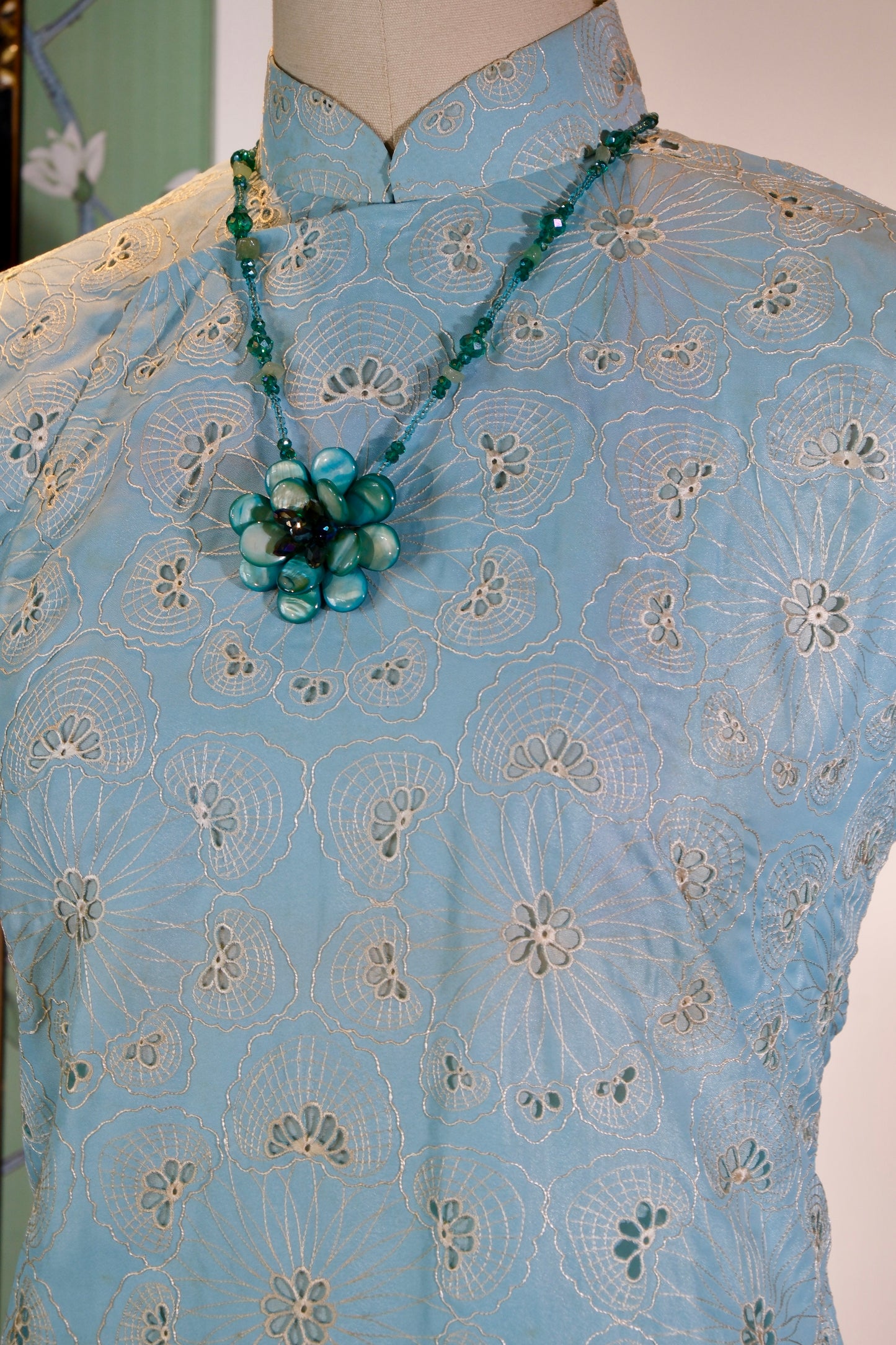
细观此衣,其面料纹样绝非传统的具象花鸟,而是一种极具装饰艺术风格的抽象表达。
* 放射状团花(Radiating Floral Motif): 衣身遍布着大小错落的放射状图案。大者如盛放的菊瓣或烟花,线条由中心向外呈扇形辐射,极具动感;小者则如星点散落其间,形成了疏密有致的视觉节奏。
* 几何化的秩序美: 这种纹样设计明显受到了当时西方Art Deco(装饰艺术)风格的影响,将中国传统吉祥寓意中的“团花”进行了现代化的几何解构。银白色的机绣线条在淡蓝色的底布上流淌,宛如水面上泛起的层层涟漪,又似夜空中绽放的银色烟火。
* 虚实相生的肌理: 法国进口的机绣工艺精湛绝伦,针脚细密而富有立体感。棉质蕾丝特有的哑光质感与刺绣的光泽相互映衬,赋予了面料一种“透气”的生命力,既有丝绸的华贵,又有棉麻的质朴与挺括。
二、 历史溯源:舶来面料与本土剪裁的混血美学
这件旗袍的身世,折射出上世纪中叶中国纺织业的独特面貌。
据《上海纺织工业志》记载,50年代虽处特殊时期,但高档纺织品仍保留着对外交流的窗口。“法国进口机绣”这一标签,在当时意味着极高的成本与身份的象征。这种面料通常通过贸易交换或特殊渠道进入国内,被用于制作最高规格的出口工艺品或供内部高级穿着。
工匠们并未盲目照搬西式礼服的剪裁,而是坚守了中式旗袍的灵魂——“省道”与“归拔”。请注意观察腰部的收省与臀部的曲线,这是典型的海派旗袍剪裁技法,利用高温熨烫的“归拔”工艺,使平面的布料顺应女性身体的起伏,达到了“增一分则太长,减一分则太短”的合体境界。这种“西料中用”的尝试,正是那个时代服装设计师们在大时代背景下,对东方美学的一种顽强坚守与创新。
三、 艺术风格与稀缺性:不可复制的时代孤品
张爱玲曾在《更衣记》中写道:“对于不会说话的人,衣服是一种语言,随身带着的是袖珍戏剧。”
这件旗袍的艺术价值,在于它处于传统手工刺绣向现代工业化生产过渡的节点上。它没有手工苏绣那般繁复厚重,却多了一份工业时代初期的精致与利落。那抹淡雅的天青色(Azure),取自宋瓷之美,温润如玉,极衬东方女性的肤色。
稀缺性综述:
1. 面料绝版: 50年代的法国进口纯棉蕾丝存世量极少,且随着时间推移,棉纤维极易脆化,能保存至今且色泽如初、无破损者,实属凤毛麟角。
2. 工艺断层: 这种特定的机绣提花工艺在后来的化纤浪潮中逐渐失传,现代的电脑刺绣难以复刻那种带有温度的机械韵律感。
3. 文化标本: 它是研究建国初期轻工业水平与审美流变的实物铁证。
身着此衣,仿佛能听到旧时光里的留声机在缓缓转动。它不仅是一件可供收藏的古董,更是一首穿在身上的、关于优雅与坚韧的无声诗篇。
Measurements / Size Guide:
Bust / Waist / Hips / Total Length: 94/94/104/106 cm
Detailed Description:
"A poem captured in a splendid qipao, reflecting Maggie Cheung's timeless moments in fashion."
In the vast chronicle of modern apparel history, the 1950s stands as an incredibly dynamic period of transition. During this era, the peak of Western stylistic influence swept across major fashion hubs, blending beautifully with heritage techniques. This antique qipao—crafted from mainland-produced fabric using French imported machine-embroidered pure cotton lace—serves as an elegant footnote to that golden age. It stands not merely as an item of clothing, but as a frozen fragment of time, witnessing the flawless intersection of Eastern and Western textile arts within a specific historical moment.
A close inspection of this garment reveals that its fabric pattern completely moves away from traditional representational flowers or birds, opting instead for an abstract presentation heavily rooted in the Art Deco tradition.
The Radiating Floral Motif: The body of the dress is covered with an arrangement of staggered, radiating patterns. The larger motifs resemble blooming chrysanthemums or exploding fireworks, with embroidered lines fanning out dynamically from the center to create an intense sense of motion. The smaller motifs are scattered like stardust in between, creating a beautifully balanced visual cadence.
The Orderly Beauty of Geometry: This pattern design draws clear inspiration from Western Art Deco style, taking the traditional Chinese "floral medallion" (团花)—typically associated with auspicious blessings—and deconstructing it into a modernized geometric layout. The silver-white embroidered lines glide smoothly across the pale blue ground fabric, mimicking rippling water or silver fireworks lighting up a night sky.
The Shifting Luster of Texture: The French imported machine embroidery is executed with spectacular precision, yielding tight, fluid stitches that provide a distinct three-dimensional texture. The matte surface characteristic of pure cotton lace contrasts beautifully with the soft sheen of the embroidery thread. This gives the textile a breathable, living quality, combining the structured crispness of cotton with a luxurious, premium finish.
The background of this qipao reflects the unique and complex landscape of the mid-century textile industry.
According to historical records of regional textile mills, even during specialized periods in the 1950s, high-end textile production maintained windows for international exchange. The label of "French imported machine embroidery" represented immense material cost and served as an absolute symbol of elite status at the time. These luxury fabrics typically entered the region through trade exchanges or specialized channels, designated for top-tier exhibition pieces, premium exports, or high-level internal use.
Rather than blindly copying Western evening gown patterns, local master tailors firmly maintained the core soul of the traditional Chinese qipao through the meticulous application of structural darting (省道) and the historic iron-shaping technique known as Gui-Ba (归拔). Looking closely at the taking-in of the waist and the contouring of the hips, one sees the finest execution of Shanghai-style (Haipai) tailoring. By utilizing high-temperature steam irons to shrink and stretch the fabric (归拔), the artisans coaxed a flat piece of textile to conform flawlessly to the natural curves of the female silhouette, achieving a bespoke fit that feels entirely organic. This practice of using Western materials for Chinese silhouettes showcases a resilient preservation and brilliant innovation of Eastern aesthetics during a transformative era.
Eileen Chang once wrote in Reflections on Clothing (更衣记): "For those who cannot speak, clothes are a language, a pocket theater carried upon the body."
The artistic value of this qipao lies precisely at the historical intersection where traditional hand embroidery transitioned into modern industrial production. It sheds the heavy, dense weight of classic hand-stitched silk Suxiu, replacing it with the crisp, clean precision characteristic of early industrial engineering. The elegant azure blue base tone borrows directly from the timeless beauty of Song Dynasty ceramics—warm, soft, and perfectly suited to complement the natural radiance of Eastern skin tones.
Obsolete Textile Materials: 1950s French imported pure cotton lace has a survival rate that is exceptionally low. Because natural cotton fibers are highly prone to becoming brittle and degrading over the decades, finding a specimen preserved in pristine condition with its original color depth entirely intact is a genuine curatorial rarity.
Technological Discontinuity: This specific style of multi-ply machine-guided jacquard embroidery gradually disappeared with the post-war rise of mass-produced synthetic fibers. Modern computerized embroidery struggles to duplicate the subtle, warm mechanical rhythm achieved by mid-century equipment.
Cultural Specimen: The garment serves as an invaluable physical benchmark for researching the historical development, aesthetic evolution, and light-industry capabilities of the early mid-century era.
To wear this garment is to feel as though a vintage phonograph is turning quietly in the background. It exists not merely as an antique treasure for collection, but as a silent, wearable poem dedicated to an era of resilience, grace, and timeless modernization.