深圳溯源
Couldn't load pickup availability
衣服尺寸:
胸围/腰围/臀围/衣长:94/86/100/112 厘米
细节描述:
这是一件极具研究价值的上世纪六十年代香港产古董旗袍。它不仅是服饰史的实物见证,更是一件融合了东西方审美与工艺的艺术品。
纹样考释:光影交错的几何美学
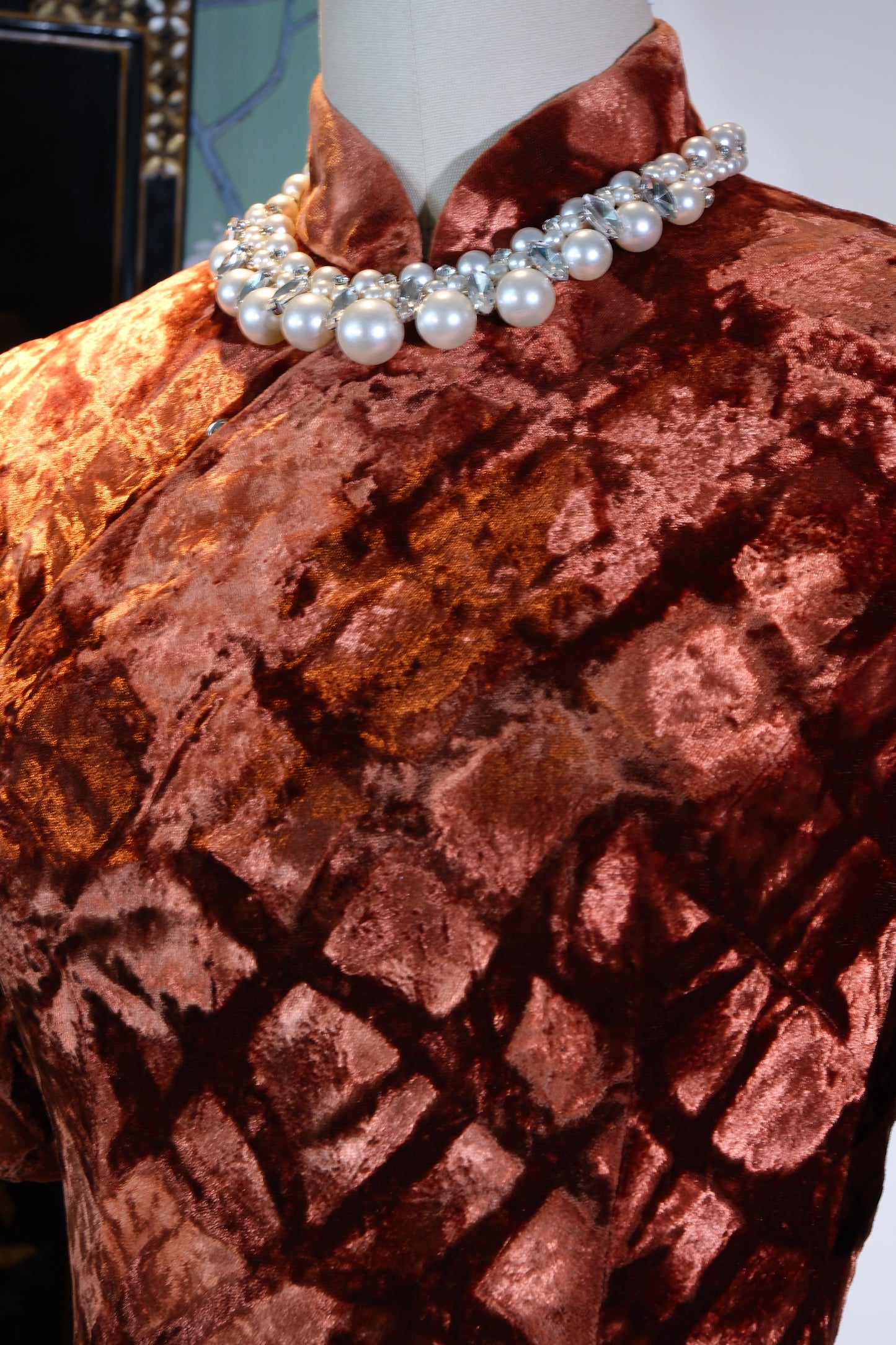
这件旗袍最引人入胜之处,在于其面料上独特的抽象几何压花图案。
- 视觉形态: 图案并非传统的平面印花或刺绣,而是通过高温压印工艺在丝绒表面形成的立体肌理。深褐色的菱形网格线条如同枯藤老树般苍劲,交错分割出大小不一的菱形块面。
- 光影效果: 这种压花工艺利用了丝绒面料“顺毛亮、逆毛暗”的光学特性。在光线照射下,隆起的菱形块面呈现出如赤铜般的金属光泽,而凹陷的网格线条则隐入深沉的暗影中。这种明暗对比(Chiaroscuro)赋予了面料极强的雕塑感和流动感,仿佛波光粼粼的湖面,又似夕阳下斑驳的窗棂投影。
- 文化隐喻: 这种几何纹样虽看似现代抽象,实则暗合了中国传统建筑中的“窗棂格”或“冰裂纹”意象。但在六十年代的语境下,它被解构重组,褪去了封建礼教的刻板,转而追求一种符合现代主义审美的秩序感与节奏感。
历史溯源:香江岁月的摩登回响
要读懂这件旗袍,必须将其置于上世纪六十年代香港的历史坐标系中。
- 时代背景: 六十年代的香港正处于经济腾飞与文化转型的交汇点。张爱玲曾言:“对于不会说话的人,衣服是一种语言。”此时的香港女性,既保留了东方女性的含蓄内敛,又深受西方战后时尚(如迪奥的New Look余韵)的影响。这件旗袍修身剪裁所强调的S型曲线,正是那个时代女性意识觉醒、追求身体解放的缩影。
- 工艺溯源: 您提到的“日本进口压花丝绒”是解读其稀缺性的关键钥匙。
- 贸易脉络: 五六十年代,日本纺织业在人造纤维和后整理工艺(如压花、植绒)上领先亚洲。香港作为转口贸易港与轻工业中心,大量进口日本的高级面料进行本地加工。这种面料在当时属于“高档货”,非普通市井百姓所能轻易拥有,通常是名媛、歌星或高级职员的定制首选。
- 绝版工艺: 随着七十年代后成衣工业化流水线的发展,这种需要极高精度控制的复杂压花丝绒面料逐渐被廉价的化纤印花所取代。如今,这种带有岁月包浆、绒毛细密且压纹依然清晰立体的老料,已成凤毛麟角。
艺术风格与稀缺性论述
从服装史学的角度审视,这件藏品具有双重稀缺性:
1. 材质的不可再生性: 真正的古董丝绒(Velvet),其底织多为真丝或高支棉,绒毛细腻温润,手感如婴儿肌肤。经过六十年的氧化,颜色从最初的鲜亮转为如今沉稳醇厚的“焦糖古铜色”,这种色泽是时间赋予的独一无二的滤镜,现代印染技术无法复刻这种深邃的历史感。
2. 东西方美学的完美折衷: 它既有中国传统旗袍的立领符号,又在视觉上呈现出类似西方装饰艺术运动(Art Deco)后期的几何抽象风格。它是“中西合璧”这一宏大叙事在微观服饰上的精准投射。
Measurements / Size Guide:
Bust / Waist / Hips / Total Length: 94/86/100/112 cm
Detailed Description:
This 1960s Hong Kong-made antique qipao holds profound archival and research value. Beyond serving as a physical document of apparel history, it stands as an exquisite art object bridging Eastern and Western material culture, aesthetic theory, and industrial technique.
The visual anchor of this qipao resides in its distinct abstract geometric embossed pattern created directly upon the velvet pile.
Morphological Form: Moving away from standard surface printing or hand embroidery, the pattern relies on high-temperature thermal embossing to create a tactile, three-dimensional relief across the pile. Deep brown diamond lattice lines intersect with structural confidence, segmenting the surface into geometric facets of varying scale.
Chiaroscuro & Optical Dynamics: The embossing process leverages the natural directional nap of velvet—where fibers appear lustrous with the grain and deep with the reverse. Under ambient light, the raised diamond facets yield a rich, metallic copper sheen, while the recessed lattice lines sink into quiet shadow. This dramatic chiaroscuro grants the fabric a sculpted, fluid motion, echoing flickering ripples on water or late afternoon sun cast through latticed windows.
Cultural Metaphor: Though modern and abstract at first glance, the geometric arrangement subtly evokes classical Chinese architectural motifs—specifically traditional window lattices (chuangling ge) and cracked-ice screens (bingliewen). Deconstructed within a 1960s framework, the design sheds feudal rigidity in favor of Modernist balance, rhythm, and structural discipline.
Understanding this garment requires situating it within the historical trajectory of 1960s Hong Kong.
Socio-Cultural Context: Mid-century Hong Kong occupied a dynamic intersection of economic growth and cultural transformation. Echoing Eileen Chang's famous assertion that "clothes are a language, a pocket theater carried upon the body," the Hong Kong woman of the 1960s balanced Eastern composure with post-war Western tailoring influences. The defined waist suppression and contoured silhouette mirror a growing female autonomy and physical expression.
Textile Trade & Technical Origin: The use of imported Japanese embossed velvet serves as a crucial marker of the garment's quality and provenance:
Trade Networks: During the 1950s and 1960s, the Japanese textile industry led East Asia in synthetic fiber development and specialized finishing techniques (including embossing and flocking). As an entrepôt and tailoring hub, Hong Kong regularly imported high-grade Japanese textiles for bespoke production. Such materials were luxury goods, favored by prominent socialites, performers, and career professionals.
Obsolete Finish: With the rise of mass-market ready-to-wear manufacturing in the 1970s, complex thermal-embossed velvets requiring precise heat-and-pressure calibration were gradually replaced by flat chemical prints. Today, archival specimens retaining dense pile and crisp embossed relief are exceedingly rare.
Examined through an academic lens, this piece possesses dual archival significance:
Irreplaceable Vintage Material: Genuine mid-century velvet features a silk or high-count cotton structural base with a dense, soft pile. Over six decades of gentle oxidation, the original palette has matured into a rich, deep caramel bronze. This subtle patina is a natural filter granted exclusively by time—a depth of tone that contemporary dyeing cannot replicate.
Harmonious Cultural Synthesis: The garment preserves traditional Eastern design cues—such as the high mandarin collar—while presenting a visual language aligned with late Art Deco geometric abstraction. It remains a precise micro-projection of the broader historical dialogue between East and West.
This 1960s embossed velvet qipao is far more than a vintage garment; it is a frozen frame of mid-century cosmopolitan fashion. Written in copper-toned relief and structured geometry, it records an era where industrial innovation and classical grace met along the South China Sea.