深圳溯源
Couldn't load pickup availability
衣服尺寸:
胸围/腰围/臀围:94/84/106 厘米
衣长:114 厘米
细节描述:
【引言:时光的织物】
在服装史的浩瀚长河中,有些衣物是历史的注脚,而有些则是时代的诗篇。这件诞生于上世纪六十年代的台湾产织锦旗袍,便是一首用丝线与色彩谱写的“东方摩登”短诗。它静立于光影之间,不仅是一件御寒蔽体的织物,更是一段凝固的时光,一种流动的艺术,见证了那个特殊年代里女性意识的觉醒与审美范式的转移。
【纹样赏析:繁花深处的波普回响】
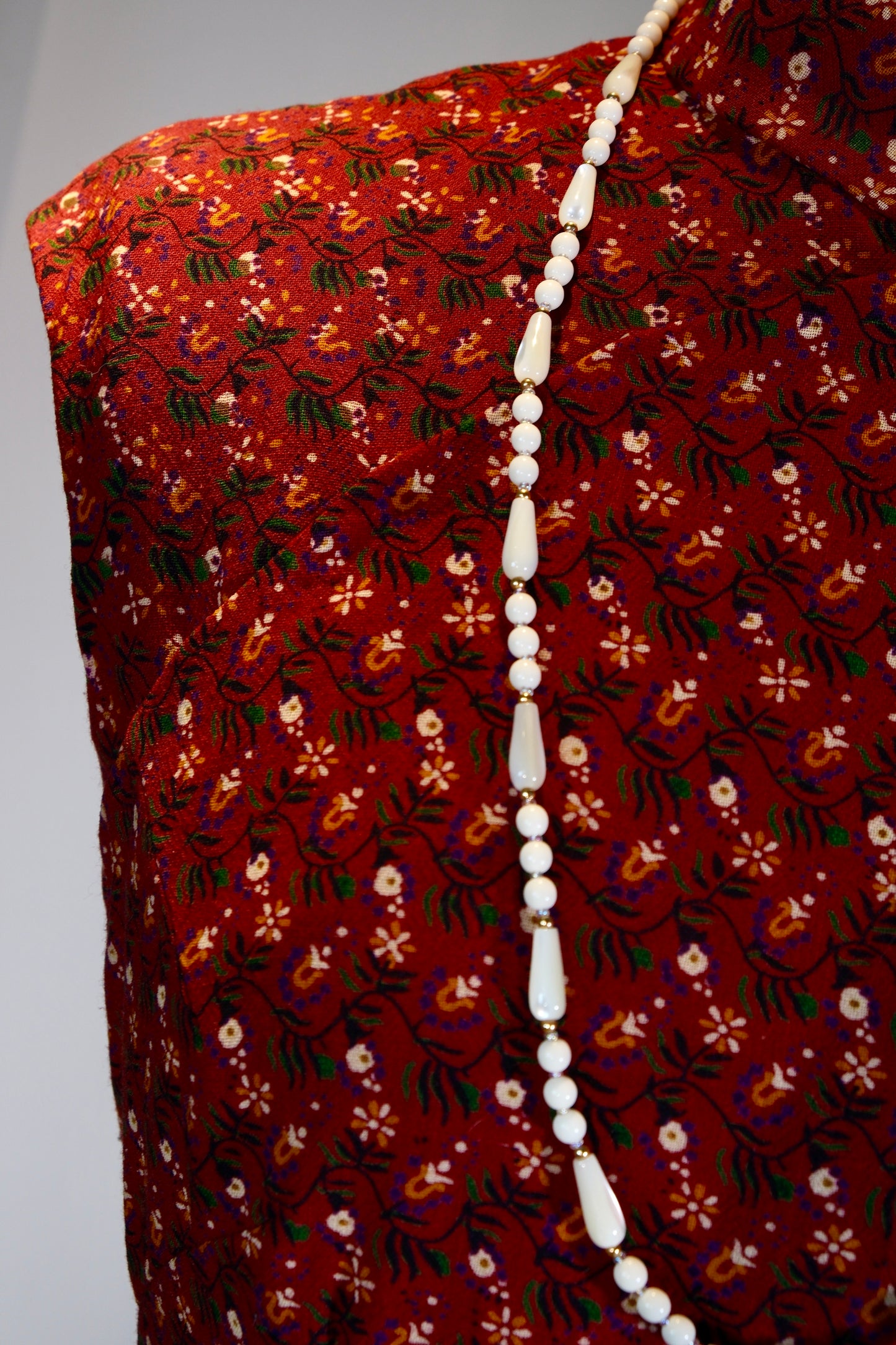
凝视这件旗袍,仿佛跌入了一座微缩的春日花园。其图案设计极具巧思,以深沉醇厚的赭红为底色,如同陈年普洱般温润内敛。在这抹红色之上,细碎的花卉与藤蔓纹样以一种近乎“满铺”的姿态蔓延开来。
这些纹样并非传统工笔画般的写实描摹,而是经过了高度的抽象化与几何化处理。白、黄、绿、紫四色交织,错落有致地分布在织物表面,形成了一种富有节奏感的视觉韵律。这种密集而重复的构图,隐约呼应了六十年代西方盛行的波普艺术对“重复”与“大众化”的视觉探索,却又被巧妙地包裹在中式审美的温婉外壳之下。这是一种独特的“东方摩登”——既有传统纹样的雅致底蕴,又具备了现代设计的构成主义美感,繁而不乱,艳而不俗。
【历史叙事:海岛上的剪裁革命】
从服装社会学的角度审视,这件旗袍是战后台湾社会文化转型的珍贵标本。六十年代的台湾,正处于经济起飞与文化自觉的前夜。彼时的女性,开始走出深闺,步入职场与社交场域,她们的着装需求也随之发生了深刻的变革。
这不仅是一次面料的革命,更是一场关于“身体解放”的宣言。它标志着旗袍从“礼教符号”向“现代时装”的华丽转身,是那个时代新女性追求效率、自由与自信的无声表达。
【文化溯源:规矩之中的方圆】
《礼记·深衣》有云:“古者深衣,盖有制度,以应规、矩、绳、权、衡。”古人制衣,讲究的是法度与秩序。这件旗袍虽已深受西风东渐的影响,但其骨子里依然流淌着中式服饰的血脉。
你看那立领的高度,恰如其分地修饰了颈部线条,保留了东方女性的含蓄之美。它不是对传统的背离,而是在传统框架内进行的创造性转化,是“旧瓶装新酒”的典范之作。
【结语:稀缺的诗意】
这件旗袍的稀缺性,不仅在于其年代久远、保存完好,更在于它所承载的文化意义与艺术价值。它是六十年代台湾时尚工业的缩影,是东西方美学交融的结晶,更是无数无名匠人智慧与心血的凝聚。
穿上它,你不仅是在穿一件衣服,更是在演绎一段历史、一种态度、一份对美的执着。它提醒我们:真正的时尚,从不追逐潮流,而是沉淀时间、承载记忆、表达自我。
Measurements / Size Guide:
Bust / Waist / Hips: 94/84/106 cm
Total Length: 114 cm
Detailed Description:
In the vast river of costume history, some garments function as historical footnotes, while others exist as masterworks of poetic expression. This Taiwan-produced brocade qipao, born during the 1960s, operates precisely as a short stanza of "Eastern Modernism" written with fine filaments and deep coloration. Standing quietly between light and shadow, it transcends its primary purpose as a structural shield against the elements, serving instead as a frozen slice of chronology and a fluid piece of art. It bears physical witness to the awakening of female consciousness and the shifting of aesthetic paradigms during that unique mid-century horizon.
Gazing upon this qipao feels akin to stepping into a miniature spring garden. Its pattern layout demonstrates exceptional ingenuity, using a deep, enriched ochre-red as its foundational ground color—a shade as warm, settled, and reserved as aged Pu-erh tea. Atop this crimson field, micro-calibrated floral sprigs and winding vine matrices spread across the textile chassis in an almost continuous, fully saturated layout.
Rather than presenting a realistic botanical depiction typical of traditional Gongbi fine-brush painting, these motifs undergo a high degree of abstraction and geometric structural conversion. An interlacing of white, yellow, green, and purple filaments is distributed across the textile surface in a well-disciplined balance, creating a highly rhythmic visual cadence. This dense, repeating compositional strategy subtly echoes the visual exploration of repetition and mass production characteristic of the Western Pop Art movement that dominated the 1960s; yet, it remains beautifully wrapped within the gentle, modest shell of traditional Chinese aesthetics. This represents a distinct form of "Eastern Modernism"—carrying the refined cultural background of traditional patterns while commanding the constructivist beauty of modern design theory, remaining complex without clutter and vibrant without a hint of vulgarity.
Evaluated through the lens of fashion sociology, this qipao serves as a rare and precious physical specimen documenting the socio-cultural transformation of post-war Taiwanese society. During the 1960s, Taiwan was positioned on the eve of its economic takeoff and cultural self-awareness. Women of that generation began breaking out from private domestic spheres to enter public professional offices and cosmopolitan social settings, causing their sartorial requirements to undergo a profound, permanent revolution.
This movement operated as far more than a simple upgrade in textile selection; it stood as a silent declaration of bodily liberation. It marked the magnificent transformation of the qipao from a strict symbol of traditional etiquette into a piece of modern haute couture, projecting the unvoiced pursuit of efficiency, independence, and self-confidence championed by the new woman of that era.
The classical text The Book of Rites • Deep Robe (《礼记·深衣》) states: "In ancient times, the deep robe conformed exactly to structural rules, matching the square, the compass, the line, and the balance." The ancients crafted garments with absolute devotion to architectural rules and cosmic order. Although this qipao is deeply influenced by the eastward shift of Western design trends, its internal marrow remains firmly anchored to the genetic lineage of traditional Chinese apparel.
Observe the height of its standing collar, calibrated to perfection to frame and elongate the lines of the neck, preserving the modest restraint inherent to Eastern women. This design selection does not represent a betrayal of ancestral heritage, but a highly creative structural conversion executed within a traditional framework—standing as a textbook example of pouring new life into an ancient vessel.
The absolute rarity of this qipao rests not only upon its chronological age and unblemished state of preservation, but on the profound cultural weight and artistic value it materializes. It stands as a perfect miniature of the 1960s Taiwanese fashion industry, a crystallization of the intense fusion of Eastern and Western design aesthetics, and a physical monument to the shared wisdom and manual labor of anonymous master tailors.
To slip this garment on is to do far more than put on a beautiful piece of clothing; it is to actively interpret a historical chapter, declare a personal posture, and carry an unyielding devotion to beauty. It reminds us that authentic fashion never actively chases fleeting trends, but naturally settles time, encapsulates memory, and expresses the true interior self.
Suyuan Archival Textile Registry — Documenting the material culture, preserving the technical lineage of ancestral craft.