深圳溯源
Couldn't load pickup availability
衣服尺寸:
胸围/腰围/臀围:108/96/112 厘米
衣长: 110 厘米
细节描述:
这件上世纪六十年代由嘉新时装出品的台湾产古董旗袍,是一件融合了时代审美、工艺精神与文化记忆的珍贵服饰遗存。它不仅是一件衣物,更是一段历史的见证,一种风格的凝练,一份稀缺性的具象表达。
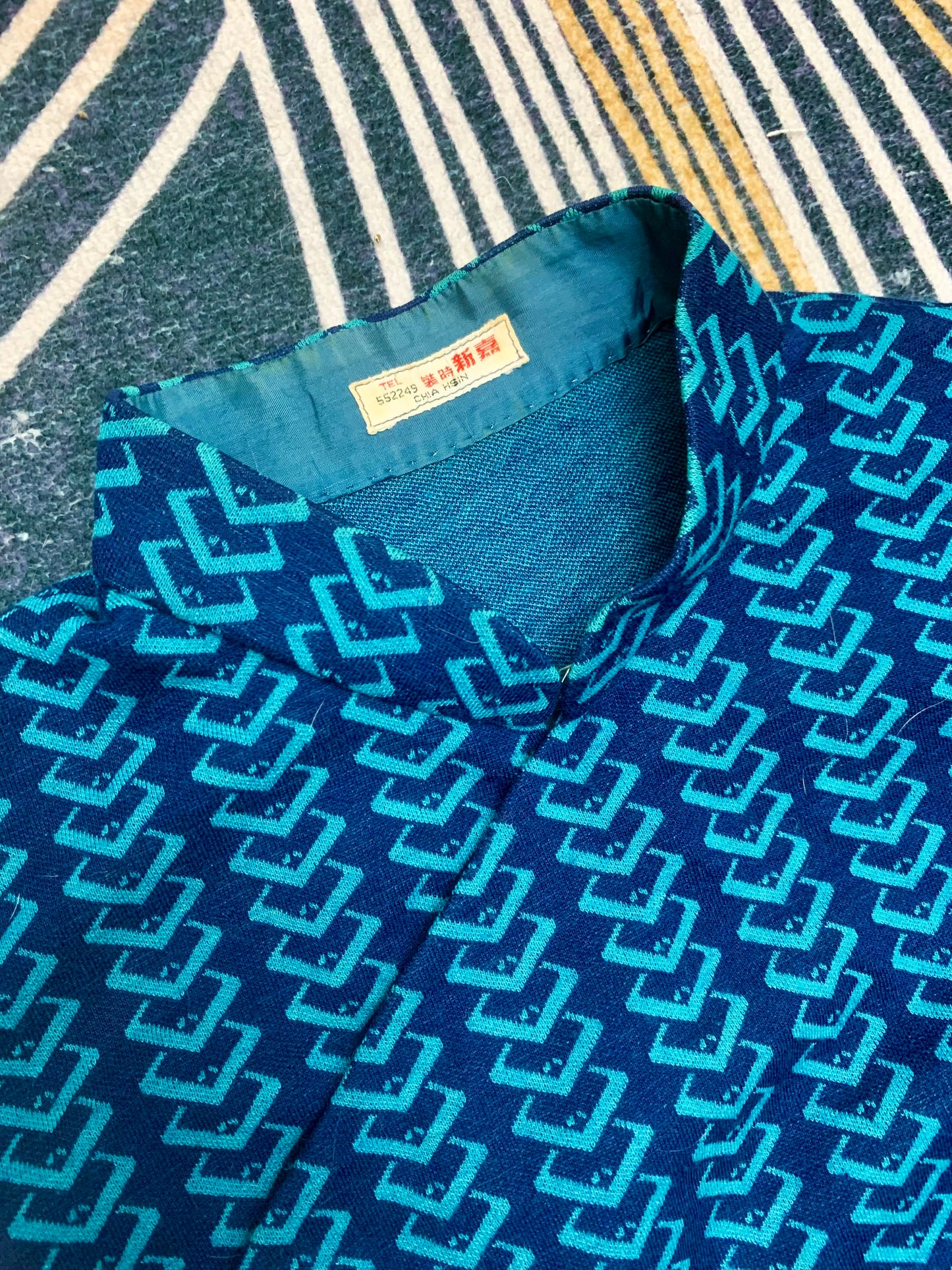
从图案设计来看,这件旗袍采用的是极具现代感的几何纹样——以深蓝为底,浅蓝勾勒出连续不断的“之”字形或“回”字形折线结构,形成一种富有节奏感与韵律美的视觉肌理。这种图案并非传统意义上的花鸟鱼虫或龙凤呈祥,而是深受1960年代国际时尚潮流影响的产物,尤其受到当时欧洲“欧普艺术”(Op Art)与“极简主义”(Minimalism)的启发。其线条规整、重复有序,既保留了东方服饰的含蓄内敛,又注入了西方现代设计的理性与秩序,堪称“中西合璧”的典范之作。在视觉上,它不喧哗却自有力量,不繁复却充满张力,是那个时代女性追求独立、知性与优雅的象征。
这件旗袍的稀缺性,不仅在于其年代久远,更在于其出品方“嘉新时装”在台湾服装史上的特殊地位。嘉新是1950至1970年代台湾高端定制女装的代表品牌之一,专为政要夫人、名媛淑女及文化界人士量身打造服饰,其作品往往采用进口面料、手工缝制、细节考究,且产量极少。如今能完整保存至今、品相如新的嘉新旗袍,实属凤毛麟角。而其采用的针织面料在当时亦属创新之举——不同于传统丝绸或棉麻,针织材质更具弹性与垂坠感,贴合身形却不束缚行动,体现了当时对“舒适与美感并重”的新式女性着装理念的追求。
若引经据典,可追溯至《礼记·深衣》中“古者深衣,盖有制度,以应规矩,绳权衡”,意指传统服饰讲究形制与礼仪;而此件旗袍虽无宽袍大袖,却以精密剪裁与几何纹样延续了“衣以载道”的精神内核。它不是对传统的简单复刻,而是以现代语言重新诠释东方美学,正如张爱玲所言:“衣服是一种言语,随身带着一种袖珍戏剧。”这件旗袍所讲述的,正是1960年代台湾都市女性在现代化浪潮中,如何以衣着构建自我身份、表达审美主张的“袖珍戏剧”。
它不仅是收藏家眼中的珍品,更是研究者眼中不可多得的实物史料——记录了战后台湾社会转型期的审美变迁、女性意识的觉醒,以及本土时装工业在吸收外来文化后所形成的独特风格。其价值,早已超越衣物本身,成为一段可以被触摸、被凝视、被传承的文化记忆。
Measurements / Size Guide:
Bust / Waist / Hips: 108/96/112 cm
Total Length: 110 cm
Detailed Description:
This antique Taiwanese-produced qipao, manufactured by Chia Hsin Fashion during the 1960s of the last century, stands as a precious material relic fusing epochal aesthetics, artisan spirit, and cultural memory. It operates far beyond its utility as a basic garment to serve as a physical witness to history, a distillation of style, and a concrete manifestation of absolute scarcity.
Appraised via its visual pattern layout, this qipao implements a highly modernized geometric motif—utilizing a deep blue grounding background chassis upon which a light blue outlines a continuous zigzag or fretwork line structure, engineering a visual texture saturated with rhythmic cadence and structural symmetry. This pattern choice thoroughly rejects traditional representational motifs like flowers, birds, dragons, or phoenixes, serving instead as a direct product of 1960s international fashion vectors—profoundly inspired by the contemporary European Op Art and Minimalism movements. Its lineworks are perfectly regulated and repeat with absolute order, beautifully retaining the containment and inward nature of Eastern apparel while seamlessly injecting the rationality and discipline of Western modern design, making it a textbook paradigm of East-West synthesis. Visually, it does not clamor yet possesses its own inherent strength; it avoids complexity yet remains packed with aesthetic tension, operating as a definitive badge of that generation of women's pursuit of independence, intellect, and grace.
The absolute scarcity of this qipao is anchored not only by its chronological age, but more profoundly by the unique, prestigious status held by its manufacturer, "Chia Hsin Fashion," within Taiwanese costume history. Chia Hsin operated as one of the definitive premier brands representing high-end bespoke womenswear in Taiwan from the 1950s through the 1970s, tailoring exclusively for the wives of political dignitaries, elite socialites, and prominent cultural figures. Their structural creations relied heavily on imported textile matrices, meticulous hand-stitching, and rigorous attention to detail, resulting in exceptionally limited production volumes. Today, finding a Chia Hsin qipao that balances absolute completeness of form with such an immaculate, mint-like preservation state is exceptionally rare—a true phenomenon.
Furthermore, the implementation of a knit fabric matrix was a highly innovative engineering feat for its era. Distinct from conventional smooth silks or organic cotton-linens, the knit material yields superior elasticity and a substantial, clean drape, contouring flawlessly to the body silhouette without restricting physical mobility. This material choice reflects a dedicated pursuit of a new female dress philosophy that placed equal weight on absolute comfort and aesthetic beauty.
Tracing its lineage through classical canonical texts, the piece subtly echoes the dictates of The Book of Rites · Shenyi: "The ancient deep robe conformed entirely to structural regulations, aligning perfectly with the compass, the square, the plumb-line, and the balance," indicating how traditional apparel revered structural form and ritualistic propriety. While this specific qipao sheds the expansive, wide robes and massive sleeves of antiquity, it extends the foundational spirit of "apparel as a vessel for philosophical truth" (Yi Yi Zai Dao) through its precision three-dimensional pattern drafting and geometric line logic. It rejects simple historical replication, choosing instead to re-interpret Eastern aesthetics through a modernist linguistic framework. This perfectly actualizes the sentiment penned by the celebrated author Eileen Chang: "Clothes are a language; what one carries with them is a pocket drama." What this qipao articulates is precisely the pocket drama of 1960s Taiwanese metropolitan women constructing their self-identity and declaring their aesthetic sovereignty amidst the sweeping tide of modernization.
This piece functions not only as a peerless treasure in the eyes of a serious curator, but as an invaluable primary physical resource for costume researchers. It archives the aesthetic transformations, the awakening of female consciousness, and the unique stylistic identity formulated by Taiwan's domestic fashion industry as it absorbed external global cultures during the post-war societal transition. Its value has long transcended the textile matrix itself to become a segment of cultural memory that can be physically touched, closely observed, and permanently passed down through lineage.