溯源
Couldn't load pickup availability
衣服尺寸:
胸围/腰围/臀围/衣长:90/78/94/108 厘米
细节描述:
一、 图案与工艺:光影下的浮雕诗学
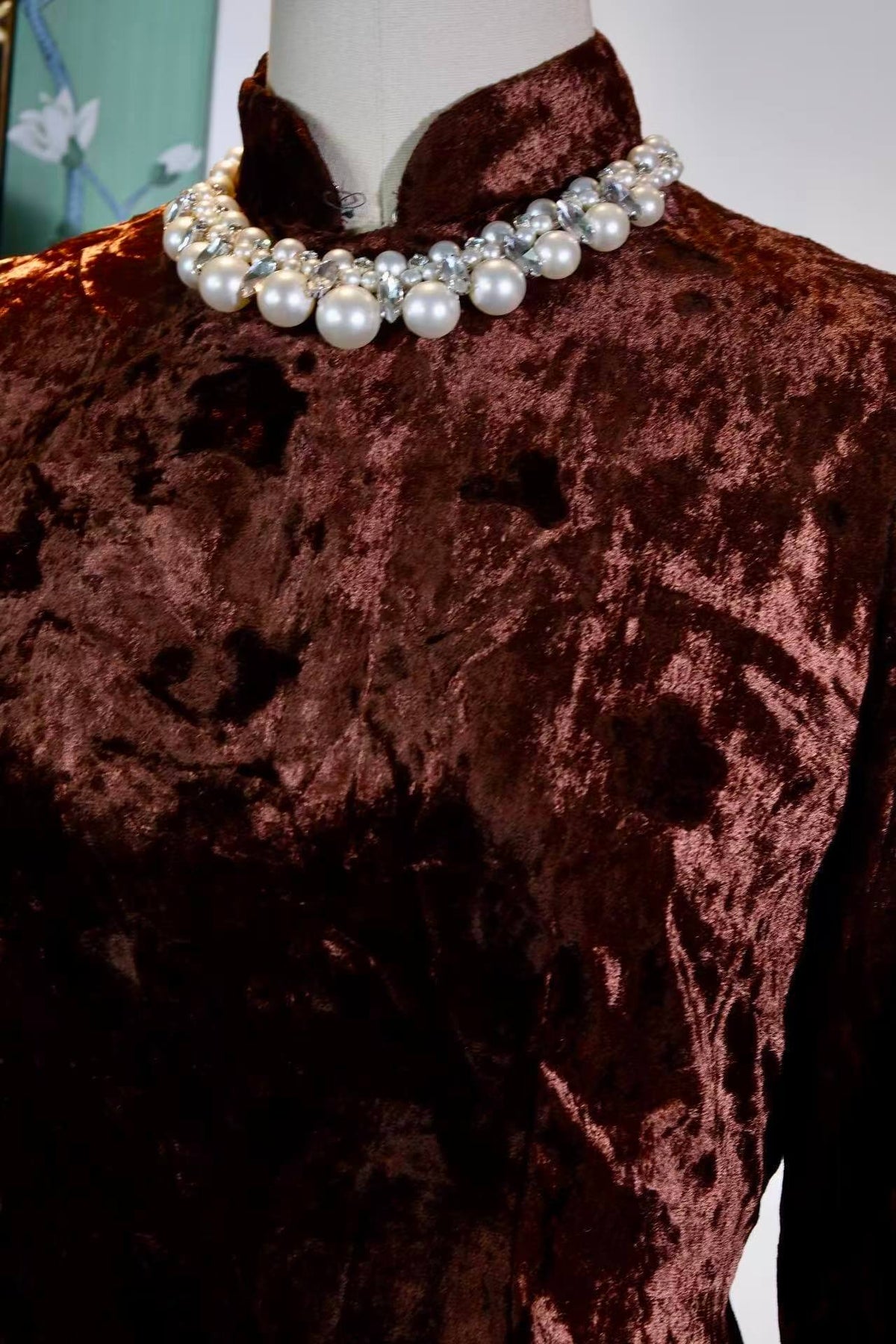
这件旗袍最引人入胜之处,在于其面料本身所构建的视觉语言。它并非传统的平面印染或刺绣,而是采用了上世纪六十年代极为盛行的日本进口压花丝绒。
- 肌理描述:这是一种“做减法”的艺术。工匠利用高温模具在丝绒表面进行物理压制,使原本平整的绒毛倒伏,形成深浅不一的色泽变化。图中的图案呈现出一种抽象的巴洛克式卷草纹样,又似中国传统云雷纹的现代变体。
- 视觉效果:这种压花工艺创造了一种微妙的“浮雕感”。在自然光下,深赭石色的底色上,那些被压平的纹理如同流动的暗金,随着人体的转动而波光粼粼。它不似织锦那般张扬,却比素缎更具内涵,宛如一幅未干的水墨画,墨色在宣纸上自然晕染出的层次感。这种面料在当时被称为“天鹅绒中的贵族”,因其对温度和湿度的敏感,保存至今且光泽如新者,实属凤毛麟角。
二、 剪裁与形制:海派风韵的晚期绝唱
从形制上看,这件作品精准地捕捉了1960年代台湾旗袍的典型特征——那是海派旗袍在台湾落地生根后的成熟形态。
- 立体剪裁:不同于早期旗袍的平面拼接,这件衣服明显引入了西方的立体剪裁法(Darts)。请注意腰部的收省与胸部的隆起处理,它不再掩盖女性的身体曲线,而是像第二层皮肤一样勾勒出S型的曼妙身姿。
- 领口与袖长:经典的元宝领高度适中,既保留了东方的含蓄矜持,又不至于束缚颈部活动;七分袖的设计则显得干练利落,符合六十年代女性逐渐走向职场与社会公共空间的时代背景。
- 色彩美学:这种深沉的焦糖赭石色,是那个年代特有的审美符号。它褪去了三十年代的大红大绿,转而追求一种低调的奢华与稳重,正如张爱玲晚年所言:“生命是一袭华美的袍”,而这件袍子,便是那华美中最沉稳的一抹底色。
三、 历史叙事:海峡彼岸的流金岁月
这不仅仅是一件衣服,它是冷战时期东亚时尚版图的一个切片。
上世纪五六十年代,台湾作为“亚洲四小龙”之一,其纺织业与成衣业迅速崛起。当时的台北荣昌街、西门町一带,汇聚了来自上海的裁缝大师与最新的日本面料。这件旗袍正是那个时代的产物:日本的面料技术、台湾的精湛做工、以及源自中国大陆的传统形制,三者在此完美交融。
我们可以想象,在那个没有快时尚的年代,一位生活在台北的优雅女性,或许是在某次重要的晚宴前,特意挑选了这块昂贵的日本进口丝绒,找老师傅量身定制了这件战袍。她穿着它出席过外交酒会,或是仅仅在某个深秋的午后,独自坐在窗边喝一杯咖啡。丝绒记录了她的体温,也记录了那个时代特有的、在动荡中寻求精致生活的坚韧。
四、 艺术风格与稀缺性:不可复制的孤品
清代李渔在《闲情偶寄》中论及服饰:“贵洁不贵华,贵雅不贵艳。”这件旗袍恰恰印证了这一美学高度。
- 稀缺性分析:丝绒面料极难保存,易磨损、易倒绒、易虫蛀。一件六十年代的丝绒旗袍能历经六十载岁月,依然保持绒毛挺立、色泽饱满,且没有明显的断裂痕,其概率极低。它是真正的“时间胶囊”。
- 艺术价值:它代表了旗袍从“传统服饰”向“现代时装”过渡的最终形态。它既有东方的气韵生动,又有西方的结构严谨。在当今的古董衣市场上,这种品相的压花丝绒旗袍,已不仅仅是衣物,更是博物馆级别的收藏级艺术品。
结语:
当你穿上它,你穿上的不仅是一袭锦衣,更是六十年的光阴流转。那压花的纹理里,藏着旧时光的秘密;那流转的光泽中,映照着东方女性永不褪色的优雅。
Measurements / Size Guide:
Bust / Waist / Hips / Total Length: 90/78/94/108 cm
Detailed Description:
I. Pattern and Craftsmanship: Relief Poetics Under Light and Shadow The most captivating aspect of this cheongsam lies in the visual language built by the fabric itself. It avoids traditional flat printing or embroidery, opting instead for imported Japanese embossed velvet that was extraordinarily popular in the 1960s.
Texture Description: This is an art of "subtraction." Artisans utilized high-temperature molds to physically press the velvet surface, causing the naturally upright pile to lie flat and creating tone variations of differing depths. The motif in the image presents an abstract Baroque scroll pattern, resembling a modern variation of traditional Chinese cloud-and-thunder motifs.
Visual Effect: This embossing craft creates a subtle "sense of relief." Under natural light, set against the deep ochre base tone, those flattened textures resemble flowing dark gold, shimmering like rippling water as the body turns. It lacks the clamor of brocade yet possesses far greater depth than plain satin, akin to an un-dried ink painting where ink bleeding into Xuan paper creates natural, layered depth. This fabric was known as the "aristocrat among velvets" at the time; because of its sensitivity to temperature and humidity, finding a piece that has survived to this day with its luster looking fresh as new is truly a rarity.
II. Tailoring and Silhouette: Late Swan Song of Shanghainese Style From a structural perspective, this piece accurately captures the quintessential features of 1960s Taiwanese cheongsams—the mature form of Shanghai-style cheongsams after taking root in Taiwan.
Three-Dimensional Tailoring: Unlike the flat-pattern seam work of earlier eras, this garment clearly introduces Western three-dimensional tailoring methods (Darts). Notice the waist darts and bust shaping; it no longer hides the female form, but contours a graceful S-curve like a second skin.
Collar and Sleeve Length: The classic ingot collar sits at a moderate height, preserving Eastern subtlety and modesty without constricting neck movement; the three-quarter sleeve design appears crisp and capable, fitting the era's backdrop where women increasingly entered workplaces and public social spaces.
Color Aesthetics: This deep caramel-ochre is a unique aesthetic symbol of that period. It shed the loud reds and greens of the 1930s, pursuing instead an understated luxury and composure—just as Eileen Chang remarked in her later years: "Life is a sumptuous robe," and this robe represents that most grounded, steady base tone within magnificence.
III. Historical Narrative: Golden Years Across the Strait This is far more than a piece of clothing; it is a slice of East Asian fashion history during the Cold War era.
In the 1950s and 1960s, as one of the "Four Asian Tigers," Taiwan experienced a rapid rise in its textile and garment industries. At that time, the Rongchang Street and Ximending areas in Taipei gathered Shanghai's master tailors alongside the newest Japanese fabrics. This cheongsam is a direct product of that era: Japanese fabric technology, Taiwanese master craftsmanship, and traditional silhouettes originating from Mainland China converged in perfect harmony.
We can imagine that in an era without fast fashion, an elegant woman living in Taipei—perhaps before an important evening banquet—specially selected this expensive imported Japanese velvet and commissioned a master tailor to craft this bespoke gown. She wore it to diplomatic receptions, or perhaps simply sat alone by a window sipping coffee on a late autumn afternoon. The velvet recorded her body heat, as well as the unique resilience of an era seeking a refined life amid changing times.
IV. Artistic Style and Rarity: An Irreplaceable One-of-a-Kind Specimen In Random Thoughts and Leisure Scraps (Xian Qing Ou Ji), Qing scholar Li Yu discussed attire: "Exquisiteness values purity over extravagance; elegance values refinement over garishness." This cheongsam perfectly confirms this aesthetic height.
Rarity Analysis: Velvet fabric is notoriously difficult to preserve—prone to wear, flattened pile, and moth damage. The probability of a 1960s velvet cheongsam surviving six decades while retaining upright pile, saturated color, and zero noticeable fractures is extraordinarily low. It is a true "time capsule."
Artistic Value: It represents the final form of the cheongsam's transition from "traditional garment" to "modern haute couture." It possesses both Eastern vitality and Western structural rigor. In today's vintage apparel collection market, an embossed velvet cheongsam in such pristine condition is no longer merely clothing, but a museum-grade collectible piece of art.
Epilogue: When you put it on, you wear far more than a splendid garment; you wear sixty years of flowing time. Hidden within the embossed textures are the secrets of bygone days; reflected within its shimmering luster is the unfading elegance of Eastern women.