溯源
Couldn't load pickup availability
这套60年代的时装裙,恰似一首凝固的散文诗,将法国的浪漫工艺与香港的摩登剪裁,编织进那个时代特有的优雅与克制之中。
一、面料与工艺:经纬之间的东西方对话
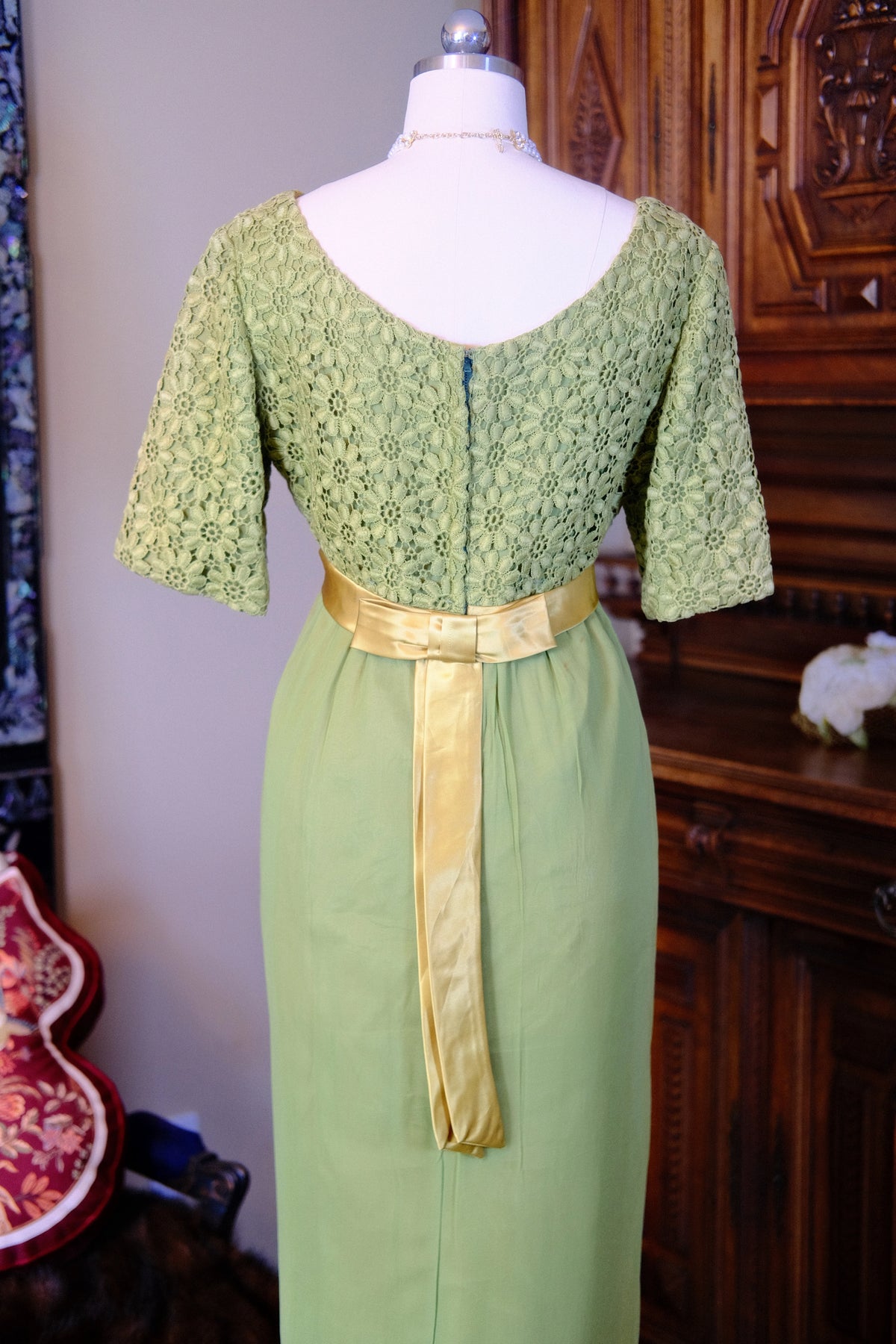
这件礼服最引人注目的,莫过于其上身采用的法国进口蕾丝。在20世纪60年代,法国尚蒂伊或加莱地区的蕾丝工坊仍保持着极高的手工水准。观察细节图可见,这种蕾丝并非廉价的机制网眼,而是采用了经典的花卉钩编工艺,纹样繁复而不凌乱,呈现出一种浮雕般的立体感。这种蕾丝通常质地轻薄透气,却有着极佳的骨架感,能够完美贴合人体曲线而不软塌。
与之拼接的下身裙摆,据考证为香港产时装面料。60年代的香港正处于纺织业腾飞的黄金期,被称为“东方巴黎”。当时的香港制衣业擅长处理人造纤维与混纺面料,这件裙摆的面料垂坠感极佳,表面泛着低调的哑光色泽,极有可能是当时流行的高级醋酸纤维或精细棉麻混纺。这种面料不仅抗皱性好,适应当时女性日益繁忙的社交生活,更在视觉上承接了上身蕾丝的繁复,以“简”衬“繁”,体现了极高的审美素养。
腰间的香槟金缎面腰带则是点睛之笔。它不仅起到了分割上下身比例的实用功能,更在色彩上打破了单一的豆绿色调,增添了一抹富丽堂皇的贵气。这种异材质拼接——粗糙与细腻、哑光与光泽的对比,正是高级定制中常用的手法。
二、版型与剪裁:从“New Look”到“摇摆伦敦”的过渡
从服装史的角度审视,这件裙装的版型处于一个微妙的过渡期。
- 领口设计:它采用了宽大的船型领,这种领型最早由香奈儿夫人推广,能在视觉上拉宽肩部线条,显得颈部修长优雅。这与50年代迪奥“New Look”那种极度收腰、强调胸臀比的紧身胸衣式审美有所不同,它更强调一种舒展、自然的体态美。
- 袖型与裙长:三分袖的设计既端庄又便于活动,袖口微微外扩,修饰手臂线条。裙长过膝,呈直筒微A字状,这是60年代早期典型的“铅笔裙”变体。它没有后来“迷你裙”运动的激进,保留了传统淑女的含蓄,但腰部位置的略微下移和裙身的放松,已经预示了女性身体解放的趋势。
- 背部细节:背部的隐形拉链与腰带的蝴蝶结系带设计,兼顾了穿脱的便利性与装饰性,体现了当时成衣工业化水平提升后,对穿着体验的重视。
三、文学意象与文化隐喻:豆绿深处的旧时光
若要以文学的笔触来描绘这件衣裳,我会引用《诗经》中的“绿兮衣兮,绿衣黄里”。虽然原诗意在悼亡,但这抹豆绿色本身,在中国古典文学中往往象征着初春的生命力与温婉的女子情态。而在西方语境下,这种接近“薄荷绿”或“苹果绿”的色调,是60年代波普艺术兴起前,上流社会下午茶会中最偏爱的颜色之一,代表着清新、生机与不张扬的高贵。
这件衣服像是一位穿越时空的闺秀。她可能身着此裙,出现在1963年香港半岛酒店的舞会上,或是巴黎左岸的某个沙龙里。头上的网纱礼帽与颈间的珍珠项链,是那个时代名媛的标准配置。网纱半遮半掩的神秘感,与蕾丝的通透相呼应,营造出一种“犹抱琵琶半遮面”的东方韵味,却又融合了西式礼服的立体廓形。
总结:
这不仅仅是一件衣服,它是60年代全球化时尚贸易的缩影。法国的浪漫主义灵魂,附体于香港精湛的制造骨肉之上。它见证了那个年代女性在传统优雅与现代自由之间的平衡术。穿着它,仿佛能听到黑胶唱片里缓缓流出的爵士乐,闻到旧时光里淡淡的脂粉香。这是一件值得被博物馆珍藏的艺术品,因为它记录了美是如何在东西方文化的交汇点上,悄然绽放的。
This 1960s fashion dress resembles a piece of frozen prose poetry, weaving the romantic artistry of France together with the modern tailoring of Hong Kong into the unique elegance and restraint of its era.
The most arresting feature of this evening dress is unquestionably the imported French lace adorning the bodice. In the 1960s, lace ateliers in the Chantilly or Calais regions of France still maintained an exceptionally high standard of handcrafting. Examining the detail photos, one sees that this lace is no cheap machine-made netting, but rather a classic floral crochet execution—intricate without being chaotic, presenting a relief-like three-dimensional depth. Lightweight and breathable, this style of lace possesses remarkable structural integrity, clinging smoothly to the contours of the body without collapsing.
The joining skirt, research indicates, is crafted from Hong Kong-produced fashion fabric. In the 1960s, Hong Kong's textile industry was entering its golden age as the "Paris of the East." The local tailoring industry excelled at handling synthetic fibers and blended textiles; the skirt fabric falls with exceptional drape and carries a understated matte sheen, highly indicative of the luxury acetate or fine cotton-linen blends popular at the time. Highly crease-resistant to suit the increasingly active social lives of mid-century women, the fabric visually balances the intricate lace above—using simplicity to accentuate complexity in a display of supreme aesthetic discernment.
The champagne-gold satin belt at the waist serves as the defining accent. Beyond its functional role of defining the body's proportions, it visually breaks the monochromatic bean-green palette, adding a stroke of opulent nobility. This contrast of mixed mediums—rough against smooth, matte against luster—is a hallmark technique of haute couture.
Viewed through the lens of fashion history, the garment's silhouette rests in a subtle transitional phase:
Neckline Design: It features a wide boatneck, a neckline popularized by Coco Chanel that visually broadens the shoulder line while making the neck appear slender and graceful. Departing from the ultra-nipped waists and corseted bust-to-hip emphasis of Dior's 1950s "New Look," it prioritizes an open, natural poise.
Sleeve Construction & Length: The three-quarter sleeve design offers both propriety and freedom of movement, with a subtle flare at the cuff to flatter the arms. The hemline rests just below the knee in a straight, slightly flared A-line—a quintessential early 1960s pencil skirt variation. Lacking the radical nature of the later miniskirt movement, it retains traditional lady-like modesty; however, the slightly dropped waistline and relaxed skirt body already signal the emerging trend of female bodily liberation.
Back Construction: The concealed rear zipper paired with the sashing at the belt balances functional ease with decorative charm, reflecting the period's growing emphasis on wearability following the advancement of ready-to-wear manufacturing.
To describe this garment with a literary pen, one might turn to the Classic of Poetry: "Green is the robe, green robe with a yellow lining." Though the original verse laments a loss, this shade of bean green itself frequently symbolizes the vitality of early spring and the gentle demeanor of women in classical Chinese literature. In a Western context, this hue—akin to mint green or apple green—was a favored tone for high-society afternoon teas prior to the rise of Pop Art in the mid-1960s, representing freshness, vitality, and an unpretentious nobility.
This garment feels like a high-society lady stepping through time. She might have worn this dress to a 1963 ball at the Peninsula Hotel in Hong Kong, or perhaps a salon on Paris's Rive Gauche. A veiled fascinator paired with a strand of pearls around the neck formed the iconic ensemble for debutantes of that era. The mysterious semi-translucence of the veil mirrors the sheer breathability of the lace, creating an Eastern charm of subtle concealment wrapped within the sculpted silhouette of Western evening wear.
This is more than a piece of clothing; it is a microcosm of global fashion trade in the 1960s. The romantic soul of France inhabits the exquisite manufacturing framework of Hong Kong. It stands witness to the balancing act women performed during that era between traditional grace and modern freedom. Wearing it, one can almost hear jazz floating softly from a vinyl record and catch the faint scent of compact powder from days gone by. It is an artwork deserving of a museum collection, quietly recording how beauty quietly bloomed at the intersection of East and West.