深圳溯源
Couldn't load pickup availability
衣服尺寸:
胸围/腰围/臀围:104/98/108 厘米
衣长:108 厘米
细节描述:
【图案描述:经纬之间的诗画意境】
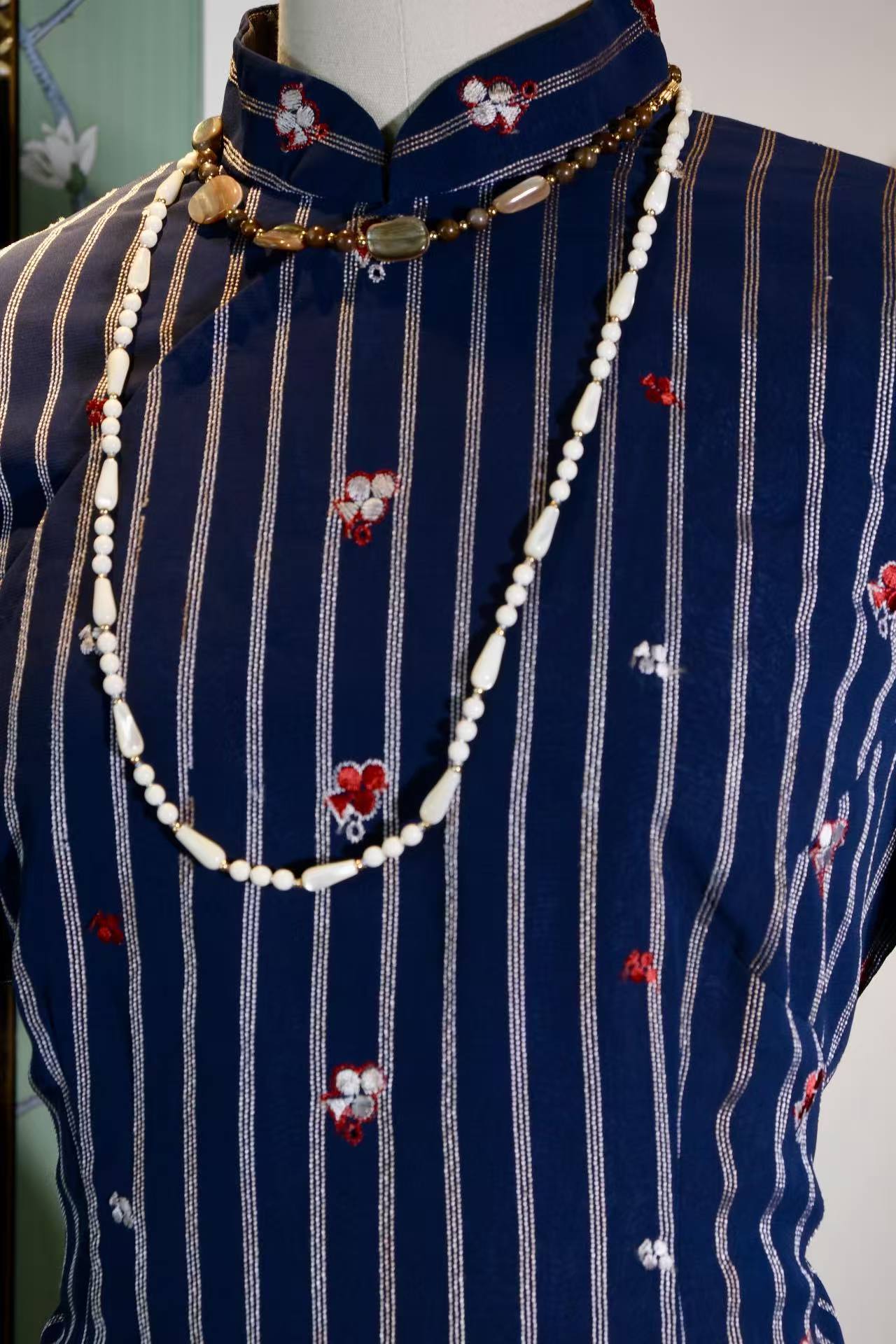
此件旗袍以深邃藏蓝为底,如夜空般沉静,其上交织着银白竖条纹,线条细密而规整,宛如雨丝织就的帘幕,既有几何秩序的理性之美,又暗含“疏影横斜”的古典韵律。最精妙处在于衣身散落的红白小花刺绣——花朵以红色丝线勾勒轮廓,白色填充花瓣,针脚细密如工笔点染,形似梅花或山茶,疏密有致地分布在条纹间隙中,仿佛夜空中零星的灯火,又似雨后枝头未落的花瓣。这种“花间道”纹样(源自日本传统织物术语,指花卉与条纹相间的图案)融合了东方自然意象与现代构成主义,既保留了文人画的留白意境,又以机绣的精准赋予其工业时代的精致感。
【古董衣的故事:跨海而来的工艺史诗】
这件旗袍诞生于20世纪60年代的台湾,彼时正值东亚纺织业技术革新的黄金期。日本进口的高精度绣花机被引入台湾工坊,将传统手工刺绣的效率提升至新高度,却未牺牲艺术性——机器能复刻出比人手更均匀的针距,使每朵小花的形态、色彩过渡都达到近乎完美的对称。这种“机器绣花”并非对传统的背叛,而是战后东亚文化交融的产物:台湾匠人保留中式旗袍的立领、收腰剪裁,又吸纳日本“花间道”的纹样逻辑与机械美学,创造出一种“新中式”雏形。它见证了冷战时期亚洲产业链的流动,也承载了无数女性对“摩登”与“典雅”的双重追求——穿它的人,或许是台北咖啡馆里的文艺青年,或许是南洋归侨的闺秀,她们用这件衣服宣告:传统不必守旧,美可以跨越技术与文化的边界。
【引经据典:从《诗经》到现代性的审美对话】
- 纹样的文化基因:“花间道”之名虽源于日本,但其“花与线”的组合可追溯至中国《诗经·豳风·七月》“春日载阳,有鸣仓庚……女执懿筐,爰求柔桑”中对自然与劳作的诗意描摹。旗袍上的小花,恰似古人“采采芣苢”的灵动,却被机器赋予了永恒的秩序感。
- 色彩的哲学隐喻:藏蓝在传统文化中象征“深邃”与“克制”,《礼记·玉藻》云“衣正色,裳间色”,蓝色作为“正色”之一,本用于庄重场合;而红白小花的点缀,则暗合“间色”之巧思,打破沉闷却不失雅致,正如明代文震亨《长物志》所言“宁古无时,宁朴无巧,宁俭无俗”——这件旗袍以“古”为骨,“巧”为肉,完美平衡了传统与现代。
- 稀缺性的历史注脚:60年代台湾产的机器绣花旗袍存世极少,因当时多数出口订单流向欧美市场,本土留存的多为自用或小众定制。加之机器绣花工艺在70年代后逐渐被电脑刺绣取代,这种“半手工半机械”的过渡期作品,成为研究东亚服装工业化进程的活化石。正如学者巫鸿在《重屏:中国绘画中的媒材与再现》中所言:“物的价值不仅在于其形式,更在于它如何连接过去与现在。”这件旗袍正是如此——它既是60年代女性身体的容器,也是今日我们触摸历史的媒介。
【艺术风格与稀缺性:不可复制的时代标本】
- 风格定位:它属于“新中式”早期探索的代表作,既非纯粹的传统旗袍(无繁复滚边、无大面积刺绣),也非完全西化的连衣裙(保留立领、侧开衩等核心元素),而是以“减法”重构东方美学——用条纹替代云肩,用小花替代牡丹,用机绣替代手绣,却反而更显高级。这种“少即是多”的理念,与同时期日本设计师三宅一生的“一块布”哲学遥相呼应,证明东方美学在现代性转型中自有其独特路径。
- 稀缺性佐证:目前博物馆收藏的60年代台湾旗袍多为素色或简单印花,像这样“花间道+机器绣花+完整保存”的实物极为罕见。其面料经六十年仍保持挺括,刺绣无明显褪色或脱线,说明当年用料之精良、穿着者之珍视。对于研究者而言,它是分析战后东亚纺织技术传播的实物证据;对于收藏家而言,它是“可穿戴的历史”;对于普通人而言,它是一件能让日常穿搭瞬间拥有“故事感”的艺术品。
【结语:穿在身上的文明对话】
这件旗袍不是静止的古董,而是流动的文明——它让日本的纹样、台湾的工艺、中国的剪裁在同一个身体上相遇,让机器的精确与手的温度在每一针一线中和解。当你穿上它,你不仅是在展示一件衣服,更是在参与一场跨越六十年的审美对话:关于传统如何新生,关于技术如何服务于美,关于东方如何在世界舞台上找到自己的声音。正如张爱玲所说:“衣服是一种言语,随身带着一种袖珍戏剧。”而这件“花间道”旗袍,正是一部浓缩的东亚现代史,等待着懂它的人,续写新的篇章。
Measurements / Size Guide:
Bust / Waist / Hips: 104/98/108 cm
Total Length: 108 cm
Detailed Description:
The grounding base textile of this qipao utilizes a deep, intense navy blue, commanding a quietude akin to the midnight sky. Across this landscape, fine and perfectly regulated silver-white vertical stripes interlace, creating a visual effect reminiscent of a dense curtain of rain—a composition that simultaneously embraces the rational beauty of geometric order while subtly retaining the classical cadence of "sloping flower shadows" (Shuying Hengxie).
The absolute masterstroke of the design resides in the miniature red and white blossom embroideries scattered organically across the garment body. Each flower outline is engineered with crimson silk filaments and filled with pure white petals. The stitches are executed with a meticulous density reminiscent of fine-line brushwork (Gongbi). These blossoms, structurally resembling plum or camellia flowers, are distributed across the stripe intervals with a beautifully balanced spacing—evoking sparse lights shimmering in the dark night or solitary petals clinging to branches after a storm.
This specific pattern arrangement, known as the "Path of Blossoms" (Hanamichi, a traditional Japanese textile concept defining alternating patterns of florals and structural stripes), fuses organic Eastern natural imagery with modern constructivist design. It flawlessly preserves the evocative negative-space layout (Liubai) of literati landscape paintings while leveraging the absolute precision of machine embroidery to project the high refinement of the industrial era.
This qipao materialized during the 1960s in Taiwan, a historical window that marked the absolute golden phase of technological transformation within the East Asian textile industry. During this timeline, high-precision embroidery machinery imported from Japan was introduced to Taiwanese ateliers, elevating the production efficiency of traditional embroidery to a new peak without sacrificing an ounce of artistic merit. The machinery successfully replicated a stitch gauge far more uniform than the human hand, ensuring that the silhouette, dimensions, and tonal transitions of every miniature blossom achieved near-flawless structural symmetry.
This implementation of "machine embroidery" operated not as a betrayal of lineage, but as a direct material output of post-war East Asian cultural fusion. Taiwanese artisans rigorously maintained the heritage core of the Chinese qipao—including the standing collar and the sharp waist reduction—while seamlessly integrating the Japanese pattern logic of alternating floral stripes and the aesthetics of mechanical precision, effectively birthing an early prototype of the "New Chinese Style" (Xin Zhongshi).
The garment stands as a physical archive of Asian supply chain dynamics during the Cold War era, while simultaneously carrying a dual pursuit of modernization and classical elegance for contemporary women. The individual occupying this garment may have been an intellectual youth frequenting Taipei’s metropolitan cafés, or a refined daughter of overseas Chinese returning from Southeast Asia. Through this apparel, they declared a powerful cultural stance: tradition need not be synonymous with conservatism, and beauty can effortlessly transcend the boundaries of technology and civilization.
The Cultural Matrix of the Motif: Although the naming of the "Path of Blossoms" layout traces its lineage to Japanese textile nomenclature, the fundamental structural coupling of "florals and linear geometry" directly echoes the poetic depictions of nature and communal labor found in the ancient Chinese canonical text The Classic of Poetry · Odes of Bin · July (Shijing): "The spring days warm up, and the oriole sings... The young women take their deep baskets, and follow the paths to seek the tender mulberry leaves." The miniature blossoms scattered across this qipao mirror the dynamic vitality of the ancient verses, yet they are anchored by machinery into a state of permanent, eternal order.
The Philosophical Metaphor of the Color Palette: Within traditional Eastern color theory, deep navy blue serves as an emblem of profound depth and disciplined restraint. The text The Book of Rites · Yuzao (Liji) states: "The upper garment utilizes the orthodox color (Zhengse), while the lower garment utilizes the intermediate color (Jianse)." Blue, operating as one of the definitive orthodox colors, was historically reserved for solemn and momentous occasions. Conversely, the punctuation of red and white micro-florals implements the clever nuance of intermediate colors, effortlessly breaking the visual monotony of the dark base chassis without fracturing its noble refinement. This perfectly actualizes the dictums penned in the Ming Dynasty treatise Treatise on Superfluous Things (Changwu Zhi) by Wen Zhenheng: "Better antique than contemporary; better plain than ornate; better simple than vulgar." This qipao utilizes antiquity as its skeleton and mechanical refinement as its flesh, striking a flawless equilibrium between heritage and modernization.
The Historical Footnote of Absolute Scarcity: 1960s Taiwanese-produced machine-embroidered qipaos are exceptionally rare within global curation circles today. During that era, the vast majority of high-precision automated factory runs were allocated for export to European and American consumer markets; consequently, specimens retained within domestic boundaries were strictly restricted to personal use or boutique, small-scale custom orders. Furthermore, because this highly specific machine-embroidery technique was completely superseded by digitized computer embroidery after the 1970s, these transitional "semi-manual, semi-mechanical" creations operate as invaluable living fossils for analyzing the industrialization of East Asian apparel. As the scholar Wu Hung masterfully observed in The Double Screen: Medium and Representation in Chinese Painting: "The value of an object rests not only within its material form, but more profoundly in how it establishes a live connection between the past and the present." This qipao functions precisely as such a medium—it operated as the structural container for the female form in the 1960s, and stands today as our physical vector for touching history.
Stylistic Architecture: The garment serves as a definitive representative masterpiece of early explorations into the "New Chinese Style." It completely avoids the trap of being a purely traditional qipao—shedding heavy, multi-layered piping (Piping) and dense, all-over hand embroideries—yet it refuses to morph into a completely Westernized dress, rigorously maintaining core heritage anchors such as the high standing collar and side vents (Cika). It chooses to reconstruct Eastern aesthetics through a methodology of absolute reduction: replacing heavy decorative clouds with clean geometric lines, swapping giant peonies for micro-florals, and utilizing machine precision over manual stitchwork to achieve a significantly more elevated tier of luxury. This philosophy of "less is more" directly resonates across the decades with the iconic "A Piece of Cloth" (A-POC) design philosophy pioneered by Japanese master Issey Miyake, proving that Eastern aesthetics possesses its own highly singular trajectory when navigating its modernization transformation.
Authentication of Scarcity: The overwhelming majority of 1960s Taiwanese qipaos preserved within modern museum collections are characterized by solid colorways or basic surface prints. Encountering a physical specimen that unites the "Path of Blossoms" motif layout with period-correct machine embroidery and an absolute completeness of preservation state is an extreme rarity—a true phenomenon. That the fabric matrix has maintained its crisp structural uprightness over six decades, with zero fading of the embroidery filaments or pulling of the stitches, serves as concrete proof of the absolute premium tier of the original raw materials and the profound care exercised by its historical keepers. For clothing historians, it functions as primary physical evidence for mapping the trans-regional diffusion of post-war textile technology; for curators, it represents "wearable history"; and for the contemporary observer, it stands as a masterpiece of art capable of instantly injecting a profound narrative gravity into any curation environment.
This qipao is far from a static, dead antiquity; it operates as a piece of fluid civilization. Within its boundaries, a Japanese motif layout, Taiwanese industrial engineering, and traditional Chinese pattern drafting intersect and harmonize upon a single silhouette, allowing the cold precision of automated machinery and the warmth of human curation to find absolute reconciliation in every single stitch line.
When you occupy or curate this piece, you are doing far more than displaying a beautiful garment; you are actively participating in a cross-generational aesthetic dialogue spanning more than sixty years—a dialogue centered on how heritage births new life, how technology surrenders to the dictates of beauty, and how the East claims its definitive sovereign voice upon the global stage. It stands as a flawless materialization of Eileen Chang’s immortal observation: "Clothes are a language; what one carries with them is a pocket drama." This "Path of Blossoms" qipao is nothing less than a condensed material history of modern East Asia, waiting for those who truly decode its language to author its next chapter.