深圳溯源
Couldn't load pickup availability
衣服尺寸:
胸围/腰围/臀围:100/90/108 厘米
衣长:117 厘米
细节描述:
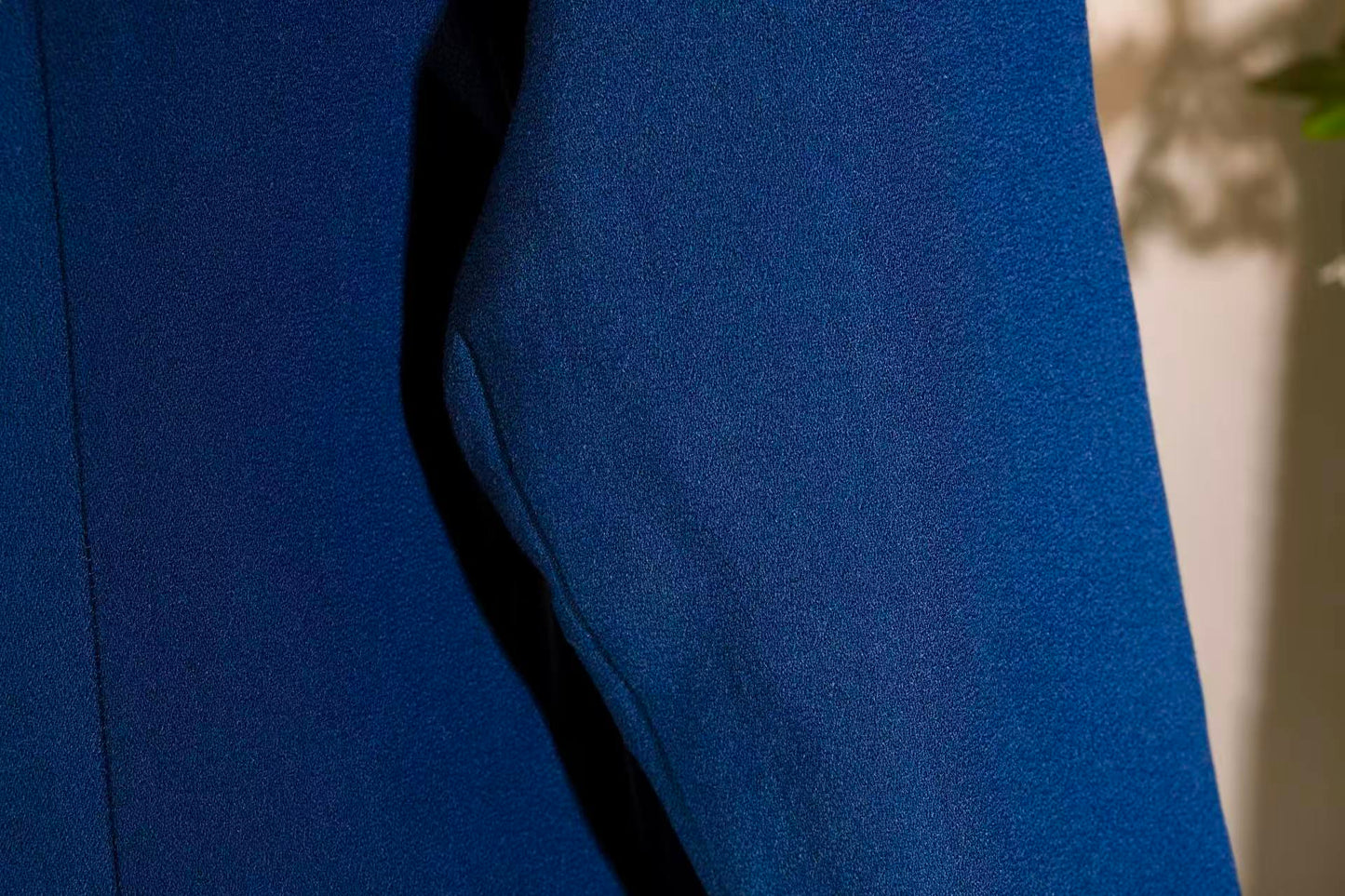
这件上世纪六十年代的香港产古董旗袍,以深邃宝蓝色调为基底,无任何印花或刺绣纹样,纯粹依靠面料肌理与剪裁线条传递东方韵味。其设计融合了中式立领与西式立体收腰结构,七分袖型流畅贴合身形,展现出当时香港裁缝对“中西合璧”美学的极致追求——无需繁复装饰,仅凭精准的省道与归拔工艺,便使面料自然贴合人体曲线,彰显穿着者的气质与身份。
从服装史角度看,这件旗袍是1960年代香港高级定制时装的典型代表。彼时香港作为东西方文化交汇点,本地裁缝大量引进欧洲混纺面料与技术,结合传统中式形制,创造出既符合东方审美又具现代感的“港式旗袍”。这种无纹样、重剪裁的设计,实则是对“少即是多”理念的早期实践,亦呼应了宋代文人“素以为绚”的美学主张——以简驭繁,以质胜饰。正如《礼记·玉藻》所言:“君子无故,玉不去身”,此袍虽无金玉之饰,却以面料之精、剪裁之妙、气韵之雅,自成风骨,堪称“衣中之玉”。
其稀缺性不仅在于年代久远,更在于它见证了香港时装业从“代工”走向“原创”的关键转型期。如今存世的同类作品多已散佚或损毁,能保存至今且品相完好者,实属凤毛麟角。它不仅是衣物,更是流动的历史、可触摸的文化符号,承载着那个时代女性对优雅、独立与现代性的双重向往。
Measurements / Size Guide:
Bust / Waist / Hips: 100/90/108 cm
Total Length: 117 cm
Detailed Description:
This antique Hong Kong-produced qipao, dating to the 1960s of the last century, employs a profound, intense sapphire blue palette as its foundational grounding chassis. Entirely stripped of surface prints or embroidered motifs, it relies exclusively on the raw textile texture and the clean geometry of its silhouette lines to articulate Eastern aesthetic refinement. Its structural architecture fuses the heritage Chinese standing collar with a Western three-dimensional waist-reduction matrix, paired with three-quarter sleeves that flow flawlessly along the arm contours. This masterpiece stands as a prime materialization of the absolute peak of "East-West synthesis" achieved by mid-century Hong Kong master tailors—bypassing complex surface ornamentation to rely solely on high-precision darting and technical Guiba ("shaping through ironing and stretching") craftsmanship to coax the textile into conformity with the organic curves of the human anatomy, beautifully declaring the sovereign grace and societal station of its historical owner.
Appraised through the lens of costume history, this garment serves as a definitive representative paradigm of 1960s Hong Kong haute couture. During this specific timeline, operating as the supreme intersection point of Eastern and Western cultural vectors, Hong Kong’s domestic tailoring guilds aggressively imported premium European blended textile matrices and advanced Western assembly methodologies. By coupling these assets with traditional Chinese garment profiles, they engineered the iconic "Hong Kong-Style Qipao" (Gangshi Qipao)—a silhouette that balanced classical Eastern sensibilities with an ultra-modern aesthetic cadence. This specific "motif-free, tailoring-centric" design approach represents an early physical practice of the minimalist philosophy that "less is more." Concurrently, it deeply echoes the classical literary aesthetic doctrine formulated during the Song Dynasty: "plainness operates as the ultimate canvas for splendor" (Su Yi Wei Xuan)—overruling complexity through absolute reduction, and championing substantive materiality over surface decoration.
Citing classical canonical texts, the treatise The Book of Rites · Yuzao (Liji) states: "A person of noble character never permits the jade to leave their person without a grave and valid reason." While this specific sapphire robe sheds all gold, silver, or jade augmentations, it relies on the elite refinement of its textile fibers, the sheer mastery of its precision pattern cutting, and the profound nobility of its overall aura to establish its own independent, unyielding structural spirit. In doing so, it successfully transforms itself into a piece of "sartorial jade" (Yi Zhong Zhi Yu).
The absolute scarcity of this curated specimen rests not merely within its chronological age, but more profoundly in its role as a primary physical witness to the critical transitional phase where the Hong Kong fashion apparatus mutated from a basic OEM manufacturing hub (Daigong) into an epicenter of sovereign, original design (Yuanchuang). The overwhelming majority of sister creations from this specific era have long since disintegrated, suffered severe structural damage, or been permanently scattered through regional migrations. Encountering a physical specimen today that balances an absolute completeness of form with such an immaculate, mint-like state of preservation is an extreme rarity—a true phenomenon within global collection circles. It transcends its material definition as an article of clothing to operate as fluid history and a touchable cultural semiotic, permanently archiving that generation of metropolitan women's dual aspiration for classical elegance, personal self-reliance, and mid-century modernity.