深圳溯源
Couldn't load pickup availability
衣服尺寸:
胸围/腰围/臀围/衣长:88/72/96/106 厘米
细节描述:
【引言:时光的褶皱】
在服装史的宏大叙事中,实物往往比文字更具说服力。当我们拂去岁月的尘埃,凝视这件上世纪四十年代的深蓝色古董旗袍时,我们看到的不仅是一件衣物,更是一段被织物封存的民国往事。作为一名长期致力于中国近现代服饰史研究的学者,我深知此类保存完好、形制标准的四十年代旗袍,在当下的收藏界与学术界皆属凤毛麟角。它不仅是“海派”文化的物质载体,更是中国传统服饰向现代转型的关键见证。
【图案考释:理性的几何与传统的回响】
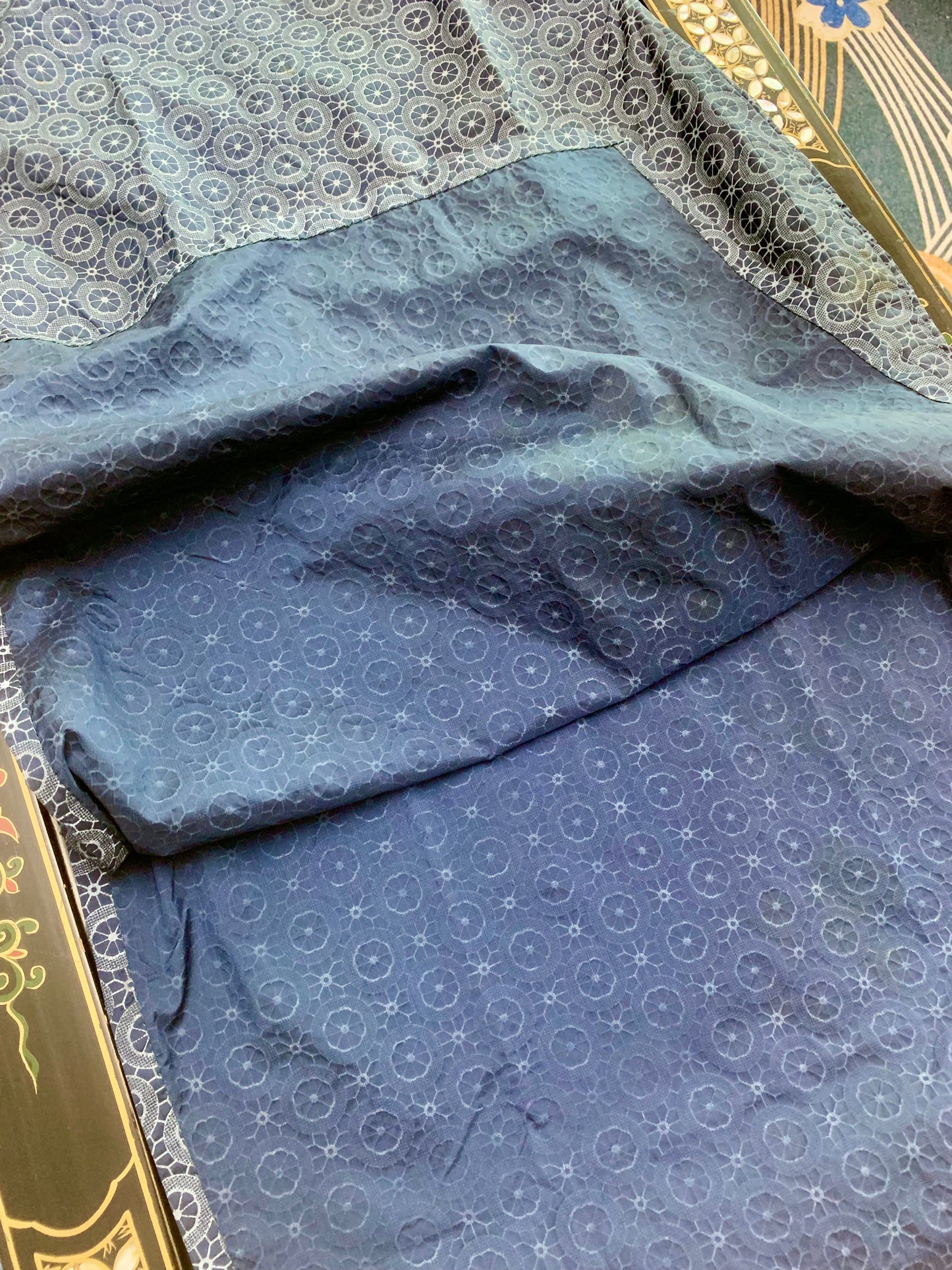
观其面料,最引人入胜者莫过于其独特的纹样设计。这并非传统意义上寓意富贵的牡丹或象征高洁的梅兰竹菊,而是一种极具现代主义色彩的几何团花纹(Geometric Medallion Pattern)。
细察之,该图案由无数个精密排列的圆形骨架构成,圆内嵌套着类似车轮或窗棂的放射状线条,圆与圆之间通过细密的网格相连,形成一种连绵不断、秩序井然的视觉效果。这种纹样在艺术史上可追溯至古代的“方胜纹”或“盘长纹”的变体,但在四十年代的语境下,它明显受到了西方装饰艺术运动(Art Deco)的影响。
这种将传统吉祥寓意抽象化、几何化的处理手法,正是民国时期“中西合璧”审美趣味的极致体现。深蓝色的底色沉稳如夜,白色的线条勾勒出理性的光辉,既保留了东方女性的内敛与深邃,又彰显了那个时代特有的摩登与干练。正如沈从文先生在《中国古代服饰研究》中所暗示的,服饰的演变往往是社会心理变迁的最直观投射,这种克制而精致的几何纹,恰恰映射了战时及战后初期人们渴望秩序与安宁的心理诉求。
【形制与工艺:黄金时代的剪裁】
从形制上看,这件旗袍完美诠释了四十年代旗袍的经典特征——“海派”改良风格的成熟期。
1. 立领与无袖设计: 它的领口依然保持着传统的高立领,象征着对礼教的坚守;但肩部采用了西式剪裁的无袖(或极短袖)设计,露出了女性优美的手臂线条。这种“上保守、下开放”或“局部西化”的设计,是当时上海滩名媛淑女的标配。
2. 省道(Darts)的运用: 请注意观察胸部的收省。不同于清代旗装平直宽松的剪裁,这件旗袍熟练地运用了西式服装的“省道”技术,精准地贴合人体曲线,塑造出凹凸有致的立体廓形。这是中国服装史上一次伟大的“身体解放”,标志着中国女装从平面裁剪向立体裁剪的根本性转变。
【稀缺性与艺术价值:不可复制的孤品】
在学术界,我们常感叹于纺织品的脆弱。丝绸易碎,色泽易褪,能历经八十余载风雨而品相如此完整者,实属罕见。
这件旗袍的稀缺性在于它不仅是一件衣服,更是一个“断代标尺”。它见证了旗袍从宽大走向合体,从繁复走向简洁的历史进程。其面料虽历经岁月,但光泽依旧温润,图案清晰可见,说明当年选用的便是上等织造品。
张爱玲曾在《更衣记》中写道:“各人住在各人的衣服里。”这件旗袍里,住着一位受过良好教育、拥有独立审美、既传统又现代的民国女性灵魂。它不仅仅是一件可供观赏的古董,更是一部穿在身上的历史书。对于收藏家而言,拥有一件四十年代的原版几何纹旗袍,便拥有了通往那个风华绝代年代的钥匙;对于研究者而言,它是验证民国服饰工艺与审美流变的珍贵实物史料。
【结语】
衣香鬓影虽已远去,但这抹深邃的蓝依然静谧地诉说着过往。这件四十年代古董旗袍,以其理性的几何纹样、精湛的立体剪裁和深厚的文化底蕴,确立了其在服装艺术史上不可替代的地位。它是一件艺术品,一段历史,更是一首无声的诗。
Measurements / Size Guide:
Bust / Waist / Hips / Total Length: 88/72/96/106 cm
Detailed Description:
Within the grand narrative of dress history, material objects often speak with far greater eloquence than written texts. When we brush away the dust of decades to gaze upon this deep blue antique qipao from the 1940s, we behold not merely a garment, but a segment of Republican-era history sealed within the weave. As a scholar long dedicated to the study of modern Chinese costume history, I recognize that an authentic 1940s qipao in such pristine condition and standard cut is an absolute rarity in both contemporary collecting and academic circles. It serves not only as a tangible vessel of Haipai (Shanghai-style) culture, but also as a vital witness to the historic transition of traditional Chinese dress into the modern era.
Gazing upon the fabric, the most captivating element is undoubtedly its unique pattern design. This is not the conventional peony symbolizing wealth and status, nor is it the traditional plum, orchid, bamboo, or chrysanthemum representing noble purity. Instead, it presents a highly modernist Geometric Medallion Pattern.
On close inspection, the motif is composed of meticulously arranged circular frameworks. Each circle nests radiating lines resembling carriage wheels or window lattice, connected to adjacent circles via fine netting to produce an endless, highly disciplined visual effect. In art history, this structure can be traced back to variations of the ancient "Fang Sheng" (double-lozenge) or "Pan Chang" (endless knot) motifs. However, in the specific context of the 1940s, it reveals the undeniable influence of the Western Art Deco movement.
This approach—abstracting and geometricizing traditional auspicious motifs—is the ultimate manifestation of the "East meets West" aesthetic taste during the Republican period. The deep blue background is as composed as the night, while the white lines trace a brilliant, rational order. This composition preserves the quiet depth and restraint of the Eastern woman while projecting the independent, sleek modernity unique to the era. As Mr. Shen Congwen suggested in Research on Ancient Chinese Costumes, the evolution of dress is often the most direct projection of shifting societal psychology. This disciplined, exquisite geometric pattern perfectly mirrors the wartime and immediate post-war psychological yearning for order and peace.
Structurally, this qipao beautifully captures the classic hallmarks of 1940s tailoring—the mature phase of the reformed Haipai style.
The High Collar and Sleeveless Design: Its neckline firmly retains the traditional high standing collar, symbolizing a steadfast adherence to cultural decorum. Conversely, the shoulders adopt a completely Westernized sleeveless (or exceptionally short-sleeve) design, revealing the elegant contours of the arms. This design strategy of "conservative above, expressive below" (or localized Westernization) was the standard formula for the elite socialites of old Shanghai.
The Mastery of Darts: Observe the precise execution of the bust darts. Departing entirely from the flat, loose, two-dimensional cut of Qing Dynasty Manchu robes, this qipao masterfully implements Western structural darting. This technique coaxes the fabric into three-dimensional anatomical contours that elegantly hug the female form. This was a magnificent "anatomical liberation" in Chinese dress history, marking the fundamental paradigm shift from flat-pattern drafting to three-dimensional tailoring.
In academic circles, we often lament the fragility of textiles. Silk is easily compromised and dyes naturally fade over time; hence, for a piece to journey through more than eighty years of history while retaining such absolute integrity is an extraordinary anomaly.
The scarcity of this qipao lies in its role as a living "chronological anchor." It documents the historical trajectory of the qipao as it transitioned from voluminous to fitted, and from ornate to minimalist. Though the fabric has weathered the decades, its luster remains beautifully warm and the patterns remarkably crisp, proving that only the finest utility weaving of its era was selected for its creation.
Eileen Chang famously observed in Reflections on Clothing: "Each of us lives within our own clothes." Within this qipao resides the soul of a highly educated, intellectually independent Republican-era woman who seamlessly straddled tradition and modernity. It stands not merely as an antique for observation, but as a wearable history book. For the connoisseur, owning an authentic 1940s geometric qipao is akin to holding a key to a legendary, bygone golden age; for the historian, it is an invaluable, primary physical document validating the evolution of Republican-era textile craftsmanship and aesthetic transitions.
Though the rustle of silks and the shadows of temples have long faded into history, this profound, quiet shade of blue continues to whisper its story in serene magnificence. With its rational geometric motifs, masterfully executed three-dimensional tailoring, and rich cultural resonance, this 1940s antique qipao commands an irreplaceable position in the history of textile art. It stands as a work of fine art, a segment of history, and a silent, timeless poem.