溯源
Couldn't load pickup availability
衣服尺寸:
胸围/腰围/臀围/衣长:98/88/106/106 厘米
细节描述:
【器物描述:针尖上的南洋草木】
观此衣,首先映入眼帘的并非传统旗袍惯见的牡丹、凤凰或云纹,而是一幅极具现代构成感的植物画卷。
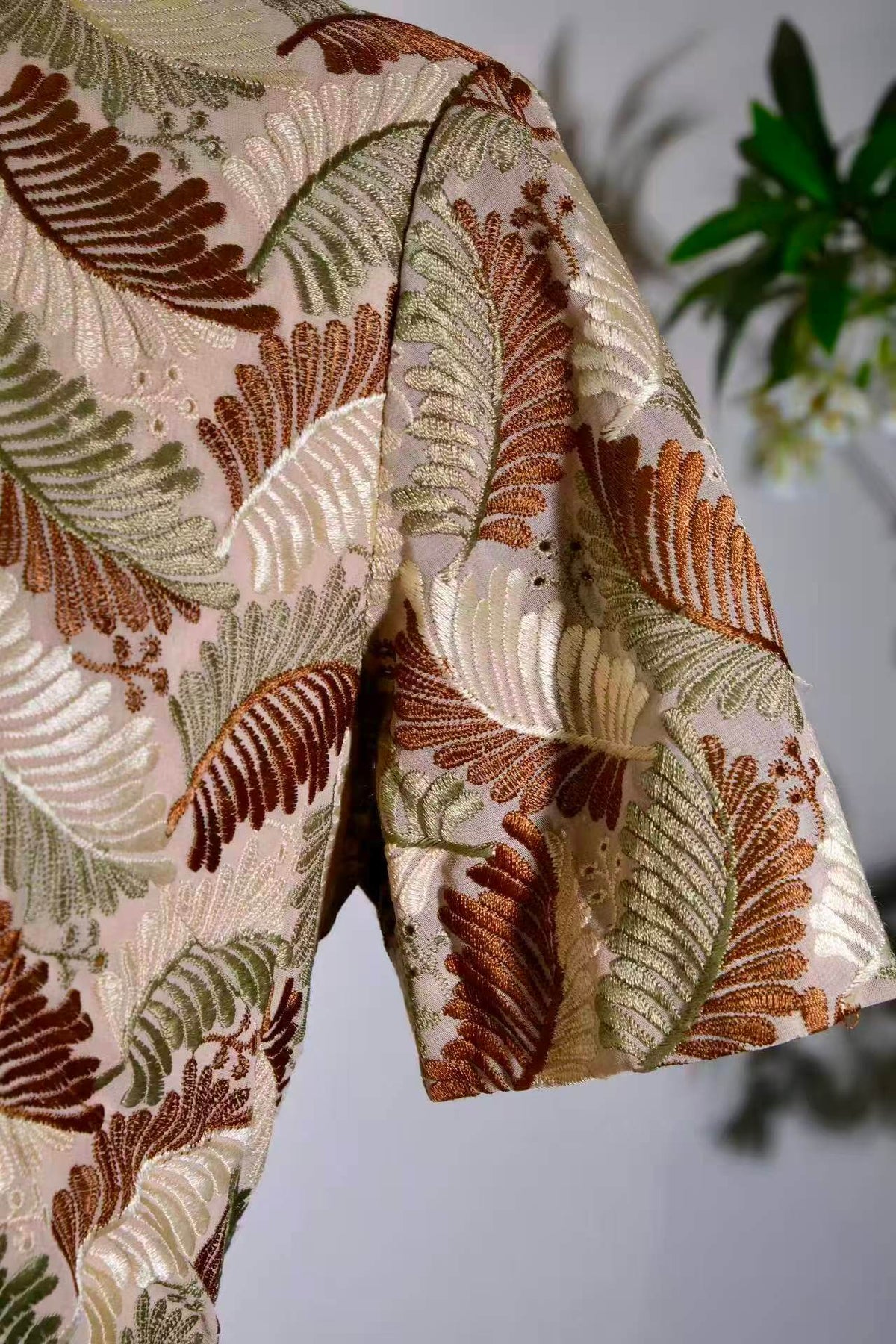
底料选用上世纪中叶颇为珍贵的米杏色透视网纱,其上以法式机绣工艺(French Machine Embroidery)铺陈出满幅的蕨类叶片纹样。这些叶片并非写实描摹,而是经过了高度的艺术抽象化处理:
- 色彩: 采用了赭石、苔绿与奶油白三色交织。这种配色方案极具高级感,既有大地色的沉稳,又有草木初生的清新,宛如雨后森林的配色。
- 形态: 绣片呈现出羽状复叶的形态,线条流畅舒展,如同风吹过的痕迹。叶脉的走向经过精心设计,在视觉上形成了连续的波浪韵律,既修饰了女性的身体曲线,又打破了传统旗袍的沉闷感。
- 工艺: 细看袖口与衣身(如图5),这是一种典型的“蕾丝网地刺绣”。工匠在极薄的网纱上,利用丝线的张力构建出立体的叶脉,针法细密而不失通透,光影流转间,仿佛叶片在肌肤上呼吸。
【历史溯源:香江织造与法兰西风的邂逅】
这件旗袍不仅是一件衣物,更是二十世纪五十年代香港服装工业黄金时代的缩影。
彼时的香港,被誉为“东方巴黎”。张爱玲在《更衣记》中曾写道:“各人住在各人的衣服里。”五十年代的香港旗袍,正处于从传统宽袍大袖向西式立体剪裁转型的关键期。这件作品便是这一时期的典型代表——“港产法式”风格。
1. 面料的跨洋旅行: 题目提及“法国进口机绣蕾丝”,这在当时是极其奢华的配置。五十年代,法国里昂(Lyon)的纺织业独步天下,其生产的机制蕾丝与刺绣网纱,通过贸易航线远销至殖民地香港。这种面料本身就带着欧洲的贵族基因。
2. 剪裁的在地化改良: 请注意其领口与袖型。它保留了中式立领的含蓄,但袖口采用了微喇的荷叶边设计(虽不明显,但袖山处有西式装袖的痕迹),这是为了适应当时香港上流社会频繁的鸡尾酒会与舞会需求。腰身的收省(Darts)极为精准,明显受到了迪奥(Dior)“New Look”风潮的影响,强调女性的胸腰比,却又用东方的含蓄将其包裹。
【文化互文:草木有本心,何求美人折】
若以文学之眼审视此衣,它脱离了“大红大绿”的俗艳,进入了一种清雅的文人境界。
唐代张九龄在《感遇》中吟咏:“兰叶春葳蕤,桂华秋皎洁……草木有本心,何求美人折。”这件旗袍上的蕨叶纹样,恰恰呼应了这种“葳蕤”之态。它不似牡丹般富贵逼人,也不似梅花般孤高冷傲,而是一种充满生命力、野蛮生长却又被精致规训的自然之美。
在五十年代的语境下,穿着这样一件旗袍的女性,往往受过良好的中西教育。她们或许在汇丰银行做文员,或许是某位名流的太太。她们选择这种非传统的植物纹样,本身就是一种审美宣言:拒绝被定义的传统东方主义,追求一种现代的、自然的、属于自我的优雅。
【稀缺性综述:不可复制的时代孤品】
作为研究者,我必须强调此类古董衣的稀缺性:
1. 材质的脆弱性: 五十年代的网纱多为真丝或早期人造丝(Rayon),历经七十载岁月,极易脆化断裂。能保存至今且绣片完整、色泽未褪者,万中无一。
2. 工艺的断代: 这种老式法式机绣需要经验丰富的工匠操作特定的古董机器,随着工业化快时尚的兴起,这种耗时耗力的精细工艺早已失传或成本高昂至无法量产。
3. 历史的见证: 它是冷战时期东西方文化在远东交汇的实物证据。它记录了那个特殊的年代,西方的高级面料如何通过香港这个窗口,被中国工匠的智慧重新解构,最终化作东方女性身上的一抹风情。
这不仅是一件旗袍,这是一段被封存在丝线里的流金岁月。
Measurements / Size Guide:
Bust / Waist / Hips / Total Length: 98/88/106/106 cm
Detailed Description:
[Garment Description: Nanyang Flora on the Tip of a Needle]
Observing this dress, what catches the eye first is not the traditional peonies, phoenixes, or cloud scrolls commonly seen on conventional cheongsams, but a plant landscape filled with a strong sense of modern composition.
The base fabric utilizes a warm cream-apricot sheer mesh mesh, extraordinarily precious in the mid-twentieth century, upon which full-coverage fern leaf motifs are laid out using French Machine Embroidery techniques. These leaves are not realistic depictions, but have undergone a high degree of artistic abstraction:
Coloring: It employs a tri-color weave of ochre, moss green, and cream white. This color scheme carries an innate sense of high sophistication—combining the grounded stability of earth tones with the fresh vitality of new growth, reminiscent of a forest palette after rainfall.
Form: The embroidered patches display pinnate compound leaf forms with fluid, sweeping lines that resemble tracks left by the wind. The direction of the leaf veins was meticulously engineered to form a continuous visual wave rhythm, which contours female curves while breaking away from the heaviness of traditional cheongsams.
Craftsmanship: Looking closely at the cuffs and garment body, this represents classic "lace mesh-ground embroidery." Artisans used thread tension on razor-thin mesh fabric to build three-dimensional leaf veins; the stitching is dense without sacrificing transparency, making the leaves seem almost to breathe against the skin as light and shadow flow.
[Historical Provenance: Encounter of Hong Kong Weaving and French Flair]
This cheongsam is more than an item of attire; it is a microcosm of the golden age of Hong Kong's garment industry in the 1950s.
At that time, Hong Kong was celebrated as the "Paris of the East." Eileen Chang once wrote in A Record of Changing Clothes: "Everyone lives inside their own clothes." Hong Kong cheongsams in the 1950s were in a crucial transition period from traditional wide robes and sweeping sleeves toward Western three-dimensional tailoring. This piece serves as a textbook representative of that era—the "Hong Kong-crafted French" style.
Transoceanic Fabric Journey: The title mentions "French imported machine-embroidered lace," which was an extraordinarily luxurious specification back then. In the 1950s, the textile industry of Lyon, France, stood unmatched worldwide; its machine-made lace and embroidered mesh were exported via trade routes to colonial Hong Kong. The fabric itself carried aristocratic European genes.
Localized Tailoring Innovations: Observe its neckline and sleeve cut. It retains the subtle modesty of a Chinese mandarin collar, while the cuffs adopt slightly flared ruffle borders (though subtle, traces of Western set-in sleeves appear at the sleeve head), designed to meet the demands of frequent cocktail parties and galas among Hong Kong's high society at the time. The waist darts (Darts) are precisely executed, visibly influenced by Christian Dior's "New Look" wave, emphasizing the bust-to-waist ratio while wrapping it in Eastern restraint.
[Cultural Intertextuality: Flora Has an Inner Heart, Why Seek a Beauty's Plucking?]
If examined through a literary lens, this dress steps away from the gaudy vulgarity of "bold reds and bright greens," entering a refined literati realm of pure elegance.
The Tang Dynasty poet Zhang Jiuling sang in Thoughts on Encountering Unexpected Events: "Orchid leaves bloom lushly in spring, cinnamon blossoms shine bright in autumn... Flora possesses an inner heart; why seek a beauty's plucking?" The fern leaf motifs on this cheongsam precisely echo this "luxuriant" spirit. It is not aggressively opulent like the peony, nor cold and aloof like the plum blossom, but represents a natural beauty full of vitality—wildly growing yet exquisitely disciplined.
In the context of the 1950s, a woman wearing such a cheongsam was often well-educated in both Eastern and Western traditions. She might have worked as a clerk at HSBC, or been the wife of a prominent socialite. Her choice of non-traditional botanical patterns was itself an aesthetic manifesto: rejecting defined, traditional Orientalism in pursuit of a modern, natural elegance that belonged uniquely to herself.
[Rarity Overview: An Irreplicable One-of-a-Kind Historical Specimen]
As a researcher, I must emphasize the extreme rarity of such vintage garments:
Fragility of Material: 1950s mesh fabrics were mostly silk or early rayon (Rayon), which turn brittle and break easily after enduring seventy years. Finding one preserved to this day with intact embroidery patches and unfaded colors is one in ten thousand.
Generational Interruption of Craft: This vintage style of French machine embroidery required highly experienced artisans operating specific antique machines. With the rise of industrial fast fashion, this time-consuming and labor-intensive craft has long been lost or rendered too costly for mass production.
Witness to History: It stands as physical evidence of the convergence between Eastern and Western cultures in the Far East during the Cold War era. It records that special epoch—how luxury Western fabrics passed through the window of Hong Kong to be restructured by the wisdom of Chinese artisans, ultimately transforming into a touch of romance on Eastern women.
This is not merely a cheongsam; it is a segment of golden years sealed within silk threads.