溯源
Couldn't load pickup availability
【历史背景:流金岁月,西风东渐】
时光回溯至二十世纪六十年代的香港,那是一个充满矛盾与张力的“流金岁月”。彼时的香江,正处于中西文化剧烈碰撞与交融的漩涡中心。西方的“摇摆伦敦”风潮(Swinging Sixties)远渡重洋,与东方的传统审美在维多利亚港畔相遇。这件旗袍,便诞生于那个摩登与古典并存的辉煌年代,是海派文化在香港的极致回响与升华。
【面料工艺:抽象压花,光影交响】
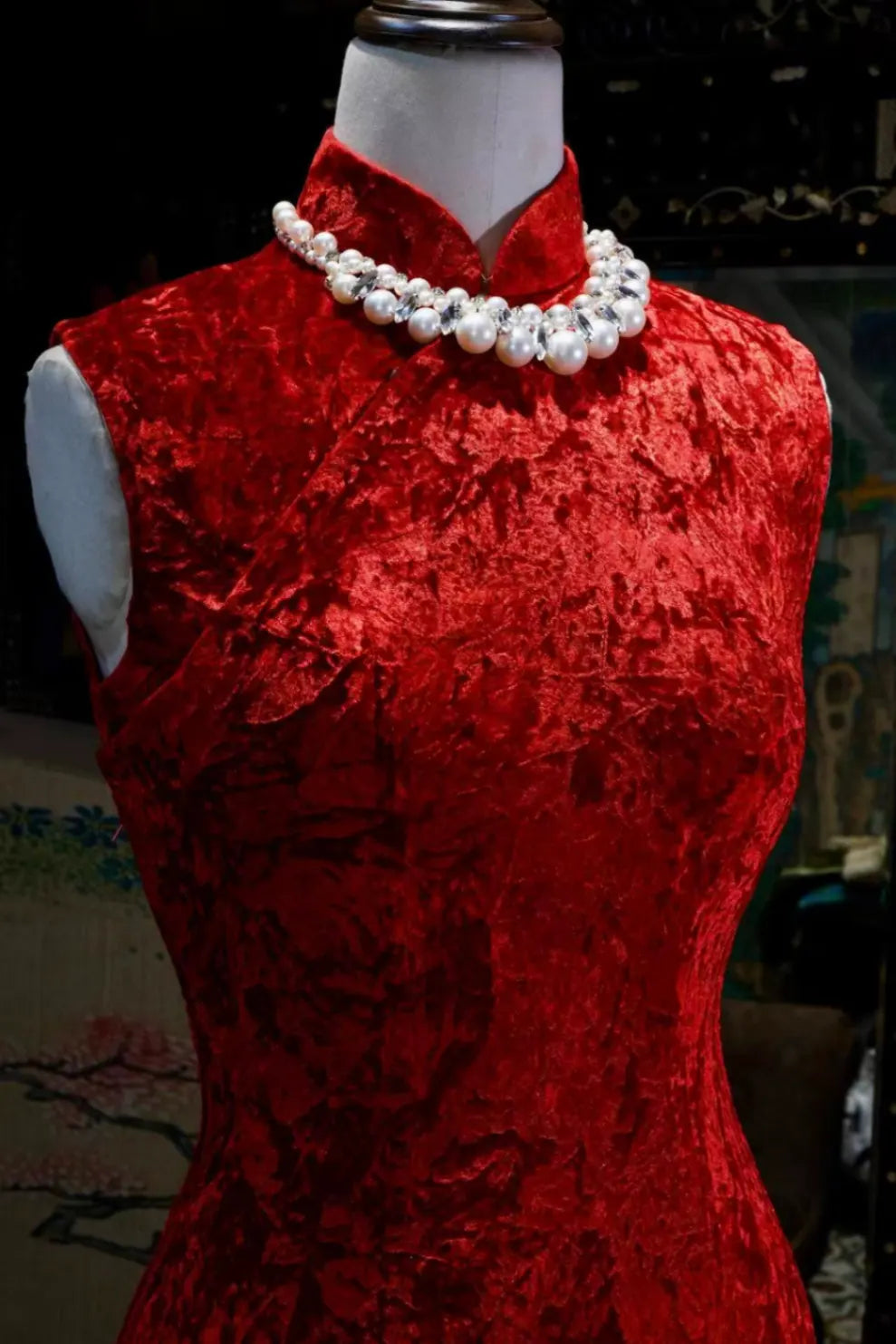
在服装史中,六十年代的旗袍面料迎来了一场“肌理革命”。这件作品最引人入胜之处,在于其采用的抽象压花(Embossing/Debossing)丝绒面料。
不同于传统苏缎的平面平滑,亦不同于织锦缎的具象图案,这种面料工艺借鉴了西方现代主义艺术中的“抽象表现主义”。工匠利用高温模具在厚重的红色丝绒上压印出不规则的、仿佛抽象画般的凹凸纹理。
* 触觉上: 保留了丝绒(Velvet)如“云霞铺锦”般的细腻与温润,抚之如凝脂。
* 视觉上: 压花工艺在布面上形成了微妙的“微地形”。当光线拂过,凹凸之处产生深浅不一的光影折射——高光处如朱砂映日,暗处似深潭凝碧。这种“肌理感”打破了传统红色的单调,赋予了布料如油画般的厚度与立体感。
【版型美学:海派风骨,曲线如歌】
从服装版型来看,这是一件极为标准的六十年代“海派改良旗袍”典范,深受当时香港裁缝“海派精神”的熏陶。
1. 立体剪裁的成熟: 它彻底摆脱了旧式旗袍的“平面十字剪裁”,全面采用西式的“省道(Darts)”工艺。胸省、腰省、臀省的设计极其精准,紧贴身体曲线,将东方女性“S”型的曲线美展现得淋漓尽致。正如张爱玲所言:“旗袍是严谨的,但又有一种极度的放荡。”这种“严谨”在于版型对身体的绝对控制,而“放荡”则在于对性感曲线的极致勾勒。
2. 经典的元宝领与无袖设计: 领口采用了经典的“元宝领”(或称高领),高耸挺立,象征着东方的矜持与高贵;而肩线则采用无袖剪裁(Sleeveless),露出女性圆润的肩臂线条,这种设计在当时极为前卫,是六十年代“夏奇拉”(Jackie Kennedy)式优雅与现代摩登的结合。
【色彩意象:朱红如火,倾城之恋】
“红”在中国传统文化中,是生命、热情与尊贵的图腾。但这件旗袍的红,并非俗艳的“大红”,而是一种带有岁月沉淀感的“复古红”或“酒红”。
在压花纹理的加持下,这抹红仿佛有了生命。它让人联想到李安电影《花样年华》中那欲说还休的暗涌,又或是张爱玲笔下那“一袭华美的袍”。这种红,不似烈火燎原,却似炉中暗火,温暖、神秘,带着六十年代特有的慵懒与颓废之美。
【搭配点睛:温润珠光,岁月留痕】
图中搭配的叠戴式仿珍珠与宝石项链,是六十年代名媛贵妇的标准配饰。珍珠的温润洁白与红色的浓烈张扬形成了绝妙的视觉对冲。这种“红白相映”的搭配,既中和了红色的攻击性,又为整体造型增添了一抹温润的古典诗意。
【结语】
这件六十年代香港产抽象压花丝绒旗袍,不仅是一件遮体御寒的衣物,更是一座微缩的时代博物馆。它记录了那个年代香港作为“东方巴黎”的璀璨,见证了东西方美学在方寸布料上的博弈与共生。
如今,当我们隔着岁月的烟尘凝视它,依然能听到那半个世纪前,留声机里周璇的浅吟低唱,以及高跟鞋敲击在石板路上那清脆的回响。
Era: Circa 1960s
Materials: Crimson abstract embossed velvet (Embossed Velvet)
Silhouette & Construction: 1960s Hong Kong couture Qipao tailoring (3D Tailoring), high structured mandarin collar (Yuanbao Collar), sleeveless cut (Sleeveless), precision waist and bust darting (Darts)
Rolling back the hands of time to the 1960s, we encounter Hong Kong during its "golden age"—a pivotal epoch charged with cultural contradiction and tension. At the epicenter of a swirling convergence between Western trends and Eastern traditions, the "Swinging London" phenomenon crossed the oceans to meet traditional aesthetics along Victoria Harbour. Born into that brilliant era where modernity and classicism coexisted, this Qipao stands as the ultimate Hong Kong articulation and elevation of Shanghainese tailoring culture.
Within fashion history, 1960s Qipao textiles underwent a profound "texture revolution." The most captivating dimension of this piece resides in its abstract embossed (Embossed/Debossed) velvet fabric.
Departing from the smooth planarity of traditional Suzhou satin and the figurative motifs of woven brocade, this textile technique draws inspiration from Western modernist Abstract Expressionism. Artisans utilized high-temperature molds to imprint irregular, abstract bas-relief textures across the heavy crimson velvet:
Tactile Quality: It retains the exquisite softness and warmth of velvet (Velvet), feeling like jade upon the skin.
Visual Impact: The embossing creates a subtle "micro-topography" across the fabric. As light sweeps over the surface, the raised and recessed areas refract varying densities of light and shadow—high-contrast areas reflect like cinnabar in sunlight, while recessed folds absorb light like deep jade pools. This textural depth shatters monochromatic monotony, imparting an oil-painting weight and sculptural dimensionality to the fabric.
Structurally, this garment represents a quintessential specimen of the 1960s modernized Shanghainese-style Qipao, deeply influenced by the master tailors of Hong Kong.
Maturity of Three-Dimensional Tailoring: Dispensing entirely with the flat, two-dimensional "cross-cut" of earlier traditional Qipaos, it fully embraces Western darting (Darts). The bust, waist, and hip darts are executed with absolute precision, contouring the body to perfection and revealing the Eastern female S-curve silhouette. As Eileen Chang famously remarked: "The Qipao is rigorous, yet possesses an extreme sensuality." Its rigor lies in the pattern's absolute control over the form, while its sensuality emerges from the ultimate definition of feminine curves.
Classic Mandarin Collar & Sleeveless Cut: The neckline employs a classic high mandarin collar (Yuanbao Collar), standing erect to symbolize Eastern restraint and nobility. Conversely, the armholes feature a sleeveless cut (Sleeveless) to expose the rounded contours of the shoulders and arms—a forward-looking design in its day that fused Jackie Kennedy-style elegance with modern mid-century sophistication.
In traditional Chinese culture, red symbolizes life, passion, and nobility. Yet the crimson of this Qipao shuns loud ostentation, opting instead for a vintage burgundy or wine-red weathered by time.
Enriched by the embossed texturing, this red comes alive. It evokes the quiet, surging undercurrents of emotional restraint in Wong Kar-wai’s In the Mood for Love, or the magnificent, ruined grandeur of Eileen Chang’s literary world. Far from a roaring flame, this red resembles a smoldering hearth ember—warm, mysterious, and imbued with the languid, decadent beauty unique to the 1960s.
The layered faux-pearl and gem necklace paired with the gown reflects the standard styling of 1960s high-society women. The serene, cool white of the pearls creates a stunning visual counterpoint against the intense crimson velvet. This harmonious contrast tempers the assertiveness of the red while injecting a layer of poetic classical poise into the ensemble.
This 1960s Hong Kong abstract embossed velvet Qipao transcends its role as simple apparel to become a micro-museum of period history. It chronicles the brilliance of Hong Kong as the "Paris of the East," bearing witness to the symbiosis of Eastern and Western aesthetics within a square yard of silk.
Gazing upon it through the mist of decades, one can almost hear Zhou Xuan’s low, sweet humming drifting from a vintage gramophone, punctuated by the crisp click of high heels echoing down stone-paved streets.