深圳溯源
Couldn't load pickup availability
衣服尺寸:
胸围/腰围/臀围:82/64/92 厘米
衣长:106 厘米
细节描述:
【器物之美:立体浮雕下的东方肌理】
这件诞生于上世纪五十年代的古董旗袍,是“海派”与“港风”交汇时期的绝唱。不同于寻常丝绸的平面光泽,它采用了一种极为罕见且工艺繁复的立体浮雕提花(Embossed Jacquard)面料。
图案解析:
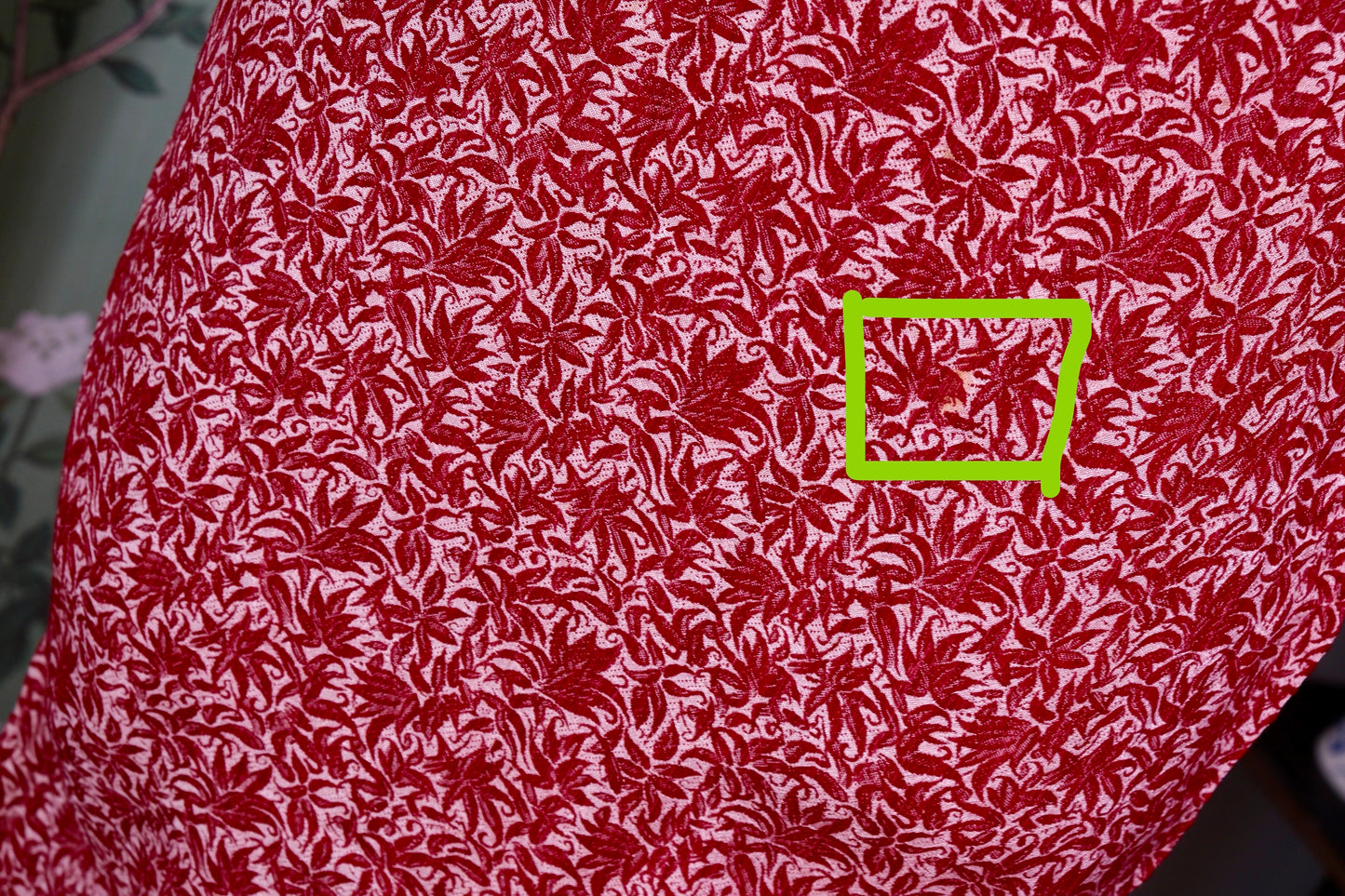
细观衣身,满铺的纹样并非简单的印染,而是通过高难度的织造工艺,将缠枝莲与卷草纹进行了抽象化的艺术重构。红色的丝线在白色的底胚上隆起,形成如同浅浮雕般的触感。这种纹样在传统语境中象征着“生生不息、连绵不断”,但在五十年代的香港,它被赋予了摩登的几何感。叶片舒展,藤蔓交织,既有宋锦的雅致,又有Art Deco(装饰艺术)风格的秩序感。光影流转间,红白二色不再是静止的色彩,而是随着穿着者的呼吸起伏,宛如流动的朱砂痣。
【历史回响:香江岸边的黄金时代】
若要读懂这件衣裳,便需回到那个风云际会的五十年代。彼时的香港,作为东西方文化的熔炉,正处于旗袍演变的巅峰期。
张爱玲曾言:“对于不会说话的人,衣服是一种语言。”在那个年代,香港的裁缝店(Tailor Shop)林立,名媛闺秀们不再满足于传统的平针刺绣,转而追求更具建筑感和雕塑感的奢华面料。这件旗袍正是那个时代的缩影——它保留了传统的高领与归拔工艺(通过高温熨烫使平面布料产生立体弧度),完美贴合女性曲线;同时,其选用的重工提花面料,在当时多用于出口欧美的高级定制或本地望族的晚宴装束。
它不仅是一件衣服,更是一段被封存的时光。它见证了维多利亚港的霓虹初上,聆听过老式留声机里的周璇金曲,也或许曾在某场重要的社交舞会中,惊艳了时光。
【稀缺性考据:不可复制的工艺孤品】
从服装史学的角度审视,此类立体提花面料在存世的古董衣中属于极稀缺品类。
1. 工艺的断代: 这种具有强烈凹凸质感的提花织机,随着六十年代后成衣工业化和化纤面料的普及,逐渐退出了历史舞台。现代机器虽能模仿花纹,却难以复刻那种经过岁月沉淀后,丝线依然紧实、浮雕感依然犀利的“骨相”。
2. 保存的奇迹: 众所周知,红色染料在古代及近代极易氧化褪色,但这件旗袍历经七十余载,色泽依旧如新酿的女儿红般醇厚艳丽,且面料未见脆化,足见当年用料之考究与保存之精心。
3. 版型的标本价值: 其袖口微翘、腰身极度收敛的剪裁,是典型的五十年代“港工”特征,区别于同时期上海旗袍的温婉,多了一份南洋与西洋混合的利落与挺拔。
【结语】
这不仅仅是一袭红裙,它是穿在身上的博物馆藏品。在这个快时尚泛滥的年代,拥有一件五十年代的立体浮雕提花旗袍,便是拥有了一段触手可及的、关于优雅与匠心的永恒记忆。
注释:微瑕特价
Measurements / Size Guide:
Bust / Waist / Hips: 82/64/92 cm
Total Length: 106 cm
Detailed Description:
Born in the 1950s, this antique qipao stands as a brilliant swansong from the historical period where the traditional Shanghai style (海派) and the early Hong Kong style (港风) converged. Departing entirely from the flat, uniform luster characteristic of common silks, it utilizes an exceptionally rare and technically complex embossed jacquard (Embossed Jacquard) fabric chassis.
Close inspection of the garment body reveals that the fully saturated layout is entirely achieved through high-difficulty textile engineering rather than simple surface printing or dyeing. It executes an abstracted artistic reconstruction of the ancestral interlocking lotus and scrolling foliage motifs. The vibrant red silk filaments rise prominently over the white ground matrix, establishing a distinct, tactile three-dimensional depth akin to architectural low relief. While this specific pattern lexicon symbolizes "endless generation and unbroken lineage" within a traditional context, in 1950s Hong Kong, it was cleverly re-engineered with a modern geometric sensibility. The leaves expand and the vines interlace, balancing the poetic refinement of traditional Song dynasty brocades with the structural order of the global Art Deco design movement. Under shifting ambient light, the red and white fields cease to operate as static colors; they move dynamically with the breathing and rhythm of the wearer, appearing as a fluid cinnabar mark across the textile canvas.
To fully interpret this garment, one must step back into the transformative, high-friction decade of the 1950s. During this window, Hong Kong operated as a premier spatiotemporal crucible where Eastern traditions and Western influences met, pushing the structural evolution of the qipao to its absolute historical peak.
As Eileen Chang famously remarked in her essay Chronicle of Changing Clothes: "To those who cannot speak, clothes are a language." During that generation, custom tailor shops (Tailor Shop) blossomed across the colony's urban centers. Elite madams and daughters of affluent merchant families were no longer content with conventional flat satin embroidery, pivoting instead toward luxury textiles that commanded an architectural and sculptural volume. This qipao stands as a pristine miniature of that socio-industrial transition—faithfully preserving the strict traditional standing collar and the master tailoring art of Gui-Ba hot-iron blocking (sculpting a flat textile matrix directly into permanent three-dimensional curves to contour flawlessly around the natural geography of the female form). Concurrently, the heavy-gauge embossed fabric selected for this piece was primarily reserved during its day for high-end custom apparel destined for Western export or exclusive evening galas hosted by prominent local clans.
It transcends its primary classification as a functional garment, acting as a beautifully sealed capsule of time. It bore physical witness to the early emergence of the neon cityscape over Victoria Harbour, listened to the low, melodious hum of Zhou Xuan's voice drifting from vintage gramophones, and perhaps permanently captured the glamour of an elite mid-century ballroom encounter.
Evaluated through the lens of textile conservation and design history, authentic embossed jacquard specimens command ultimate curatorial value and represent an exceptionally rare category among surviving mid-century apparel archives:
The Structural Fragmentation of Craft: The specialized mechanical looms engineered to generate this profound, high-contrast structural relief completely exited commercial production lines following the post-war explosion of automated mass-manufacturing and cheap petrochemical synthetic fibers in the 1960s. Modern textile machinery can mimic the superficial visual pattern, but it remains entirely incapable of replicating the internal skeletal framework ("骨相") of this vintage weave—where the silk filaments remain tightly locked under immense mechanical tension to preserve a sharp, razor-thin sculptural relief despite the passage of generations.
The Miracle of Preservation: It is a well-established principle in textile conservation that historical red dyes are exceptionally vulnerable to atmospheric oxidation and dramatic fading over time. Yet, spanning more than seventy years of a natural timeline, the coloration of this qipao remains as rich, deep, and醇厚 as freshly cellared vintage wine, with the structural mesh base completely free from fiber embrittlement—a magnificent testament to the elite caliber of the original raw materials and an immaculate history of archival stewardship.
The Archive Value of the Fit: The architectural silhouette—marked by a subtle, outward flare at the micro-sleeve cuff paired with an exceptionally tight, disciplined waist reduction—serves as a textbook specimen of the iconic 1950s "Hong Kong bespoke" (“港工”) tailoring methodology. Distanced from the soft, approachable fluidity of concurrent mainland Shanghainese styles, it projects a dry, capable, and distinctly upright cosmopolitan poise born from a unique blend of Western and maritime Southern culture.
This is far more than a functional red dress; it stands proudly as a wearable museum masterpiece. In a contemporary global landscape saturated and flattened by fast fashion, possessing an authentic 1950s embossed jacquard qipao means holding onto a piece of tangible, eternal history—a monument to an unyielding commitment to craftsmanship, elegance, and absolute poise.
Suyuan Archival Textile Registry — Documenting the material culture, preserving the technical lineage of ancestral craft.
Note: As-Is Special Price