溯源
Couldn't load pickup availability
衣服尺寸:
胸围/腰围/臀围/衣长:90/82/96/106 厘米
细节描述:
【引言:衣冠里的时代注脚】
张爱玲曾言:“对于不会说话的人,衣服是一种语言,随身带着的是袖珍戏剧。”若要为上世纪五十年代的香港寻一种注脚,这件淡紫色几何提花旗袍,便是那出最优雅、最克制的独角戏。它不仅仅是一件衣裳,更是那个特殊时代下,东西方审美在香江畔激烈碰撞后留下的温柔结晶。作为服装史的研究者,抚触这件古董,仿佛能听到那个年代缝纫机哒哒作响的余音,那是属于“海派”遗风与“港式”实用主义交织的绝唱。
【纹样解码:秩序与光影的几何诗学】
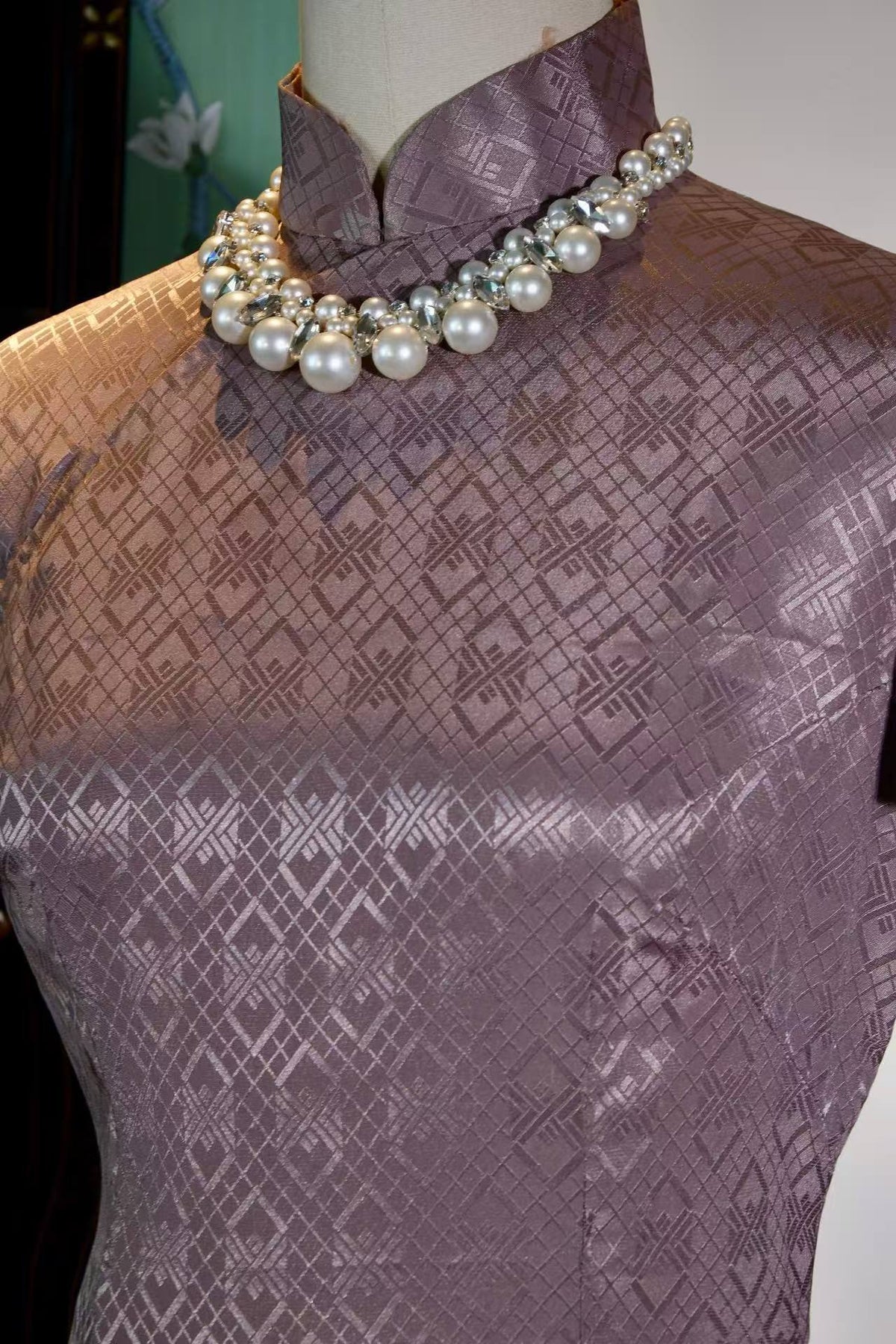
细观此衣,最引人入胜者莫过于其面料上的提花工艺。不同于传统旗袍偏爱的牡丹、凤凰等具象吉祥纹样,这件旗袍大胆选用了抽象几何纹样。
这种图案在纺织学中被称为“经纬交织的理性浪漫”。你看那面料之上,菱形与十字线条相互穿插、嵌套,构成了严谨而富有韵律的连续纹样。这并非简单的现代几何,而是脱胎于中国传统“万字不到头”或“盘长”纹样的变体,却经过了Art Deco(装饰艺术风格)的洗礼。
* 视觉语言:线条刚柔并济,既有直线的利落,又有织物光泽带来的流动感。
* 色彩美学:通体呈现一种低饱和度的藕荷色(淡紫)。在中国传统色谱中,紫气东来,但这抹紫不妖艳、不沉重,反而透着一种知性与沉静。光线流转间,提花的凹凸质感让颜色产生了微妙的深浅变化,宛如烟雨江南中那一抹朦胧的晨雾。
【剪裁与形制:五十年代港派旗袍的黄金法则】
从服装史的角度审视,这件旗袍是典型的1950年代香港改良式样。
* 省道与立体感:不同于清末民初平裁的宽松,五十年代的旗袍深受西式立体剪裁影响。请注意看胸省与腰省的运用,刀法精准,将女性的身体曲线勾勒得淋漓尽致,却又不过分暴露。这是一种“含蓄的性感”,符合当时香港名媛既想展示女性美,又需保持端庄的社会心理。
* 领与袖的克制:立领高度适中,既修饰颈部线条,又不至于拘束;短袖设计利落干练,适应了香港亚热带的气候以及当时女性日益活跃的社会生活节奏。
【典故与意境:此时无声胜有声】
《诗经·郑风》有云:“有美一人,清扬婉兮。”这件旗袍所传达的,正是这种“清扬婉兮”的气质。它让人联想到李安电影《花样年华》中苏丽珍的身影——虽然电影背景稍晚,但那种通过衣物包裹身体的仪式感是一脉相承的。
古人云:“锦衣夜行”,但这件锦衣若穿在身上,便是在行走间书写诗篇。它没有大红大绿的喧嚣,却有着“淡极始知花更艳”的高级感。这种几何纹样,在当时也象征着一种现代化的憧憬——在那个动荡后的重建时期,人们渴望秩序、渴望理性,而这种整齐划一又变化无穷的几何图案,恰恰抚慰了人们内心对安稳生活的向往。
【稀缺性综述:不可复制的时光孤品】
为何说它是稀缺的艺术品?
1. 面料的绝版:五十年代的提花织锦缎,多由老式织机手工或半手工织造,其丝线的捻度、染色的植物媒介,皆非今日工业化印染可比拟。随着时间推移,这种带有天然光泽且不易褪色的老料已近乎绝迹。
2. 保存的难度:丝绸娇贵,历经七十余载岁月,能保持如此完整的品相,无破损、无明显污渍,光泽依旧温润,实属凤毛麟角。
3. 历史的见证:它是“港产”旗袍的代表作。那个时代的香港裁缝,很多是来自上海的老师傅,他们将精湛的苏绣、滚边技艺带到了香港,并结合本地审美进行了改良。这件衣服,就是那段“南迁文化”最直接的实物证据。
【结语】
这不仅是一件旗袍,这是一段被封存的时光。它静静地立在那里,用那淡紫色的几何光影,诉说着一个关于优雅、关于变迁、关于东方美学如何在现代世界中寻找立足之地的故事。拥有它,便是拥有了一段触手可及的流金岁月。
Measurements / Size Guide:
Bust / Waist / Hips / Total Length: 90/82/96/106 cm
Detailed Description:
[Introduction: Footnote of an Era in Attire]
Eileen Chang once remarked: "To those who cannot speak, clothes are a language, carrying with them a pocket-sized drama wherever they go." If one were to seek a footnote for 1960s-preceding 1950s Hong Kong, this light-purple geometric jacquard cheongsam would be the most elegant and restrained monodrama. It is not merely a garment, but a gentle crystallization left behind after Eastern and Western aesthetics collided intensely along Victoria Harbour in that unique era. As a researcher of costume history, touching this vintage piece feels like hearing the lingering echoes of clicking sewing machines from that period—a swan song interweaving the legacy of "Shanghai style" with "Hong Kong-style" pragmatism.
[Pattern Decoding: Geometric Poetics of Order and Light]
Upon close inspection, the most captivating aspect of this dress is the jacquard craftsmanship of its fabric. Departing from concrete auspicious motifs like peonies or phoenixes favored by traditional cheongsams, this piece boldly adopts abstract geometric patterns.
This type of motif is known in textile science as the "rational romance of warp and weft." Look upon the fabric: diamonds and cross lines intersect and nest within one another, forming a rigorous and rhythmic continuous pattern. This is no simple modern geometry, but a variation born out of traditional Chinese "Wan-character unending" (Wan Zi Bu Dao Tou) or "Endless Knot" (Pan Chang) motifs, transformed through the baptism of Art Deco.
Visual Language: The lines blend strength with softness, possessing both the crispness of straight lines and the sense of flow brought by the fabric's luster.
Color Aesthetics: The entire garment presents a low-saturation lotus-root pale purple (Ou He). In traditional Chinese color palettes, purple symbolizes noble augury ("purple air coming from the east"), yet this shade is neither gaudy nor heavy, exuding an intellectual and serene composure instead. As light flows across it, the raised and recessed texture of the jacquard produces subtle variations in shade, reminiscent of a misty morning fog in rainy Jiangnan.
[Tailoring and Silhouette: Golden Rules of 1950s Hong Kong Cheongsams]
Examined through the lens of costume history, this cheongsam is a quintessential modified 1950s Hong Kong style.
Darts and Three-Dimensionality: Unlike the loose, flat-pattern cuts of the late Qing and early Republican eras, 1950s cheongsams were deeply influenced by Western three-dimensional tailoring. Notice the placement of bust and waist darts—executed with precise skill, outlining a woman's body contours exquisitely without being overly revealing. This embodies a "restrained sexiness," fitting the social psychology of Hong Kong socialites who wished to display feminine beauty while maintaining propriety.
Restraint in Collar and Sleeves: The standing mandarin collar sits at a moderate height, flattering the neckline without feeling constricting; the clean, short-sleeve design adapted well to Hong Kong's subtropical climate and the active pace of women's social lives at the time.
[Allusions and Artistic Conception: Silence Speaks Louder Than Words]
The Book of Songs (Classic of Poetry) states: "There is a beautiful lady, clear-eyed and graceful." What this cheongsam conveys is precisely this "clear-eyed and graceful" disposition. It calls to mind the figure of Su Li-zhen in Wong Kar-wai's film In the Mood for Love—though the film's backdrop is set slightly later, the ritualistic sense of wrapping the body in fine clothing stems from the exact same heritage.
The ancients said "wearing brocade at night," yet wearing this brocade is like writing poetry through movement. It lacks the clamor of loud reds and greens, possessing instead an elevated aesthetic where "only in extreme subtle lightness does one realize the flower is all the more radiant." In those days, geometric patterns also symbolized a yearning for modernization—during the post-war period of reconstruction, people longed for order and rationality, and these neat yet infinitely varied geometric patterns comforted the inner longing for a stable life.
[Rarity Overview: An Irreplaceable One-of-a-Kind Specimen]
Why is this considered a rare piece of art?
Obsolete Fabric: 1950s jacquard brocade satins were mostly woven by hand or semi-mechanically on old-style looms. The twist of their silk threads and the plant-based dye mediums were incomparable to modern industrial printing and dyeing. Over time, vintage fabrics carrying natural luster and fade resistance have virtually disappeared.
Difficulty of Preservation: Real silk is delicate. After surviving over seventy years, maintaining such pristine condition—without damage, obvious stains, or loss of warm luster—is a true rarity.
Historical Witness: It stands as a representative masterpiece of "Hong Kong-made" cheongsams. Many Hong Kong tailors of that era were master craftsmen who migrated from Shanghai, bringing exquisite Suzhou embroidery and piping techniques to Hong Kong and modifying them according to local aesthetics. This garment serves as direct physical proof of that "southward-migrating culture."
[Epilogue]
This is not merely a cheongsam; it is a slice of preserved time. It stands quietly, using light-purple geometric interplay to tell a story about elegance, transformation, and how Eastern aesthetics found their footing in the modern world. To possess it is to own a tangible, touchable piece of golden history.