深圳溯源
Couldn't load pickup availability
衣服尺寸:
胸围/腰围/臀围/衣长:96/80/104/102 厘米
细节描述:
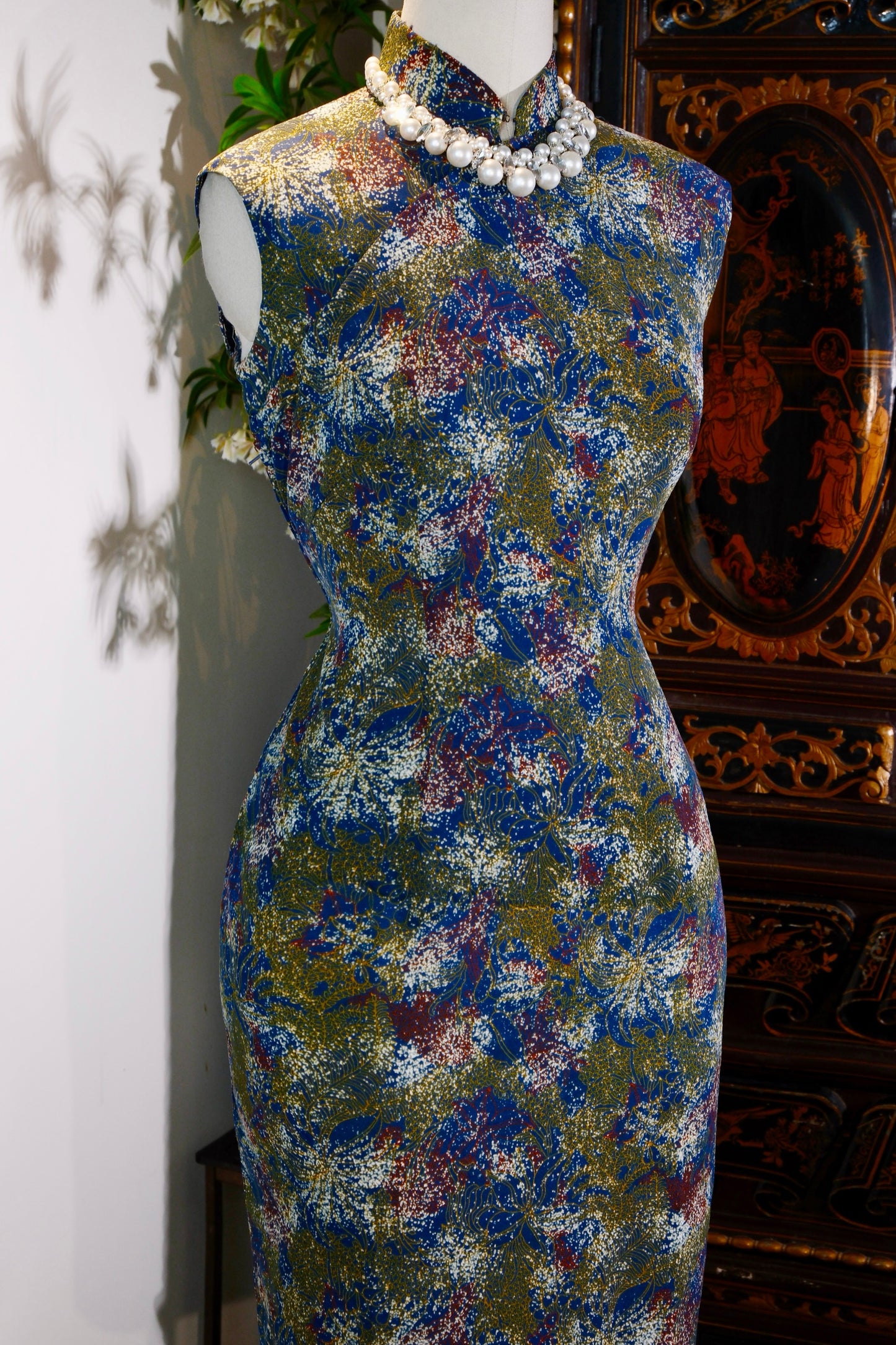
【图案赏析:穿在身上的莫奈花园】
这件旗袍的视觉核心,在于其极具前瞻性的面料纹样。它彻底摒弃了传统旗袍中常见的具象牡丹或龙凤图腾,转而采用了一种“抽象表现主义”与“印象派光影”相结合的印花工艺。
* 色彩交响: 面料底色呈现出深邃的孔雀蓝与苔藓绿的交织,仿佛雨后初霁的幽深园林。在此基础上,大块的赭石红、亮白与金铜色以点彩法(Pointillism)的形式铺陈开来。这种色彩的堆叠并非杂乱无章,而是模拟了油画笔触的厚重感与流动感。
* 肌理质感: 仔细观察,白色的斑点如同洒落的月光或飞溅的水花,打破了深色底料的沉闷,营造出一种波光粼粼的视觉错觉。这种设计在当时极为罕见,它不追求写实的花卉形态,而是捕捉花朵在风中摇曳、光影斑驳瞬间的“神韵”。正如宗白华先生在《美学散步》中所言:“艺术的境界,既使心灵和宇宙净化,又使心灵和宇宙深化。”这件旗袍的图案,正是将自然的混沌之美,浓缩于方寸织物之间。
【形制考证:西风东渐下的黄金剪裁】
从服装史的角度审视,这件作品是典型的1960年代“海派”余韵与“港式”改良的结晶。
* 立体剪裁的巅峰: 不同于早期旗袍的平面裁剪,这件衣服展现了极高水准的西式立体剪裁(Draping)。请注意其肩部的处理,采用了略带垫肩效果的圆润线条,这是50年代末至60年代初受好莱坞电影服饰影响的典型特征,旨在塑造女性挺拔、自信的姿态。
* 极致的收腰与S型曲线: 腰线的提取极高且收紧,臀部的弧度通过归拔工艺处理得圆润自然,下摆微微收敛。这种剪裁对穿着者的身材要求极高,但也最大程度地展现了东方女性含蓄而张扬的曲线美。它不再仅仅是传统的遮蔽之物,而是成为了展示女性身体意识的载体。
【历史叙事:香江岁月的流金回响】
这件旗袍诞生于上世纪六十年代的香港,那是一个东西方文化剧烈碰撞、交融的黄金时代。
彼时的香港,既是传统的守望者,也是现代的弄潮儿。张爱玲曾写道:“对于不会说话的人,衣服是一种语言,随身带着的是袖珍戏剧。”这件旗袍,就是那个时代最生动的独白。它可能曾属于一位出入于中环写字楼或出席晚宴的职业女性,她受过良好教育,眼界开阔,既不盲从西方的全盘西化,也不固守传统的陈旧规制。
在那个成衣工业尚未完全流水线化的年代,这样一件采用复杂提花或高难度印染面料、并由经验丰富的老裁缝手工缝制的旗袍,造价不菲。它是身份的象征,更是审美的宣言。随着时间的推移,当年的繁华落尽,这件衣物便成了历史的标本,封存了那个时代的体温与呼吸。
【艺术价值与稀缺性:不可复制的孤品】
在古董衣收藏界,我们常说“十年看款,百年看料”。
* 面料的绝唱: 这种具有强烈油画质感的混纺提花面料,在现代纺织工业中已难觅踪迹。现代数码印花虽然精准,却往往缺乏这种老面料特有的“拙味”与厚度感。这种面料随着年代的久远,纤维内部会产生一种独特的温润光泽(Patina),是新衣无法模仿的岁月包浆。
* 风格的断代: 60年代的抽象风格旗袍处于一个微妙的过渡期。它比40年代的繁复更简约,又比70年代的嬉皮更优雅。它是现代主义艺术介入服装设计的早期案例。
结语:
这不仅是一件衣裳,更是一幅流动的油画,一段可穿戴的历史。它静静地立在那里,用那一抹斑斓的色彩,诉说着半个世纪前香江岸边,关于美、关于独立、关于时光的不朽故事。拥有它,便是拥有了一段回不去的锦瑟华年。
Measurements / Size Guide:
Bust / Waist / Hips / Total Length: 96/80/104/102 cm
Detailed Description:
The visual core of this qipao lies in its highly forward-looking fabric motif. It completely departs from the representational peonies or dragon and phoenix totems commonly found in traditional qipaos, opting instead for a printing process that combines "Abstract Expressionism" with "Impressionist light and shadow."
Color Symphony: The background of the fabric presents an interweaving of deep peacock blue and moss green, reminiscent of a secluded garden just after a rain. Atop this canvas, large patches of ochre red, bright white, and golden bronze are laid out in a style evocative of Pointillism. This layering of color is by no means chaotic; rather, it simulates the heavy, textured brushstrokes and fluid motion of an oil painting.
Texture and Depth: On closer inspection, the white specks scatter across the surface like captured moonlight or splashing water, breaking up the weight of the dark base fabric to create a shimmering optical illusion. This design was exceptionally rare for its era. It does not chase realistic floral shapes; instead, it captures the spiritual resonance (shenyun) of blossoms swaying in the wind amidst dappled light and shadow. As the aesthetician Mr. Zong Baihua wrote in Stroll in Aesthetics: "The realm of art purifies both the soul and the universe, while simultaneously deepening them both." The pattern of this qipao condenses the chaotic beauty of nature into the space of a single textile.
Viewed through the lens of dress history, this piece is a classic crystallization of the late "Shanghai-style" (Haipai) heritage and "Hong Kong-style" reform of the 1960s.
The Pinnacle of Three-Dimensional Tailoring: Completely different from the flat-pattern drafting of earlier eras, this garment showcases an exceptionally high standard of Western three-dimensional tailoring (立体剪裁). Note the treatment of the shoulders, which implement rounded lines with a subtle padded structure. This is a classic styling cue of the late 1950s and early 1960s, heavily influenced by Hollywood film costumes, designed to project an upright, confident posture.
Extreme Waist Cinching and the S-Curve: The waistline is placed exceptionally high and cinched tightly, while the contour of the hips is shaped smoothly and naturally through traditional iron-shaping (guiba) techniques. The hem tapers slightly inward. This specific cut demands an immaculate fit from the wearer, yet it maximizes the understated yet striking curves of the female form. It is no longer a traditional shield to cover the body, but a physical medium for expressing female physical consciousness.
This qipao was born in 1960s Hong Kong—a golden era characterized by the intense collision and flawless integration of Eastern and Western cultures.
During this time, Hong Kong stood both as a guardian of tradition and a pioneer of modernity. Eileen Chang once wrote: "For those who cannot speak, clothes are a language, a pocket theater carried upon the body." This qipao is the most vivid monologue of that era. It may have belonged to a professional woman navigating the offices of Central or attending formal evening banquets—a woman who was highly educated, broad-minded, and who neither blindly followed complete Westernization nor rigidly adhered to outdated traditions.
In an era before ready-to-wear clothing was completely standardized by automated assembly lines, a qipao fashioned from such complex jacquard or difficult printed fabric, hand-stitched by an experienced master tailor, was highly costly. It was a symbol of status and a manifesto of personal taste. As the clamor of that era faded over time, the garment remained as a physical specimen, sealing the warmth and breath of its day.
In the antique clothing collecting community, it is often said: "Look to the cut for a ten-year piece; look to the fabric for a hundred-year piece."
The Swan Song of Textiles: This blended jacquard fabric, carrying a powerful oil-painting texture, has virtually vanished from the modern textile industry. While modern digital printing is mathematically precise, it frequently lacks the unique organic character (zhuowei) and structural weight found in these vintage weaves. As these heritage fibers age over decades, they develop a quiet, warm luster (patina) within the weave—a natural aging process that no new fabric can replicate.
A Chronological Benchmark of Style: This 1960s abstract-style qipao occupies a highly delicate transitional period. It is sleeker and more minimalist than the complexity of the 1940s, yet far more elegant and structured than the hippie styles of the 1970s. It stands as an early, brilliant case of modernist fine art intervening in fashion design.
This is far more than a garment; it is a flowing oil painting and a piece of wearable history. It stands quietly in its place, using its brilliant array of colors to narrate a half-century-old story from the shores of Victoria Harbour—a tale of beauty, independence, and the passage of time. To steward this piece is to preserve a tangible segment of a bygone, golden youth.