溯源
Couldn't load pickup availability
衣服尺寸:
胸围/腰围/臀围/衣长:94/84/100/105 厘米
细节描述:
【引言:时光的琥珀】
张爱玲曾言:“衣服是一种言语,随身带着一种袖珍戏剧。”当我们凝视这件诞生于上世纪六十年代的旗袍时,仿佛听到了一场跨越半个多世纪的无声独白。这不仅是一件衣裳,更是一枚凝固了时光的琥珀,封存了那个摩登与传统激烈碰撞、优雅与革新并存的黄金年代。
【图案解析:秩序中的几何美学】
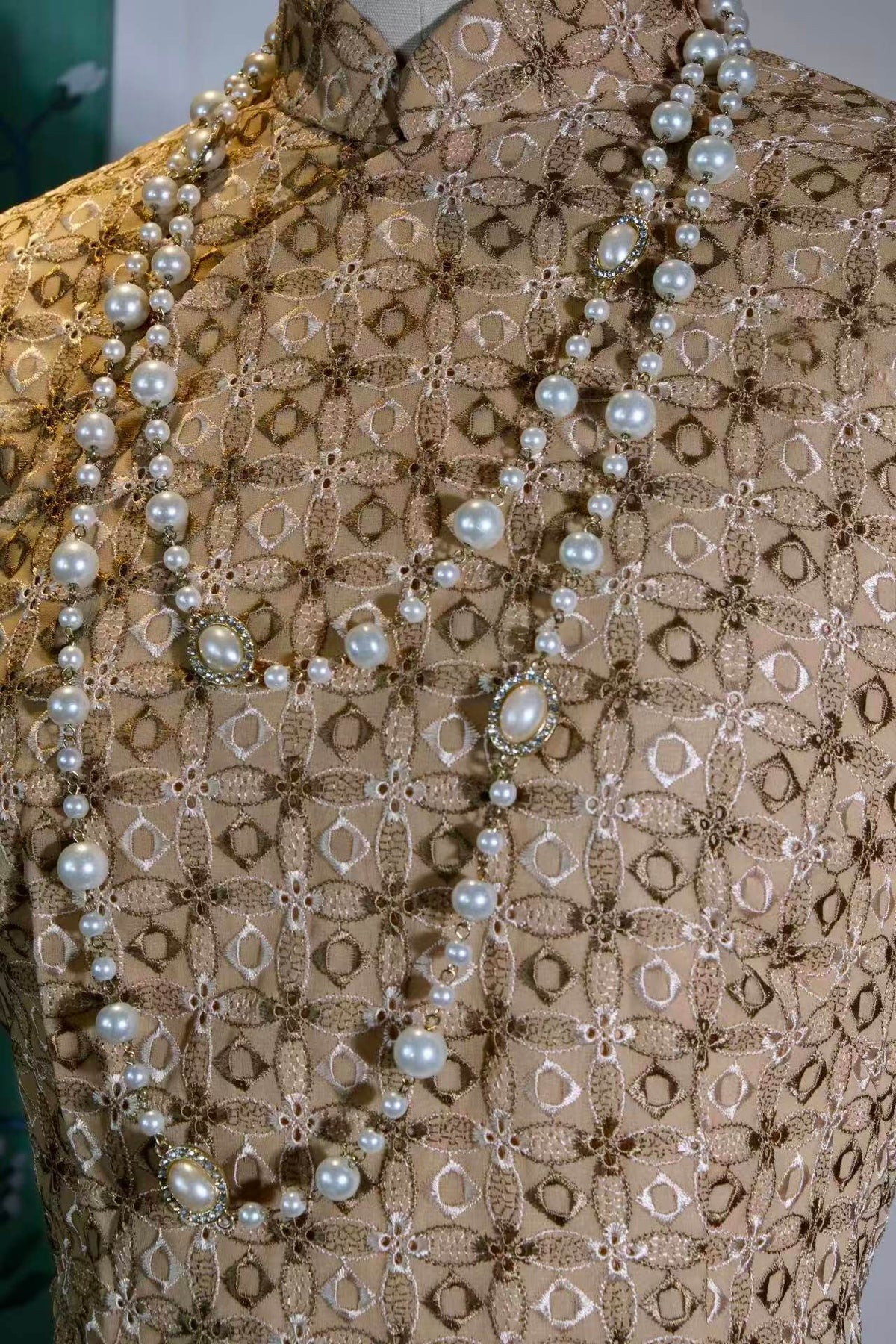
细观此衣,最引人入胜者莫过于其面料上的纹样。这并非传统中式旗袍中常见的牡丹、凤凰或山水写意,而是一种极具现代主义精神的几何连缀纹样。
这种图案由无数个菱形与椭圆交织而成,形似连绵不断的“盘长”纹变体,又似西方装饰艺术运动(Art Deco)中常见的网格结构。每一个单元图案内部都包含着精致的机绣镂空细节,如同古代铜钱纹的抽象化表达,寓意着“富贵连绵、生生不息”。这种排列整齐、重复连续的构图,在视觉上产生了一种理性的秩序感与韵律感。它打破了传统丝绸的柔媚,用一种近乎建筑结构的严谨,勾勒出女性身体的曲线美,这正是六十年代审美从繁复走向简约、从具象走向抽象的典型特征。
【材质与工艺:远渡重洋的奢华】
这件旗袍的身世颇具传奇色彩——“意大利进口机绣蕾丝棉,台湾制作”。这短短几个字,背后是一部微缩的全球贸易史。
六十年代的台湾,正处于纺织业腾飞的前夜,是当时亚洲高级定制的中心之一。而面料的来源地——意大利,则是世界蕾丝工艺的巅峰。在那个航空运输尚不发达的年代,将如此娇贵、通透且带有复杂镂空工艺的意大利蕾丝棉布运抵台北,本身就是一种身份与财力的象征。
这种面料不同于真丝的软塌,棉质底布赋予了它挺括的骨架,而表面的机绣蕾丝则提供了细腻的触感。这种“外刚内柔”的材质特性,完美支撑起了旗袍高耸的领口与收紧的腰身,使其历经六十载岁月,依然能保持当初的廓形,实属难得。
【艺术风格与稀缺性:西风东渐的绝唱】
从服装史的角度来看,这件作品属于“海派旗袍”晚期向“港台风”过渡的经典范例。
请注意其剪裁:立领依然保持了中式的含蓄高度,但袖口已演变为更具功能性的短袖,腰线的收省(Darts)处理极其精准,明显受到了西方立体剪裁的影响。这种剪裁方式不再像清代旗装那样掩盖身体曲线,而是大胆地赞美女性的自然体态。
正如《诗经·硕人》所云:“手如柔荑,肤如凝脂,领如蝤蛴,齿如瓠犀。”这件旗袍通过紧致的包身设计,将东方女性的含蓄婉约与西方时尚的性感张力完美融合。
【结语:可收藏的历史】
在快时尚泛滥的今天,这样一件做工考究、面料稀缺的古董衣,早已超越了穿着的范畴。它是博物馆级的藏品,是研究二十世纪中叶东亚时尚变迁的活化石。
那一串串搭配的珍珠项链(虽为配饰,却与旗袍相得益彰),更让人联想到那个名媛辈出的年代。穿上它,不仅仅是穿上一件衣服,更是披上了一段关于优雅、关于匠心、关于那个回不去的流金岁月的记忆。
孤品难寻,静待知音。
Measurements / Size Guide:
Bust / Waist / Hips / Total Length: 94/84/100/105 cm
Detailed Description:
[Introduction: Amber of Time] Eileen Chang once remarked: "To those who cannot speak, clothes are a language, carrying with them a pocket-sized drama wherever they go." When we gaze upon this cheongsam born in the 1960s, we seem to hear a silent monologue spanning over half a century. This is not merely a garment, but an amber frozen in time, sealing away that golden era where modernity collided fiercely with tradition, and elegance coexisted with innovation.
[Pattern Analysis: Geometric Aesthetics in Order] Observing this piece closely, the most captivating element is the pattern across its fabric. This is no ordinary peony, phoenix, or freehand landscape commonly found in traditional Chinese cheongsams, but a geometric interlocking motif thoroughly imbued with a modernist spirit.
Composed of countless interwoven diamonds and ovals, the pattern resembles a variation of the continuous "Endless Knot" (Pan Chang) motif, as well as the grid structures frequently seen in Western Art Deco. Each individual unit pattern contains delicate machine-embroidered lace-like cutout details within, acting as an abstract expression of ancient copper coin patterns that symbolize "continuous prosperity and endless vitality." This neatly arranged, repeating continuous composition creates a rational sense of order and rhythm visually. It breaks through the softness of traditional silk, utilizing a rigor akin to architectural structures to outline the gentle curves of the female form—a quintessential hallmark of 1960s aesthetics shifting from complexity to simplicity, and from concrete representation to abstraction.
[Material and Craftsmanship: Transoceanic Luxury] The provenance of this cheongsam is quite legendary—"imported Italian machine-embroidered lace cotton, made in Taiwan." These few words encapsulate a miniature history of global trade behind them.
Taiwan in the 1960s stood on the eve of its textile boom, serving as one of the centers for Asian haute couture at the time. Meanwhile, the source of the fabric—Italy—represented the pinnacle of world lace craftsmanship. In an era when air transport was not yet fully developed, shipping such delicate, translucent Italian lace cotton featuring complex cutout handiwork to Taipei was in itself a symbol of status and wealth.
Distinct from the limp softness of pure silk, the cotton base fabric imparts a crisp, structured framework, while the surface machine-embroidered lace provides a refined, delicate tactile feel. This material quality of "strength without, softness within" flawlessly supports the cheongsam's high standing collar and cinched waist, enabling it to maintain its original structural silhouette even after surviving sixty years of time—a true rarity.
[Artistic Style and Rarity: Swan Song of Western Influence on Eastern Shores] From the perspective of costume history, this piece serves as a classic exemplar of the late "Shanghai-style cheongsam" transitioning toward the "Hong Kong and Taiwan style."
Please notice its tailoring: the mandarin collar preserves the subtle height of Eastern tradition, yet the cuffs have evolved into more functional short sleeves, and the darting at the waistline (Darts) is executed with extreme precision, clearly influenced by Western three-dimensional tailoring. This cut no longer conceals body curves like Qing Dynasty banner robes, but boldly celebrates a woman's natural form.
As stated in the Book of Songs (Shuo Ren): "Her hands are like soft shoots, her skin like congealed lard, her neck like the tree-borer larva, her teeth like melon seeds." Through its tight, body-contouring design, this cheongsam seamlessly fuses Eastern subtle gentleness with the sexy tension of Western fashion.
[Epilogue: Collectible History] In today's age of overflowing fast fashion, a vintage garment with such exquisite craftsmanship and scarce fabric has long transcended the realm of daily wear. It is a museum-grade collectible, a living fossil for researching East Asian fashion transformations in the mid-twentieth century.
Those paired strands of pearl necklaces (though accessories, they complement the cheongsam perfectly) evoke even further memories of that era when socialites abounded. Putting it on is not merely wearing a piece of clothing, but draping oneself in memories of elegance, master craftsmanship, and those golden years that can never be returned to.
A one-of-a-kind specimen hard to find, quietly awaiting its true connoisseur.