溯源
Couldn't load pickup availability
衣服尺寸:
胸围/腰围/臀围/衣长:90/74/96/109 厘米
细节描述:
一、 霓裳羽衣:图案的文学意境与美学解读
这件旗袍的纹样,是一首用经纬线写就的田园诗,它完美承袭了中国古典服饰“图必有意,意必吉祥”的文化传统。
* 纹样解构: 缎面上以写意笔法织就了“梅、兰、竹、菊”四君子,以及牡丹、团花、竹影、蝴蝶与祥云等图案。梅花象征傲骨高洁,兰花寓意空谷幽兰、温婉典雅,竹影代表着虚怀若谷、高风亮节的君子气度,菊花则是“凌霜飘逸,世外隐士”的象征。这些植物纹样穿插点缀,配以翩翩起舞的蝴蝶与象征吉祥的云纹,构成了一幅生机勃勃、疏密有致的水墨画卷。
* 美学意蕴: 正如《诗经·郑风》有云“出其东门,有女如云”,中国传统服饰的纹样从未局限于单纯的装饰,而是将穿着者的内在品德与审美情趣外化于衣着之上。这件旗袍将四君子等高洁意象散点分布于流光溢彩的缎面上,不仅是对自然之美的捕捉,更是对中国传统文人风骨与君子品格的一种含蓄颂扬,展现了穿着者端庄、雅致且富有文化底蕴的独特气质。
二、 丝路遗珠:创汇时期的时代印记与工艺传奇
这件旗袍的价值,不仅在于其华美的外表,更在于其背后承载的沉甸甸的历史与无可复制的精湛工艺。
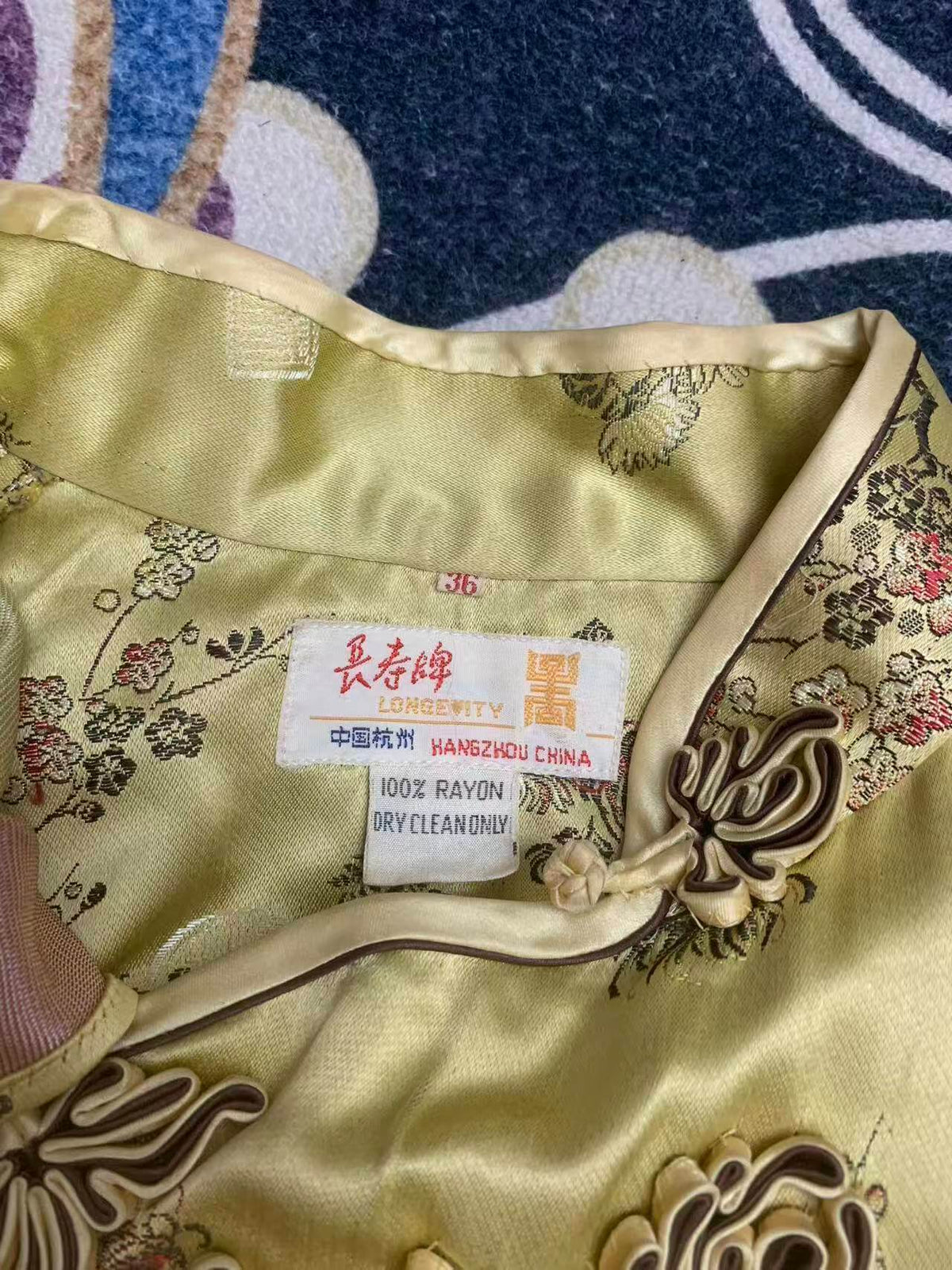
* 品牌溯源: 衣领处的“长寿牌(LONGEVITY)”标签与“中国杭州(HANGZHOU CHINA)”的字样,是其出身名门的直接证明。杭州作为中国丝绸之都,自古便有“丝绸之府”的美誉。长寿牌隶属于杭州著名的中华老字号“利民”(即后来的振兴祥中式服装厂),该厂是当时浙江省丝绸公司指定的生产外销“飞松”、“长寿”等中式服装的定点厂家。这一身份,赋予了它纯正的血统和极高的历史文献价值。
* 织造绝技: 旗袍采用杭州最为著称的提花织锦缎。这是一种在经面缎上起三色以上纬花的传统丝织工艺,图案并非后期印染,而是通过织机将经纬线交错直接织就,因此花纹立体感强、质地紧密、色泽光鲜且历久弥新。这种面料在当时被誉为“东方绸缎的皇后”,是国礼级别的高级面料。其前身“100% RAYON(人造丝)”的标注,正是上世纪六十年代创汇时期为了兼顾成本、耐用性与视觉效果而广泛采用的材质。
* 时代烙印: 上世纪五六十年代,中国丝绸工业肩负着“出口创汇”的国家使命。这批由国营丝绸厂集中设计、集中生产的旗袍,代表了中国当时服装工业的最高水准,是国家形象与文化输出的重要载体。因此,它不仅仅是一件衣服,更是一段“丝路遗珠”式的历史证物。
三、 凤毛麟角:稀缺性与收藏价值
随着时光流逝,这样一件品相完好的古董旗袍,其稀缺性与收藏价值愈发凸显。
* 历史的断层: 旗袍在经历了民国时期的鼎盛后,于上世纪六十年代后期一度被视为“封建糟粕”,遭到批判并被束之高阁。这意味着,这一时期生产的大量精美旗袍被毁或遗失。像这样得以完整保存至今的“长寿牌”创汇旗袍,实属凤毛麟角。
* 工艺的失传: 其标志性的手工盘扣,采用了“镶、嵌、滚、宕、盘、钉、勾、绣”等传统工艺。尤其是胸前这枚由深棕色与人造丝双色绲边盘结而成的复杂如意云头扣,造型如花朵般绽放,线条流畅优美,极具立体感。这种需要匠人耗费数十年功力才能完成的精细手工,在追求效率的工业化时代已近乎失传,成为不可再生的艺术绝响。
* 收藏定调: 综合其品牌渊源、历史背景、面料珍稀、工艺精湛及品相完好等因素,这件旗袍已超越了普通服饰的范畴。它不仅是民国后海派与京派剪裁融合演变的活化石,更是新中国丝绸工业黄金时代的巅峰之作。在当代二手旗袍收藏市场中,带有老字号标签、品相完好的创汇期精品旗袍,因其高知识壁垒和文化附加值,已成为藏家们竞相追逐的藏品级珍品,具有极高的历史文献价值与艺术投资潜力。
Measurements / Size Guide:
Bust / Waist / Hips / Total Length: 90/74/96/109 cm
Detailed Description:
I. Heavenly Garments: Literary Intent and Aesthetic Interpretation of the Motifs
The motif of this cheongsam is a pastoral poem written through warp and weft threads, perfectly inheriting the cultural tradition of classic Chinese apparel where "every pattern holds meaning, and every meaning must be auspicious."
Motif Deconstruction: Woven upon the satin surface in expressive, painterly strokes are the "Four Gentlemen" (plum blossom, orchid, bamboo, and chrysanthemum), alongside peonies, floral medallions, bamboo shadows, butterflies, and auspicious clouds. The plum blossom symbolizes unyielding, noble character; the orchid signifies quiet grace in secluded valleys, gentle and elegant; bamboo shadows represent a humble, open mind with high moral integrity; and the chrysanthemum stands for "resisting frost with ethereal grace, a hermit beyond the worldly realm." These botanical motifs are interspersed and accented by fluttering butterflies and cloud scrolls symbolizing good fortune, forming a vibrant, artfully balanced ink-painting composition.
Aesthetic Significance: As the Classic of Poetry (Book of Songs: Odes of Zheng) states, "Beyond the East Gate, women gather like clouds," traditional Chinese garment motifs were never confined to pure decoration, but rather externalized the wearer's inner virtues and aesthetic tastes onto their attire. Scatter-arranging these noble images like the Four Gentlemen across the shimmering satin surface is not merely capturing natural beauty, but a subtle celebration of traditional Chinese literati character and gentlemanly virtue, showcasing the wearer's dignified, refined, and culturally rich temperament.
II. Lost Gem of the Silk Road: Historical Stamp and Craft Legend of the Foreign Exchange Earning Era
The value of this cheongsam lies not only in its gorgeous exterior, but in the heavy history it carries and its irreplaceable, master craftsmanship.
Brand Provenance: The "LONGEVITY" label at the collar alongside the text "HANGZHOU CHINA" serves as direct proof of its distinguished origin. Hangzhou, as the silk capital of China, has been renowned since antiquity as the "Home of Silk." The Longevity brand belonged to Hangzhou's famous Chinese Time-Honored Brand "Limin" (later renamed the Zhenxingxiang Chinese Clothing Factory), which was designated by the Zhejiang Provincial Silk Corporation at the time as a key production factory for export Chinese garments under brand names like "Flying Pine" (Feisong) and "Longevity." This identity grants it pure lineage and immense historical and documentary value.
Weaving Mastery: The cheongsam utilizes Hangzhou's most famous jacquard brocade satin (Ti Hua Zhi Jin Duan). This is a traditional silk weaving technique where three or more colors of weft patterns are raised on a warp satin base. The motifs are not printed afterwards, but directly woven on a loom through the intersection of warp and weft threads, resulting in three-dimensional patterns, dense texture, brilliant luster, and enduring color. At the time, this fabric was hailed as the "Queen of Oriental Silks," representing national-gift quality luxury fabric. The "100% RAYON" material designation on the tag is a direct mark of the 1960s foreign exchange earning era, widely adopted to balance cost, durability, and visual appeal.
Imprint of the Era: In the 1950s and 1960s, China's silk industry carried the national mission of "exporting to earn foreign exchange." These cheongsams, centrally designed and manufactured by state-owned silk mills, represented the highest standards of China's garment industry at the time and served as crucial carriers for national image and cultural export. Thus, it is far more than a dress—it is a piece of historical evidence acting as a "lost gem of the Silk Road."
III. A Rare Gem: Scarcity and Collection Value
With the passage of time, such a vintage cheongsam preserved in flawless condition reveals an ever-increasing scarcity and collection value.
Historical Gap: Following its peak in the Republican Era, the cheongsam was temporarily viewed as "feudal dross" in the late 1960s, subjected to criticism and locked away. This meant vast numbers of exquisite cheongsams produced during this period were destroyed or lost. "Longevity" brand foreign exchange earning cheongsams surviving intact to this day are extraordinarily scarce.
Interrupted Craftsmanship: Its signature handmade frog buttons incorporate traditional techniques including inlaying, embedding, piping, trimming, knotting, pinning, hooking, and embroidering (Xiang, Qian, Gun, Dang, Pan, Ding, Gou, Xiu). In particular, the intricate Ruyi cloud-head button at the chest—woven with two-color piping in dark brown and rayon—blooms like a flower with flowing, elegant lines and rich dimensionality. This level of meticulous manual skill, requiring decades of artisan mastery, has grown nearly extinct in an industrial age pursuing mass efficiency, becoming an irreplicable artistic swan song.
Collection Appraisal: Synthesizing its brand origins, historical backdrop, fabric rarity, exquisite craftsmanship, and flawless condition, this cheongsam transcends the boundaries of ordinary apparel. It is not only a living fossil documenting the evolutionary fusion of Shanghai and Beijing tailoring styles after the Republican era, but also a crowning masterpiece from the golden age of the new China's silk industry. In today's secondary vintage cheongsam collection market, high-end export-era cheongsams bearing time-honored brand labels in pristine condition have become treasured specimens eagerly sought by collectors due to their high knowledge barriers and cultural value, holding immense historical research significance and artistic investment potential.