深圳溯源
Couldn't load pickup availability
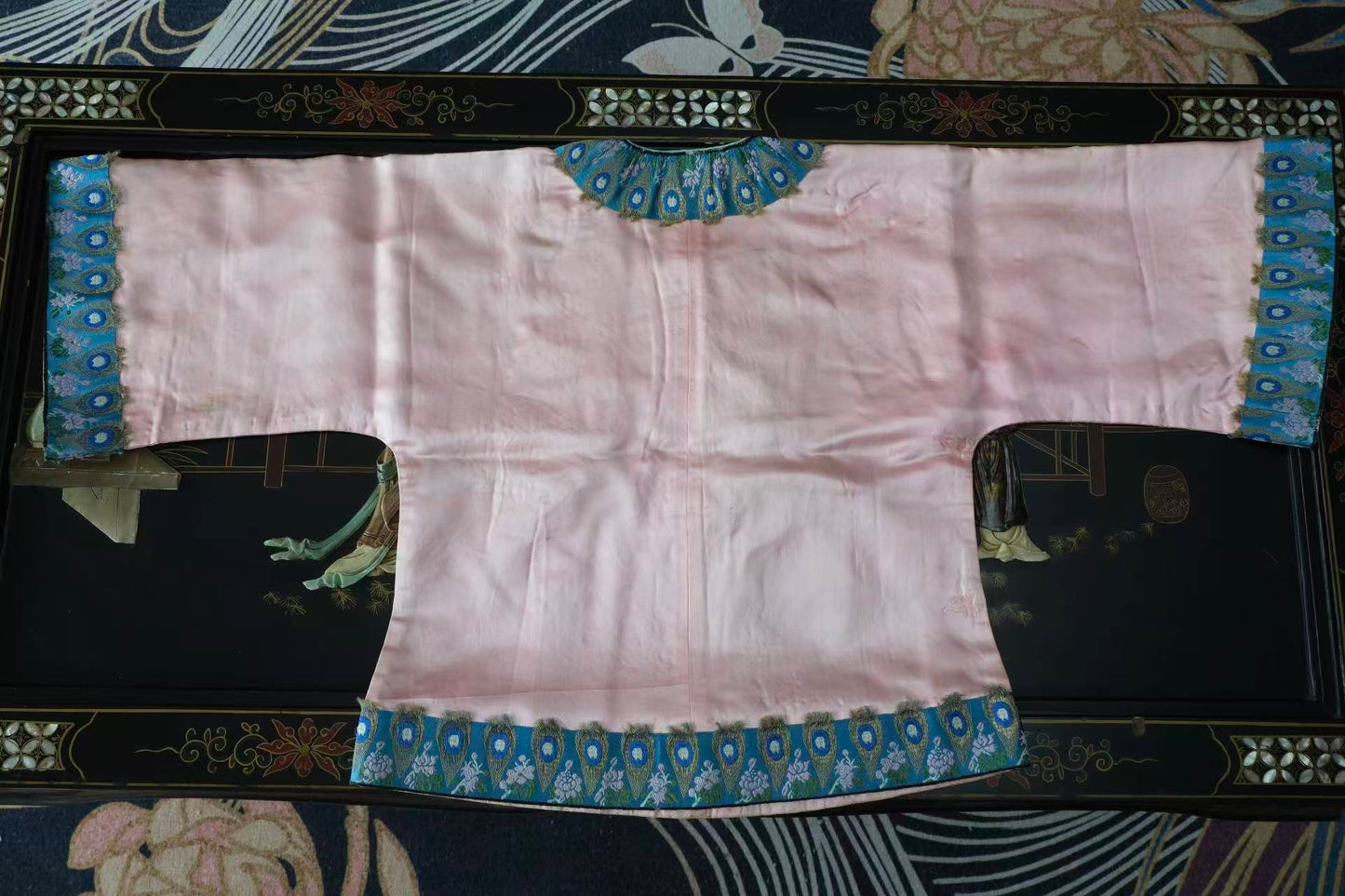
这套上世纪二十年代的服饰组合,由粉色素缎镶花边倒大袖上袄与黑色雀羽纹纱罗镶花边倒大袖长马甲构成,是民国初期女性日常与社交场合中极具代表性的“两件套”着装范式。其形制、纹样与工艺,不仅映射了当时社会审美从传统向现代的过渡,更承载着女性在时代洪流中对身份表达与自我意识的微妙探索。
一、图案解析:孔雀翎与花卉的吉祥隐喻
整套服饰最引人注目的视觉焦点,在于其上袄领口、袖口及马甲下摆处所饰的蓝底孔雀翎纹织带。此纹样并非随意装饰,而是深植于中国传统吉祥文化中的经典符号。
- 孔雀翎纹:在明清官服制度中,孔雀为三品文官补子图案,象征“文明”与“高洁”。至民国时期,这一纹样被民间广泛挪用,褪去等级色彩,转而成为女性服饰中寓意“美丽、尊贵、吉祥”的装饰元素。图中孔雀翎以蓝、白、金三色丝线织就,翎眼圆润饱满,周围辅以淡紫、浅绿小花,形成“孔雀开屏,百花簇拥”的视觉效果,既显华贵又不失柔美。
- 黑色雀羽纹纱罗:马甲主体采用黑色暗纹纱罗面料,其上织有“雀羽纹”,即仿孔雀羽毛纹理的提花图案。这种“以黑衬彩”的手法,是民国女装中常见的“低调奢华”策略——远观沉稳内敛,近看则暗藏玄机,彰显穿着者对细节与质感的极致追求。
- 粉色素缎:上袄选用柔和的粉色素缎,无任何印花或刺绣,仅以织带勾勒轮廓,体现“素雅为美”的审美取向。这种“留白”处理,恰如中国画中的“计白当黑”,让繁复的孔雀纹饰更显突出,也暗示了穿着者不事张扬、内蕴风华的气质。
二、古董衣的故事:从闺阁到街头的时尚革命
这套服饰诞生于1920年代,正值中国社会剧烈变革之际。辛亥革命后,满清服饰制度瓦解,女性开始摆脱“宽袍大袖”的束缚,追求“合身、便捷、美观”的新式服装。倒大袖(又称“喇叭袖”)正是这一时期的标志性设计——袖口宽大如喇叭,既保留了传统汉服的飘逸感,又便于活动,适应了女性走出家门、参与社会活动的需求。
据《申报》1923年一篇题为《女界新装》的报道记载:“今之女子,多喜着倒大袖衫,配黑马甲,行于市衢,顾盼生姿。”可见此类搭配在当时已蔚然成风。而这套服饰的特殊之处,在于其“内外兼修”的设计哲学:外穿黑色马甲,庄重得体;内搭粉色上袄,温婉可人。这种“外刚内柔”的搭配,恰如当时新女性的写照——既要在社会上立足,又不愿完全舍弃传统女性的柔美特质。
三、引经据典:艺术风格与稀缺性
从艺术风格而言,这套服饰融合了清代宫廷织绣工艺与民国都市时尚美学。孔雀翎纹织带的织造技法,源自苏州、杭州等地的“宋锦”与“云锦”传统,需经数十道工序方能完成,非普通作坊所能胜任。而黑色纱罗面料的“雀羽纹”提花,则体现了民国时期纺织工业对传统纹样的现代化改造——通过机械提花机实现复杂图案的大规模生产,但仍保留了手工织物的细腻质感。
在稀缺性方面,此类“粉+黑”配色、“孔雀翎+雀羽纹”组合的完整套装,存世量极为稀少。原因有三:其一,粉色素缎易褪色、易污损,保存难度大;其二,黑色纱罗虽耐脏,但质地轻薄,易破损;其三,孔雀翎纹织带因工艺复杂、成本高,多用于重要场合,日常穿着较少,故传世品多为“礼服级”藏品。正如沈从文先生在《中国古代服饰研究》中所言:“民国初年女装,虽趋简朴,然富家女子仍不惜工本,以织锦、刺绣为饰,以求‘雅’与‘贵’并存。”这套服饰,正是“雅贵并存”的绝佳例证。
四、结语:一件衣服,一个时代的缩影
这套上世纪二十年代的粉色素缎镶花边倒大袖上袄配黑色雀羽纹纱罗镶花边倒大袖长马甲,不仅是一件衣物,更是一段历史的见证。它承载着女性从“闺阁”走向“街头”的勇气,也折射出传统与现代、东方与西方在服饰领域的碰撞与融合。今日观之,其孔雀翎纹依旧璀璨,其雀羽纹纱罗依旧轻盈,仿佛在无声诉说着那个“新旧交替、风华绝代”的年代。
This ensemble from the 1920s consists of a solid pink satin trimmed inverted-sleeve top (粉色素缎镶花边倒大袖上袄) paired with a black peacock-feather pattern gauze trimmed inverted-sleeve long vest (黑色雀羽纹纱罗镶花边倒大袖长马甲). It represents a highly definitive "two-piece" dressing paradigm utilized by women for both daily wear and social encounters during the early Republican era. Its structural configuration, motifs, and handcraft not only map the transition of social aesthetics from tradition to modernism, but also carry women's subtle exploration of identity expression and self-awareness within the shifting tides of the era.
The most compelling visual focal point of the entire ensemble rests upon the blue-ground peacock plume woven ribbon that trims the collar and cuffs of the top, as well as the lower hem of the vest. Rather than serving as mere arbitrary ornamentation, this motif is a classic symbol deeply rooted in traditional Chinese auspicious culture.
The Peacock Plume Motif: Within the official dress codes of the Ming and Qing dynasties, the peacock was the rank badge pattern for civil officials of the third grade, symbolizing "civilization" and "high integrity." By the Republican period, this motif was widely adopted by the public, shedding its strict hierarchical status and transforming into a decorative element on female apparel that signified "beauty, nobility, and auspicious fortune." In this piece, the peacock plumes are woven with blue, white, and gold silk threads, creating perfectly rounded, full eyes surrounded by subtle lavender and light green blossoms. This achieves a visual effect of "a peacock spreading its tail, encircled by a hundred flowers," appearing majestic yet remaining soft and graceful.
The Black Peacock-Feather Pattern Gauze: The main body of the long vest utilizes a black damask gauze fabric woven with a "peacock-feather motif"—a jacquard pattern that mimics the organic texture of peacock plumage. This method of "using black to offset brilliance" was a frequent strategy for achieving "understated luxury" in Republican womenswear. It appears steady and reserved from a distance, yet reveals an intricate pattern upon closer inspection, broadcasting the wearer's ultimate pursuit of detail and textile quality.
The Solid Pink Satin: The upper top selects a soft, solid pink satin entirely free of any printing or embroidery, relying solely on the woven ribbons to map out its structural contours. This execution reflects an aesthetic preference for "plainness as beauty." This treatment of negative space aligns with the compositional philosophy of "treating white space as ink" (ji bai dang hei) in traditional Chinese painting, throwing the complex peacock motifs into high relief while hinting at the wearer's unboastful, internally refined character.
This ensemble was born in the 1920s, a period marked by violent social transformation across China. Following the Xinhai Revolution, the dress codes of the Qing imperial court dissolved, and women began breaking free from the confinement of "wide robes and sweeping sleeves" to pursue a new style of apparel that was form-fitting, convenient, and aesthetically pleasing. The inverted sleeve (倒大袖, also known as the "trumpet sleeve") operated as a hallmark design of this exact window. The cuffs are wide like a trumpet; it preserved the ethereal movement of traditional Han clothing while optimizing physical mobility, adapting seamlessly to the needs of women stepping outside the home to participate in social life.
According to a report titled New Dress Spheres for Women published in the newspaper Shun Pao in 1923: "Women of today heavily favor wearing the inverted-sleeve shirt paired with a black vest, moving along the city streets with exceptional grace." It is evident that this specific pairing had already blossomed into a major trend at the time. The exceptional distinction of this ensemble, however, resides in its design philosophy of balancing internal and external layers: the exterior black vest projects solemnity and decorum, while the interior pink top provides a gentle, approachable warmth. This pairing of "external strength and internal softness" served as a perfect mirror for the new woman of that era—striving to establish a position in society without completely abandoning the soft, traditional traits of her heritage.
From the standpoint of design theory, this ensemble fuses the elite weaving and embroidery skills of the Qing imperial court with the urban fashion aesthetics of the Republican era. The weaving methodology behind the peacock plume ribbons traces its technical lineage directly to the ancient "Song brocade" and "Cloud brocade" traditions of Suzhou and Hangzhou, requiring dozens of manual processes that common workshops were entirely unequipped to handle. Concurrently, the jacquard execution of the peacock-feather pattern on the black gauze reflects the modernization of traditional motifs by the Republican textile sector—utilizing mechanical jacquard looms to achieve large-scale production of complex imagery while successfully preserving the delicate texture of hand-woven textiles.
In terms of scarcity, complete surviving ensembles featuring this specific "pink + black" color palette and "peacock plume + feather pattern" combination are exceptionally rare today for three primary reasons:
The Vulnerability of Pink Satin: Pure pink satin is highly prone to color fading and staining, presenting an immense challenge for long-term conservation.
The Fragility of Black Gauze: Although the black gauze baseline is practical for shielding against visible dirt, its lightweight, translucent weave makes it highly vulnerable to structural tearing and mechanical breakdown.
The Exclusivity of the Ribbon: Because the peacock plume woven ribbon was highly complex and costly to manufacture, it was primarily reserved for important occasions rather than everyday wear, causing the vast majority of transmitted pieces to exist at the ceremonial gala tier.
As Shen Congwen noted in Studies of Ancient Chinese Clothing (《中国古代服饰研究》): "Although womenswear in the early years of the Republic gravitated toward simplicity, women from wealthy families still spared no expense on materials and labor, utilizing brocades and embroidery as decoration to ensure that 'refinement' and 'nobility' coexisted." This ensemble stands as an absolute textbook example of that coexistence of refinement and nobility.
This 1920s ensemble—combining a solid pink satin trimmed inverted-sleeve top with a black peacock-feather pattern gauze trimmed inverted-sleeve long vest—is far more than a functional garment; it is a physical witness to a frozen slice of chronology. It carries the courage of women stepping out from the private boudoir into the public street, while reflecting the intense collision and beautiful fusion of tradition and modernity, East and West, within the field of dress. Observed today, its peacock plumes remain brilliant and its feather-pattern gauze remains light and airy, silently narrating that unforgettable generation of historical transition and peerless elegance.
Suyuan Archival Textile Registry — Documenting the material culture, preserving the technical lineage of ancestral craft.