溯源
Couldn't load pickup availability
一、 【形制与剪裁】—— 复刻巴黎的优雅剪影
“回眸一笑百媚生,六宫粉黛无颜色。” 这件时装裙完美复刻了1950年代战后“迪奥式”(New Look)的经典美学范式。其剪裁端庄而富有张力:
* 领口: 宽大的船领(Boat Neckline),微露锁骨,尽显东方女性的含蓄与优雅,恰如“肤若凝脂,领若蝤蛴”。
* 腰身与裙摆: 采用典型的50年代X型廓形,以高腰线紧束蜂腰,下摆呈伞状自然垂坠。这种剪裁不仅是对克里斯汀·迪奥(Christian Dior)战后复兴“极致女性气质”的致敬,更通过精准的省道收拢,勾勒出如“楚王好细腰”般的曼妙曲线。
二、 【面料与工艺】—— 粤绣底蕴与提花绝技
这件裙子的灵魂,在于其极具辨识度的面料。
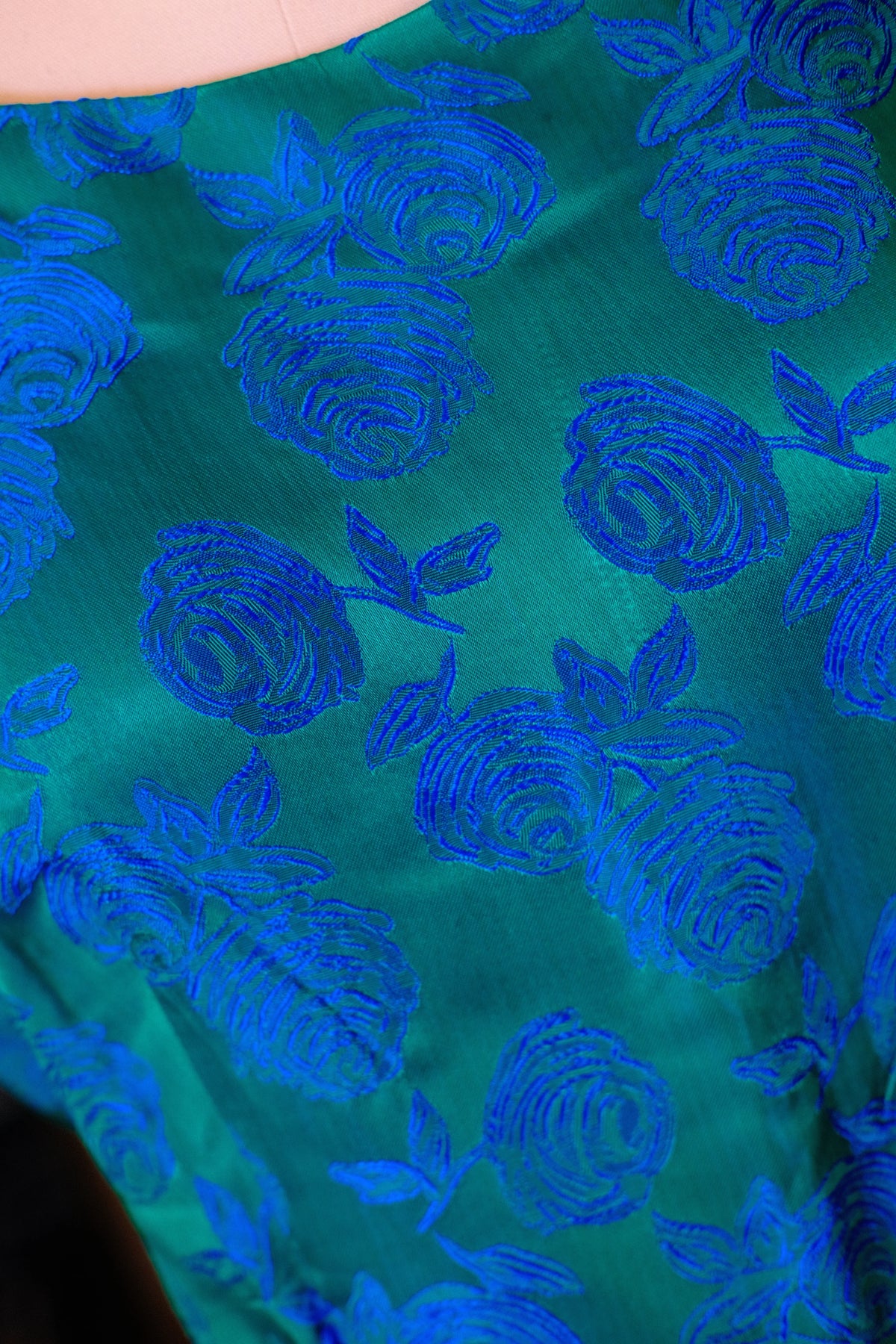
* 异色提花(Brocade): 面料采用高级的织锦缎(Brocade Satin),运用了精湛的“异色幻光”工艺。在不同光线下,它能在翠绿与孔雀蓝之间自由变幻。这种光泽感并非简单的染色,而是源于经纬线对光线的不同折射,宛如“绿如春水初生日,红似朝霞欲上时”的视觉盛宴。
* 立体玫瑰: 裙面上的蓝色玫瑰图案,并非简单的印花,而是通过提花织造与立体绣花工艺相结合的“盘金绣”技法。每一朵玫瑰都微微凸起,肌理分明,仿佛是从面料中生长出来,呈现出“云想衣裳花想容,春风拂槛露华浓”的立体诗意。
三、 【文化交融】—— 东方匠心与西方时尚
* 历史坐标: 1950年代的香港,被誉为“东方好莱坞”与“东方的巴黎”。彼时的香港时装业,汇聚了从上海南下的顶尖裁缝与粤绣大师。他们以西方版型为骨,以东方苏绣、广绣为魂,创造了独属于东方的“海派/港制巴黎风格”。
* 东西合璧: 这条裙子便是那个黄金时代的缩影。它用西方的廓形包裹着东方对“花好月圆”的审美追求(蓝玫瑰象征神秘与奇迹,绿叶象征生生不息),腰间精致的同色系缎带蝴蝶结,则是一抹点睛之笔,既有法式的浪漫,又有中式的温婉。
四、 【收藏寄语】
“绝代有佳人,幽居在空谷。” 岁月流转,这件诞生于半个多世纪前的华服,依然完好地封存着那个流金岁月的温度。它不仅是一件衣服,更是一段凝固的时光,一个关于香江、巴黎、丝绸与玫瑰的旧梦。
"A single backwards glance releases a hundred charms, reducing the court's painted beauties to pallidity."
This gown impeccably captures the post-war "New Look" aesthetic classicized by Christian Dior in the 1950s. Its tailoring balances dignified composure with structural tension:
Neckline: A wide boat neckline subtly reveals the collarbones, articulating the understated grace of Eastern women—echoing the classical description: "Skin smooth as frozen lard, neck slender as a tree-borer larva."
Waist and Skirt: Utilizing the signature 1950s X-line silhouette, it cinches tightly at the high waistline before expanding into a umbrella-like flowing skirt. This cut serves not only as a homage to Dior’s post-war revival of supreme femininity, but also contours a waistline through precise darting.
The defining soul of this gown resides in its highly recognizable textile:
Shot Silk Brocade: The fabric utilizes fine brocade satin executed with masterly "iridescent color-shifting" techniques. Under shifting light, it glides freely between emerald green and peacock blue. Rather than simple surface dyeing, this optical luster stems from the varying refractive angles of warp and weft threads—offering a visual feast of "green as spring waters freshly rising, red like dawn clouds about to ascend."
Three-Dimensional Roses: The blue rose motifs across the skirt are not flat prints; rather, they combine Jacquard weaving with three-dimensional couching embroidery techniques (Panjin Xiu). Each rose rises in subtle relief with crisp, tactile definition—appearing as though growing directly out of the textile, manifesting a three-dimensional poetic grace: "Clouds recall her flowing robes, flowers her radiant face; the spring breeze brushes the balustrade, wet with heavy dew."
Historical Coordinates: In the 1950s, Hong Kong earned renown as the "Hollywood of the East" and the "Paris of the East." During this period, the local garment industry brought together master tailors who had migrated south from Shanghai alongside Cantonese embroidery artisans. Using Western silhouettes as the framework and Eastern embroidery as the spirit, they birthed a distinct "Hong Kong-Made Parisian Style."
East-West Harmonization: This dress serves as a microcosm of that golden age. It wraps Western structural contours around Eastern aesthetic yearnings for harmony and fulfillment—with blue roses symbolizing mystery and miracles while green foliage represents eternal life. The matching satin bow pinned at the waist acts as a defining flourish, blending French romance with Eastern gentleness.
"A peerless beauty dwells quietly within the secluded valley."
As decades drift past, this haute garment born over half a century ago remains impeccably preserved, sealing within its threads the warmth of a golden era. It is far more than attire; it stands as a piece of frozen time, a vintage dream woven from Hong Kong, Paris, silk, and roses.