深圳溯源
Couldn't load pickup availability
衣服尺寸:
胸围/腰围/臀围:88/70/90 厘米
衣长:104 厘米
细节描述:
【纹样考据:缠枝莲纹里的东方美学】
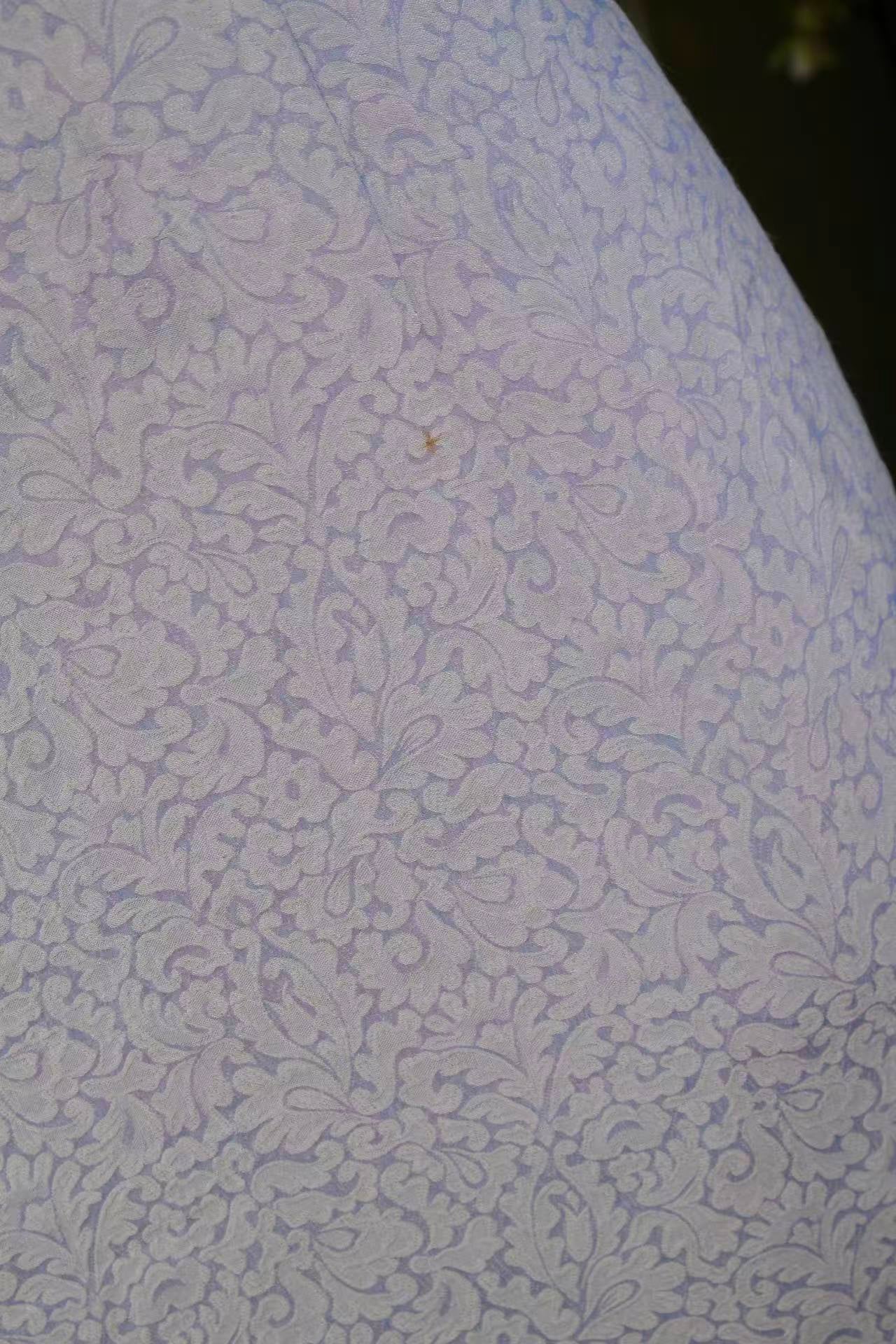
这件上世纪六十年代的香港产提花旗袍,面料上的图案为“缠枝莲纹”(亦称“转枝莲”)。其构图连绵不断、婉转流畅,莲花花瓣饱满圆润,枝叶卷曲灵动。这种纹样源自佛教艺术中的“宝相花”,自唐代起便盛行于丝绸织造,寓意“生生不息、吉庆有余”。在六十年代的香港纺织业中,这种将传统吉祥纹样与西式立体剪裁结合的工艺,正是当时“中西合璧”审美风尚的缩影。
【形制与工艺:黄金时代的余晖】
从形制上看,这是一件典型的“海派改良旗袍”遗存。它保留了传统的高立领,但袖口已演变为极窄的无袖设计,露出了女性优美的肩臂线条,这是六十年代受西方晚礼服影响后的显著特征。腰身收得极紧,通过精湛的归拔工艺(即通过熨烫使布料产生立体弧度)贴合人体曲线,下摆修长,尽显端庄与性感并存的韵味。
面料采用的是当时香港引以为傲的提花织锦。不同于普通的印花,提花是在织造过程中直接织出花纹,具有浮雕般的质感。这种淡紫色(或称藕荷色)的色调,温婉而低调,极具那个年代特有的书卷气与名媛风范。
【历史叙事:衣香鬓影下的流金岁月】
张爱玲曾在《更衣记》中写道:“对于不会说话的人,衣服是一种语言,随身带着的是袖珍戏剧。”这件旗袍,便是那出戏剧中最优雅的一幕。
上世纪六十年代的香港,正处于经济腾飞的前夜,也是旗袍文化的最后一个辉煌时期。那时的名媛闺秀,无论是出席晚宴还是日常茶叙,都习惯身着这样一件做工考究的旗袍。它不仅仅是一件衣服,更是一种身份的象征,一种对精致生活的坚持。我们可以想象,在半个世纪前的某个夜晚,一位女子身着此衣,颈间佩戴着温润的珍珠项链,穿梭于中环的霓虹灯影或是浅水湾的豪宅之间。那是一种从容不迫的优雅,是“东方巴黎”独有的风情。
【稀缺性与收藏价值:不可复制的时光标本】
如今,随着成衣工业的流水线化,这种需要耗费大量工时进行立体剪裁和复杂提花织造的古董旗袍已成绝响。
1. 面料的不可再生性: 六十年代的提花面料多为天然丝棉混纺,手感挺括且透气,现代化纤难以复刻那种温润的光泽感。
2. 工艺的失传: 老式裁缝讲究“推、归、拔”的手工熨烫定型技术,使得旗袍无需省道也能完美贴合身形,这种技艺在现代快节奏生产中已近乎失传。
3. 保存状况: 如图所示,这件旗袍历经六十载岁月,整体色泽依然雅致,虽有细微的使用痕迹(如图片6中可见的微小瑕疵),但这恰恰是其真实岁月的见证,反而增添了历史的厚重感。
结语:
这不仅是一件衣物,更是一段被织物封存的历史。它见证了香港作为时尚之都的崛起,也承载了中国传统服饰向现代转型的最后一次华丽转身。对于收藏家而言,拥有它,便是拥有了一段触手可及的香江旧梦。
Measurements / Size Guide:
Bust / Waist / Hips: 88/70/90 cm
Total Length: 104 cm
Detailed Description:
This jacquard qipao, produced in Hong Kong during the 1960s of the last century, features a pattern known as "winding lotus motifs" (also referred to as "turning branch lotus") across its fabric chassis. Its compositional layout is continuous and unbroken, winding smoothly and fluidly, with lotus petals that appear full and rounded, and stems and leaves that curl with lively motion. This specific motif originates from the "Baoxiang flower" found within Buddhist art, and has been exceptionally popular within silk weaving since the Tang Dynasty, carrying auspicious metaphors of "endless generation and abundant celebration." Within the 1960s Hong Kong textile sector, this specific craftsmanship—which integrated traditional auspicious motifs with Western-style three-dimensional pattern drafting—stood precisely as a miniature portrait of the "East meets West" aesthetic fashion of that generation.
Observing its structural form, this specimen represents a textbook survival of the "modified Shanghai-style qipao" (海派改良旗袍). It faithfully preserves the traditional high standing collar, yet the cuff architecture has evolved into a highly narrow, sleeveless configuration that exposes the graceful lines of the female shoulder and arm—a prominent defining characteristic of the 1960s born from the influence of Western evening couture. The waist reduction is drawn in exceptionally tight, conforming seamlessly to human curves through master execution of the Gui-Ba technique (a specialized process where the fabric is heat-molded via ironing to generate permanent, three-dimensional curvature), while the lower hem remains long and slender, fully manifesting a charm where dignity and sensuality coexist.
The fabric chassis utilizes the premium jacquard brocade that Hong Kong was immensely proud of during that era. Completely departing from standard surface printing, jacquard weaving integrates patterns directly into the textile structure during the weaving process itself, generating a relief-like, tactile depth. This muted lavender (or lotus-root pink) color tone is gentle and low-profile, capturing to absolute perfection the distinct intellectual aura and elite maiden demeanor characteristic of that specific timeline.
Eileen Chang recorded in her essay A Record of Changing Clothes: "To those who cannot speak, clothes are a language; what they carry around with themselves is a pocket theater." This qipao operates precisely as the most elegant scene within that theatrical production.
During the 1960s of the last century, Hong Kong was positioned on the eve of a massive economic takeoff, marking the final brilliant chapter of the qipao’s cultural history. The elite maidens and prominent madams of that generation regularly wore meticulously crafted qipaos of this caliber, whether attending formal evening galas or casual afternoon tea gatherings. It transcended its function as a basic article of clothing to operate as a definitive status symbol and a fierce commitment to a refined lifestyle. We can easily imagine, on a specific night half a century ago, a woman clad in this garment, wearing a strand of warm, gentle pearls around her neck, navigating through the neon shadows of the Central district or moving between the luxury estates of Repulse Bay. That embodied an unhurried, composed elegance—the singular cosmopolitan romance unique to the "Paris of the East."
Today, alongside the automated assembly lines of the contemporary ready-to-wear apparel industry, antique qipaos of this caliber—which demand immense manual hours for three-dimensional cutting and highly complex jacquard weaving—have become a permanent swan song.
The Non-Renewable Nature of the Textile: Jacquard fabrics from the 1960s relied heavily on natural silk-cotton blends, commanding a hand-feel that is both structurally crisp and highly breathable; modern synthetic fibers find it impossible to replicate that warm, muted luster.
The Fragmentation of Craftsmanship: Old-school tailors placed absolute emphasis on manual heat-molding and ironing techniques known as "pushing, shaping, and stretching" (推、归、拔), allowing the qipao to conform flawlessly to the body profile without requiring standard structural darts; this intricate technical lineage has nearly vanished within modern, fast-paced production ecosystems.
Preservation State: As displayed, after crossing through sixty years of timeline, the overall coloration of this qipao remains entirely refined. Although minor traces of historical usage exist (such as the micro-blemish visible in Image 6), these operate precisely as physical testaments to its authentic age, adding a layer of historical weight and gravity instead.
This transcends being a mere article of clothing; it stands as a segment of history permanently sealed within textile fibers. It bore physical witness to the rise of Hong Kong as a global fashion metropolis, and carried the final magnificent transformation of traditional Chinese apparel transitioning into modern style. For discerning collectors, acquiring this specimen means permanently possessing a tangible, touchable fragment of a bygone Hong Kong dream.