深圳溯源
Couldn't load pickup availability
衣服尺寸:
胸围/腰围/臀围:88/76/98 厘米
衣长:115 厘米
细节描述:
一、图案与工艺:经纬间的东方密码
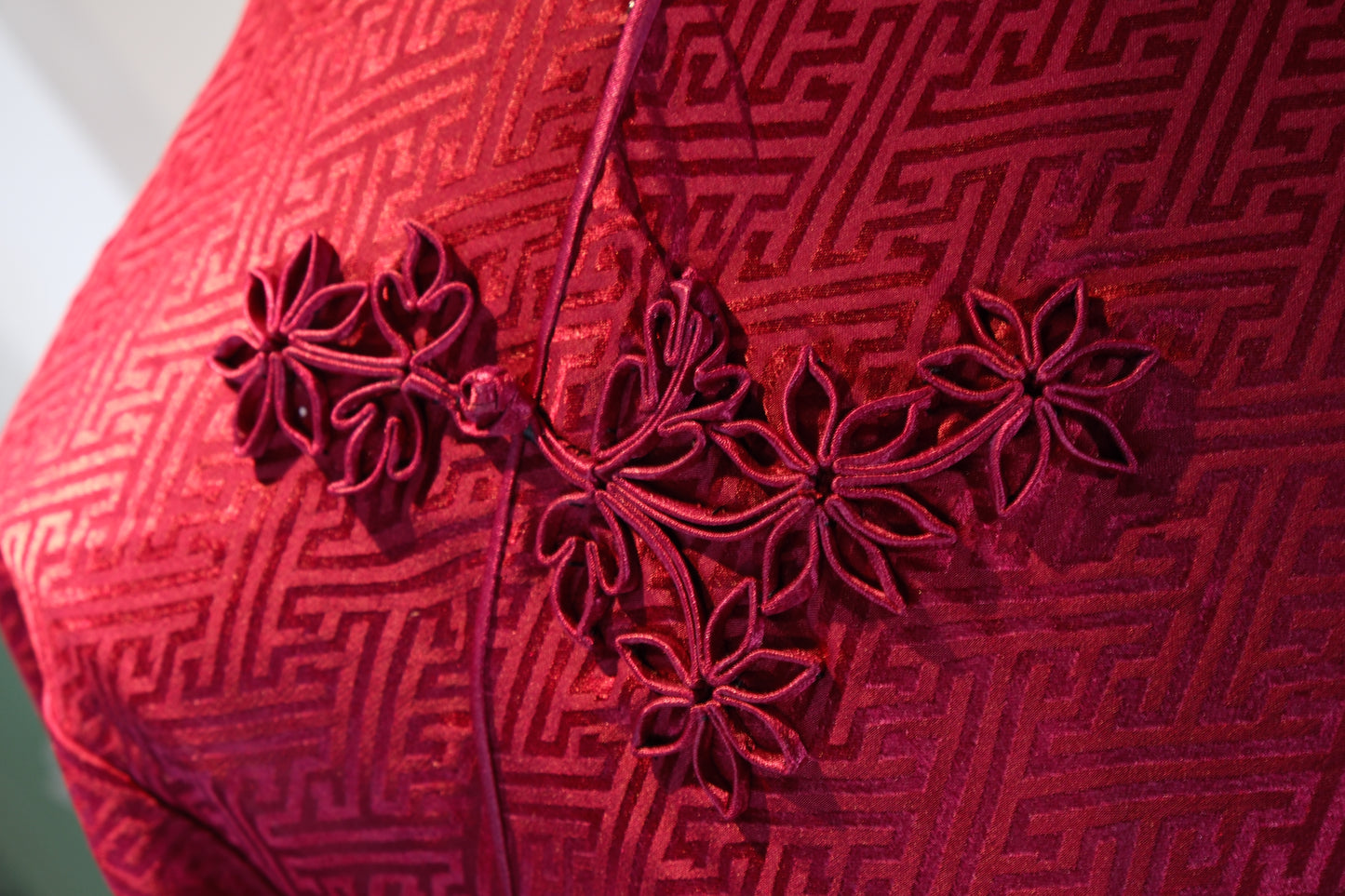
这件上世纪六十年代的香港产古董旗袍,面料为暗纹提花织锦,通体铺陈着连绵不断的“回字纹”(亦称“万字不到头”)。这种几何纹样源于新石器时代的彩陶,至商周青铜器上定型为雷纹变体,寓意“富贵不断、生生不息”。在六十年代的香港纺织业黄金期,工匠们将传统纹样与现代提花技术结合,使暗纹在光线下呈现出若隐若现的立体感——远看是沉稳的酒红底色,近观则是如迷宫般精密的几何肌理,既有宋锦的雅致,又具现代主义的秩序美。
领口至襟侧的“线香绲”(极细的包边工艺)如游丝般勾勒出旗袍的轮廓,而最点睛之笔莫过于那组“嵌丝硬花扣”:以金属丝为骨、丝线为肉,盘结成五瓣梅花造型。这种工艺源自清代宫廷“钉线绣”,但在六十年代的香港被改良为更具雕塑感的立体花扣,既保留了传统盘扣的吉祥寓意(梅花象征傲骨与高洁),又以硬朗的线条呼应了当时女性追求独立干练的时代精神。
二、古董衣的故事:香江裁缝的黄金时代
六十年代的香港,是东西方文化碰撞的熔炉,也是旗袍演变的巅峰期。彼时,上海裁缝南迁香港,带来了精湛的“海派”剪裁技艺,同时融入了西式立体剪裁的省道设计。这件旗袍正是那个时代的缩影:立领高度适中(区别于三十年代的高耸与四十年代的低矮),腰身收省精准(贴合人体曲线却不紧绷),袖长及腕(保留了传统长袖的端庄,又便于日常活动)。
它或许曾属于一位穿梭于中环写字楼与深水埗唐楼之间的职业女性——白天穿着它出席商务宴请,夜晚换上它赴一场粤剧戏院之约。酒红色的庄重与暗纹的低调,恰如其分地平衡了职场女性的干练与传统闺秀的温婉。在那个没有快时尚的年代,一件旗袍往往要经过量体、制版、裁剪、缝纫、熨烫等数十道工序,耗时数周方能完工,每一针一线都承载着匠人的体温与穿着者的故事。
三、艺术风格与稀缺性:不可复制的时光标本
从艺术史角度看,这件旗袍完美诠释了“中西合璧”的现代性。它摒弃了清代旗装的宽大平直,采用了西式服装的立体剪裁,使面料紧贴身体曲线,展现出女性自然的体态美;同时又坚守了中式服装的平面结构(如连袖、大襟),保留了东方服饰的含蓄韵味。这种“形西神中”的设计哲学,正是六十年代香港时装设计的核心精神。
其稀缺性更体现在三个方面:
1. 面料绝版:六十年代的提花织锦多采用真丝与人造丝混纺,随着环保法规与产业升级,此类高成本面料早已停产;
2. 工艺失传:“线香绲”要求工匠用0.3厘米宽的布条包边,且不能有丝毫褶皱,如今能掌握此技的匠人寥寥无几;“嵌丝硬花扣”更是需要极高的手工技巧,稍有不慎便会断裂变形;
3. 品相完好:历经六十载岁月,这件旗袍仍保持色泽鲜亮、无虫蛀、无破损,实属罕见。正如《考工记》所言:“天有时,地有气,材有美,工有巧,合此四者,然后可以为良。”这件旗袍正是天时、地利、材美、工巧的完美结晶。
四、结语:穿在身上的历史
张爱玲曾说:“衣服是一种言语,随身带着一种袖珍戏剧。”这件六十年代的香港古董旗袍,不仅是一件衣物,更是一段凝固的历史、一种活态的文化。它见证了香江的繁华与变迁,承载了东方女性的优雅与坚韧。今日穿上它,仿佛能与半个世纪前的时光对话,在举手投足间,续写那份永不褪色的东方风华。
Measurements / Size Guide:
Bust / Waist / Hips: 88/76/98 cm
Total Length: 115 cm
Detailed Description:
This antique qipao, produced in Hong Kong during the 1960s, features a damask jacquard brocade fabric entirely covered in a continuous Hui fretwork motif (also known as the "infinite Wan character grid"). This geometric pattern originates from painted pottery of the Neolithic era and was later finalized as a variation of the thunder motif (lei wen) on Shang and Zhou dynasty bronzes, symbolizing "eternal wealth and unbroken vitality." During the golden era of the Hong Kong textile industry in the 1960s, artisans combined traditional motifs with modern jacquard weaving technology, allowing the hidden pattern to present a shifting, three-dimensional depth under light. From a distance, it displays a steady, wine-red ground color, yet close inspection reveals a geometric texture as precise as a maze—possessing both the refinement of Song dynasty brocades and the orderly beauty of modernism.
The "incense-line" piping (a hyper-fine edge-binding technique) running from the collar down along the diagonal lapel frames the silhouette of the qipao like a slender thread. However, the ultimate crowning detail is the set of wire-core stiffened flower closures (嵌丝硬花扣): crafted with metallic wire as the bone and silk thread as the flesh, they are knotted into a five-petaled plum blossom silhouette. This technique traces its lineage back to the "couching embroidery" (ding xian xiu) of the Qing imperial court, but was modified in 1960s Hong Kong into a three-dimensional flower closure with a more sculptural quality. It preserves the auspicious symbolism of traditional closures (the plum blossom representing unyielding character and high integrity) while using sharp, rigid lines to echo the era's spirit of independence and capability pursued by women.
Hong Kong in the 1960s was a melting pot where Eastern and Western cultures collided, marking the absolute peak of the qipao's evolution. During this period, Shanghai tailors migrated south to Hong Kong, bringing with them exquisite Shanghainese (hai pai) tailoring skills while openly integrating the dart designs of Western three-dimensional garment construction. This qipao is a perfect miniature of that era: the standing collar is moderate in height (distinct from the towering bands of the 1930s and the low cuts of the 1940s), the waist reduction through darts is highly precise (contouring to the body lines without being constricting), and the sleeve length reaches the wrists (preserving the dignity of traditional long sleeves while remaining practical for daily activity).
It may have once belonged to a professional woman navigating between the office buildings of Central and the tenement buildings (tong lau) of Sham Shui Po—wearing it to attend business banquets by day and changing into it for a Cantonese opera gathering by night. The solemnity of the wine-red tone and the understatement of the damask jacquard appropriately balanced a career woman's capability with a traditional lady's gentleness. In an era before fast fashion, a single qipao had to undergo dozens of manual processes—including measuring, pattern making, cutting, stitching, and hot-iron pressing—taking weeks to complete. Every single stitch pass carries the human warmth of the artisan and the personal story of the wearer.
From the perspective of art history, this qipao perfectly interprets the modernity of the "East-meets-West" synthesis. It discards the wide, flat, and straight lines of Qing dynasty robes, adopting Western three-dimensional tailoring to ensure the fabric closely contours the body's curves, showcasing the natural structural beauty of the female form. Concurrently, it firmly holds onto the flat, two-dimensional structure of Chinese garments (such as the continuous cut sleeves and the overlapping large lapel), preserving the modest restraint of Eastern clothing. This design philosophy of "Western form with Eastern spirit" (“形西神中”) represents the core spirit of 1960s Hong Kong fashion design.
Its scarcity is demonstrated across three distinct sectors:
绝版面料 (绝版面料): 1960s jacquard brocades predominantly utilized a blend of natural silk and rayon filaments. Driven by environmental regulations and industrial upgrading, this type of high-cost yardage has long since ceased production.
失传工艺 (失传工艺): "Incense-line" piping requires the artisan to bind edges using a fabric strip a mere 0.3 centimeters wide without causing the slightest wrinkle; today, very few craftsmen master this skill. The "wire-core stiffened flower closure" demands even greater manual dexterity, as any slight misstep will cause it to snap or deform.
品相完好 (品相完好): Spanning a sixty-year horizon, this qipao still maintains vivid coloration, completely free of insect damage or structural tears, which is exceptionally rare. Just as The Book of Diverse Crafts (《考工记》) notes: "The sky has its seasons, the earth has its climate, materials have their beauty, and craftsmanship has its skill; when these four converge, a masterpiece is made." This qipao stands as the perfect crystallization of season, climate, material beauty, and manual skill.
As Eileen Chang famously remarked, "Clothes are a language, a pocket theater carried around with oneself." This 1960s Hong Kong antique qipao is far more than a functional garment; it is a frozen slice of history, a living manifestation of culture. It witnessed the prosperity and transformation of the Fragrant Harbour, carrying the elegance and resilience of Eastern women. To slip it on today is to converse directly with a time from half a century ago, continuing that unfading Eastern glamour within every movement.
Suyuan Archival Textile Registry — Documenting the material culture, preserving the technical lineage of ancestral craft.