溯源
Couldn't load pickup availability
衣服尺寸:
胸围/腰围/臀围/衣长:94/86/100/96 厘米
细节描述:
年代: 上世纪五十年代末(The Fabulous 50s)
产地: 香港制作,面料源自法国进口
材质: 顶级机绣蕾丝(Machine-embroidered Lace)
工艺: 法式佩斯利重工刺绣、归拔工艺
一、 纹样考据:腰果花里的“富贵迷宫”
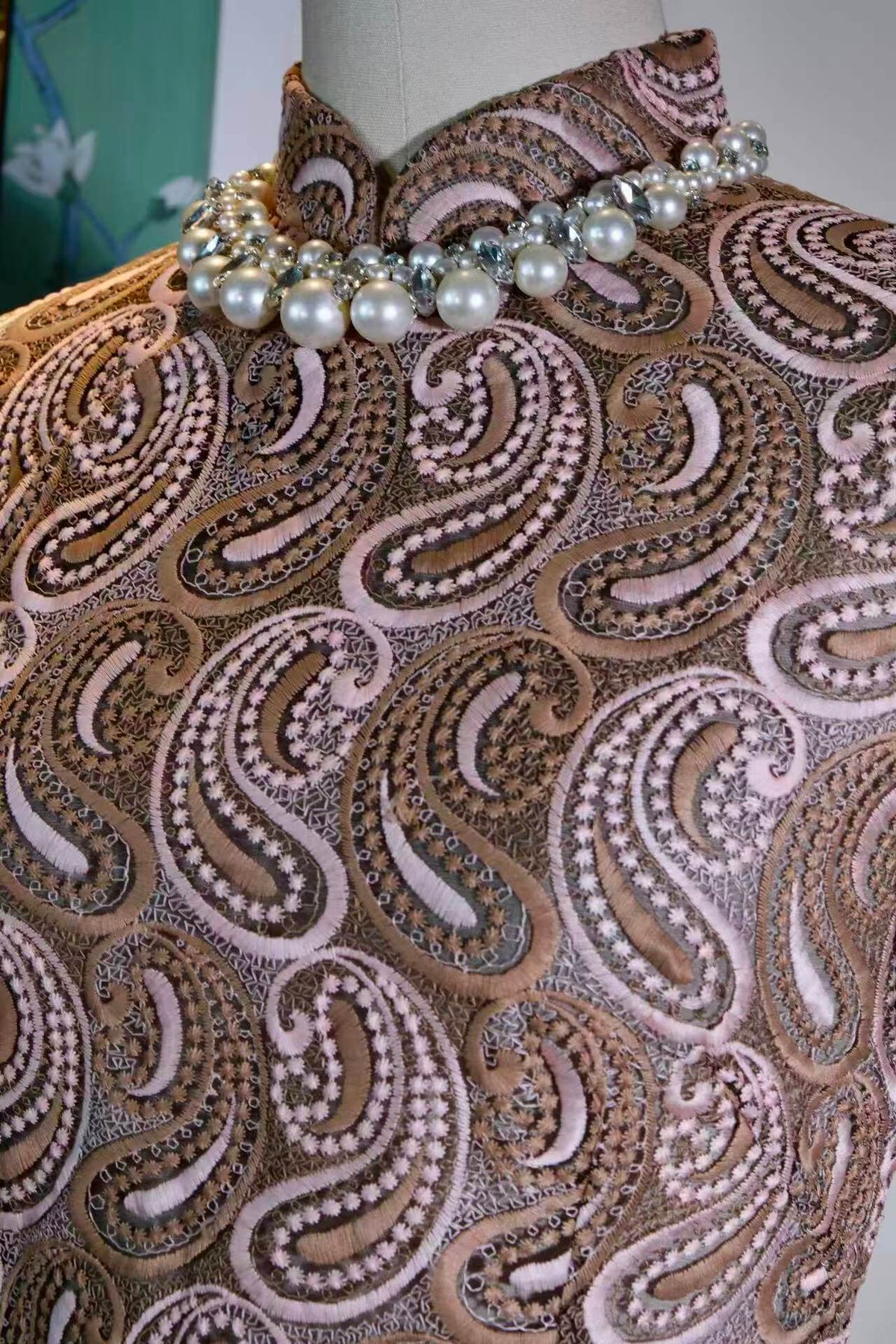
这件旗袍最摄人心魄的,莫过于其满铺的纹样。在服装史学中,这被称为“佩斯利”(Paisley)纹样,中国民间俗称“腰果花”。
这并非普通的印花,而是采用了法国进口的重工机绣蕾丝。请细看这层叠的曲线——那是源自波斯与克什米尔地区的古老图腾,形如泪滴,又似蚕茧。在十九世纪的欧洲,它是拿破仑远征带回的东方神秘符号,在维多利亚时代被西方贵族视为奢华与异域风情的代名词。
到了上世纪五十年代的香港,这股来自塞纳河畔的西风,与东方的审美撞了个满怀。设计师并未使用传统的龙凤呈祥或梅兰竹菊,而是大胆选用了这种带有强烈Art Deco(装饰艺术)风格的几何卷草纹。
这种“法式蕾丝+中式旗袍”的结合,是极其罕见且奢侈的。面料上的刺绣呈现出一种浮雕般的立体感,棕金、藕粉与灰蓝交织,如同油画般厚重。它不仅仅是布料,更像是一幅流动的、带有巴洛克式繁复美感的挂毯。
二、 剪裁美学:黄金时代的“风刀霜剑”
作为服装史研究者,我们常说:“五十年代的旗袍,是女性身体雕塑艺术的巅峰。”
这件藏品的版型,是典型的“海派西化”风格。请注意其领口、袖口与腰身的比例:
1. 低领设计: 相比民国初期的元宝领,50年代的旗袍领高降低,露出颈部线条,这与当时的好莱坞明星如格蕾丝·凯利(Grace Kelly)的优雅审美不谋而合。
2. 收腰与归拔: 旗袍的腰身收得极紧,这需要老裁缝运用高超的“归拔”熨烫工艺,使平面的布料顺应女性胸、腰、臀的S型曲线,达到“虽由人作,宛自天开”的贴合度。这种剪裁在当时被称为“风刀霜剑严相逼”,意在雕琢出女性极致的柔美与挺拔。
3. 西式袖型: 这种略带蓬松感的短袖,实际上是融合了西式洋装(Blouse)的结构,既修饰了手臂线条,又增添了几分少女的娇俏。
三、 岁月回响:香江夜雨中的绝代风华
若要为这件古董衣撰写故事,那一定发生在一个香江潮湿而迷离的夜晚。
上世纪五十年代的香港,是东西方文化碰撞的最前线。那是张爱玲笔下的世界,也是邵氏电影里霓虹闪烁的年代。这件旗袍,极有可能出自一位深受西式教育、家境殷实的“名媛”或“名伶”之手。
试想当年,一位身着此裙的女士,或许刚刚在半岛酒店享用过下午茶,面料上那精致的法式机绣,在维多利亚港的海风中,随着她的步伐熠熠生辉。这种面料在当时是极其昂贵的“洋货”,非普通人家所能拥有。它见证了那个时代女性在传统与现代、东方与西方之间的挣扎与融合——她们依然穿着旗袍,但旗袍的内里,已经开始容纳一个更广阔、更自由的世界。
这件旗袍不仅仅是一件衣服,它是那个黄金时代遗落在人间的琥珀。
四、 稀缺性评估:博物馆级的遗珠
在古董衣收藏界,“蕾丝旗袍”虽不罕见,但如此“重工法式机绣佩斯利”且保存状态如此完美的孤品,实属凤毛麟角。
1. 面料的不可再生性: 这种五十年代法国进口的机绣蕾丝,其工艺繁复,成本极高,随着战后纺织工业的变革,这种质感的面料已逐渐停产。每一寸绣线都蕴含着无法复制的时间成本。
2. 保存的奇迹: 蕾丝是极其娇贵的材质,历经七十余载,竟未见明显的破洞或脆化,且色泽依旧温润,这在收藏界被称为“传世级”品相。
3. 艺术的孤本性: 它完美诠释了“中西合璧”的最高境界。它既有法式的浪漫繁复,又有中式的含蓄端庄。这种风格在五十年代末开始逐渐被更简化的现代装束取代,因此它是那个过渡时代最后的辉煌。
结语:
张爱玲曾言:“衣服是一种言语,随身带着的袖珍戏剧。”这件五十年代的佩斯利蕾丝旗袍,就是一出未曾落幕的戏剧。它不言不语,却用最繁复的针脚、最考究的剪裁,诉说着一位女性曾经的骄傲与风华。
这不仅仅是一件可以穿在身上的古董,更是一件值得被珍藏、被凝视的艺术品。
(注:文案中提及的珍珠配饰为后期搭配建议,非旗袍本体,旨在衬托其高贵气质。)
Measurements / Size Guide:
Bust / Waist / Hips / Total Length: 94/86/100/96 cm
Detailed Description:
Era: Late 1950s (The Fabulous 50s)
Origin: Made in Hong Kong; fabric imported from France
Material: Top-tier Machine-embroidered Lace
Craftsmanship: French Paisley heavy embroidery, shaping and ironing techniques (Gui Ba)
I. Motif Research: The "Opulent Labyrinth" in the Paisley Pattern
The most breathtaking aspect of this cheongsam is undoubtedly its all-over patterned motif. In fashion history, this is known as the "Paisley" pattern, colloquially referred to in Chinese folk tradition as the "cashew flower" (Yao Guo Hua).
This is no ordinary print, but heavy machine-embroidered lace imported from France. Take a close look at these layered curves—a ancient totem originating from the regions of Persia and Kashmir, shaped like a teardrop or a silkworm cocoon. In 19th-century Europe, it was an exotic Eastern symbol brought back by Napoleon's expeditions, considered by Western aristocracy during the Victorian era as a synonym for luxury and foreign charm.
By the 1950s in Hong Kong, this Western breeze from the banks of the Seine collided full-on with Eastern aesthetics. Designers bypassed traditional auspicious motifs like dragons, phoenixes, plum blossoms, orchids, bamboo, or chrysanthemums, opting instead for this bold geometric scroll pattern possessing a strong Art Deco flair.
This combination of "French lace + Chinese cheongsam" is extraordinarily rare and extravagant. The embroidery on the fabric presents a relief-like three-dimensional feel, interweaving brown-gold, lotus-root pink, and grey-blue tones with the heavy richness of an oil painting. It is far more than mere cloth—it is like a flowing tapestry imbued with Baroque ornate beauty.
II. Tailoring Aesthetics: "Wind Blades and Frost Swords" of the Golden Age
As costume history researchers, we often say: "The cheongsam of the 1950s is the absolute pinnacle of female body-sculpting art."
The silhouette of this collector's piece is a classic exemplar of "Shanghai-style Westernized" design. Observe the proportions of its neckline, cuffs, and waist:
Low-Collar Design: Compared to the high ingot collars (Yuan Bao Collar) of the early Republican era, 1950s cheongsam collars dropped in height to reveal the necklines, aligning perfectly with the elegant aesthetic of Hollywood stars of that era, such as Grace Kelly.
Cinched Waist and Shaping (Gui Ba): The waist of the cheongsam is cinched extremely tight. This required master tailors to employ superb "shaping and ironing" (Gui Ba) techniques, forcing flat fabric to yield to the female body's bust, waist, and hip S-curves, achieving a fit so seamless it feels "crafted by human hands yet appearing as if forged by nature." This tailoring style back then was referred to as "the fierce pressure of wind blades and frost swords," designed to carve out the ultimate female softness and upright posture.
Western-Style Sleeves: These short sleeves with a subtle puff structure actually incorporate elements of Western blouses, refining the arm contours while adding a touch of youthful charm.
III. Echoes of Time: Peerless Elegance in Hong Kong's Night Rain
If one were to write a story for this vintage garment, it would certainly be set on a humid, misty night in Hong Kong.
Hong Kong in the 1950s sat on the absolute frontline of Eastern and Western cultural collisions. That was the world in Eileen Chang's writings, as well as the neon-flickering era depicted in Shaw Brothers cinema. This cheongsam was very likely commissioned by a well-to-do "socialite" or "screen legend" who was deeply educated in Western traditions.
Imagine a lady wearing this gown decades ago—perhaps she had just enjoyed afternoon tea at The Peninsula Hotel. The delicate French machine-embroidery on her fabric sparkled in the sea breeze across Victoria Harbour with every step she took. This fabric was an extraordinarily expensive "foreign commodity" at the time, far beyond the reach of ordinary households. It bore witness to women's struggles and harmony between tradition and modernity, East and West—they still wore cheongsams, but inside those cheongsams, they had begun to embrace a broader, freer world.
This cheongsam is not merely an item of clothing; it is amber dropped into the human realm from that golden age.
IV. Rarity Assessment: A Museum-Grade Gem
In the vintage clothing collection sphere, while "lace cheongsams" are not unheard of, a one-of-a-kind piece with such "heavy French machine-embroidered Paisley" in such a flawless state of preservation is a true rarity.
Non-Renewable Fabric: This machine-embroidered lace imported from France in the 1950s featured intricate craftsmanship at an astronomical cost. Following the post-war industrial shifts in textiles, fabrics with this specific texture gradually went out of production. Every inch of embroidery thread carries an irreplaceable cost of time.
Miraculous Preservation: Lace is an extraordinarily delicate material. Surving over seven decades without noticeable tearing or brittleness while retaining warm color tones is referred to in collector circles as a "generational-grade" specimen.
One-of-a-Kind Artistic Character: It flawlessly interprets the highest realm of "East-meets-West." It possesses French romantic complexity alongside Eastern subtlety and dignity. This style began giving way to more simplified modern attire in the late 1950s, making it the final flourish of that transitional era.
Epilogue
Eileen Chang once remarked: "To those who cannot speak, clothes are a language, carrying with them a pocket-sized drama wherever they go." This 1950s Paisley lace cheongsam is an un-ended drama. It speaks no words, yet through its most intricate stitches and most refined tailoring, it tells the story of a woman's past pride and elegance.
This is not only a piece of vintage history you can wear on your body, but an artwork worthy of being treasured and gazed upon.
(Note: The pearl accessories mentioned in the text are suggestions for later styling, not part of the cheongsam itself, intended to highlight its noble temperament.)