紫魅惊鸿:1940年代末织锦提花旗袍的艺术考古
这件诞生于1940年代末至1950年代初的织锦旗袍,以紫红缎面为底,暗合《礼记·檀弓》“衣正色,裳间色”之古训。立领斜襟勾勒东方骨相,七分袖设计平衡古典与现代——此为海派旗袍鼎盛时期的典型剪裁,既承袭民国女服的“倒大袖”遗韵,又吸纳西方时装的人体曲线美学。
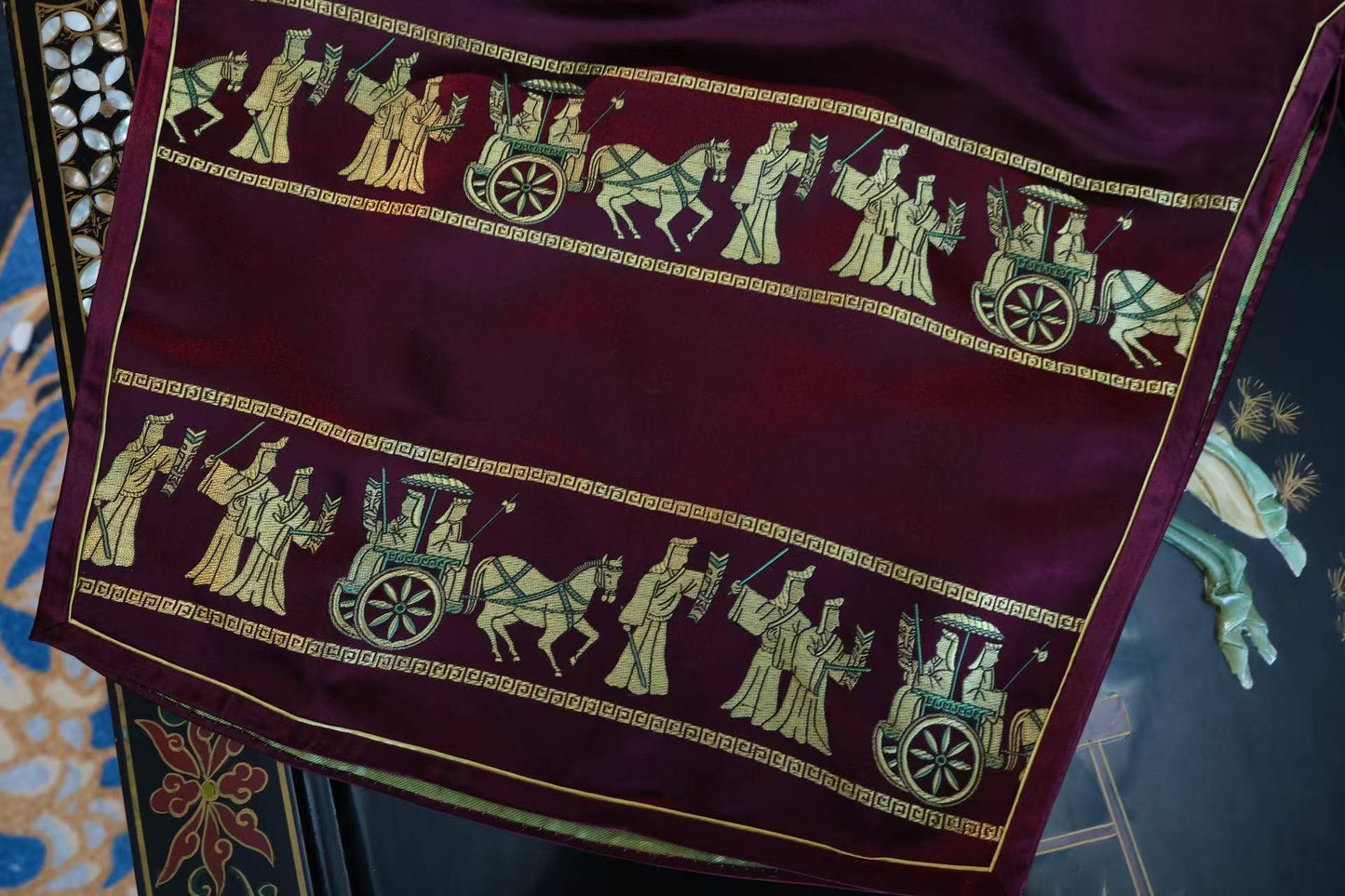
旗袍通身以金线织就“车马出行图”,其构图逻辑直溯战国漆器与汉代画像石。每组纹样以回纹边框分隔,形成“图必有意,意必吉祥”的视觉叙事:
- 车马仪仗:驷马高车(参考战国青铜车马器造型)居中,御者执辔,车上立伞盖——此非寻常出行,乃《周礼·春官》所载“王乘金辂,建大旗”之礼制缩影;
- 侍从仪态:侍从分持羽扇、宝剑、卷轴,衣袂飘然,动作遵循《考工记》“画缋之事,杂五色”原则,以平涂填色法再现古画线条;
纹样中“车马出行”母题,从战国青铜壶到唐代绞缬,再到清代缂丝,千年间始终作为“身份与礼仪”的象征。此袍将古礼融入日常服饰,堪称“移动的礼仪图腾”。
这件旗袍绝非单纯衣物,而是以织物为载体的“活化石”:它让《周礼》的车马仪仗、汉代画像石的古朴线条、宋代缂丝的精妙技法,在1940年代的上海滩重焕新生。其稀缺性在于——当传统工艺在战火中凋零,它以一袭酒红金纹,完成了对中华服饰美学的终极致敬。
🍇 Purple Glamour, Startled Swan: An Artistic Archeology of a Late 1940s Brocade Cheongsam
This brocade cheongsam, born between the late 1940s and early 1950s, features a purplish-red satin base, subtly aligning with the ancient ritual precept from the Book of Rites: Tan Gong: "The upper garment in primary colors, the lower in secondary colors." The standing collar and diagonal placket outline the "Oriental bone structure," while the three-quarter sleeves balance classical and modern sensibilities. This is a typical cut from the peak of the Shanghai-style (Haipai) era—inheriting the "inverted bell sleeve" charm of the Republic period while absorbing the body-curve aesthetics of Western fashion.
The entire garment is woven with gold thread depicting "Chariot and Horse Procession" scenes, a compositional logic tracing back to Warring States lacquerware and Han Dynasty pictorial stones. Each set of motifs is separated by fretwork (Meander) borders, forming a visual narrative where "every pattern has a meaning, and every meaning is auspicious":
-
The Chariot and Horse Guard: A grand carriage drawn by four horses (modeled after Warring States bronze chariot artifacts) sits at the center, with a driver holding the reins under a standing parasol. This is no ordinary excursion, but a miniature of the ritual system recorded in the Rites of Zhou: Chun Guan: "The King rides in the Golden Chariot, hoisting the great banners."
-
The Attendants: Attendants hold feather fans, swords, and scrolls, their robes fluttering. Their movements follow the principle in Kao Gong Ji (The Examiner of Crafts): "In the work of painting and embroidery, five colors are mixed," reproducing the lines of ancient paintings through flat-color filling techniques.
The "Chariot and Horse Procession" motif has remained a symbol of "status and ritual" for millennia, spanning from Warring States bronze jars to Tang Dynasty tie-dyeing and Qing Dynasty Kesi (tapestry silk). By integrating ancient rites into everyday attire, this robe serves as a "mobile ritual totem."
This cheongsam is by no means a simple garment; it is a "living fossil" using fabric as its medium. It allows the chariot rituals of the Rites of Zhou, the primitive lines of Han pictorial stones, and the exquisite techniques of Song Kesi to be reborn on the Shanghai Bund of the 1940s. Its scarcity lies in this—as traditional crafts withered amidst the flames of war, it completed an ultimate tribute to Chinese clothing aesthetics through a single length of wine-red and gold-woven silk.