纹间春秋:一件四十年代提花旗袍的时空对话
在时光的褶皱里,总有些织物不甘被岁月磨平棱角。这件上世纪四十年代的提花古董旗袍,便是这样一件“会说话”的衣裳——它以经纬为笔,以丝线为墨,在方寸之间写尽了旧时光的风华与气韵。
一、图案:流动的几何诗篇
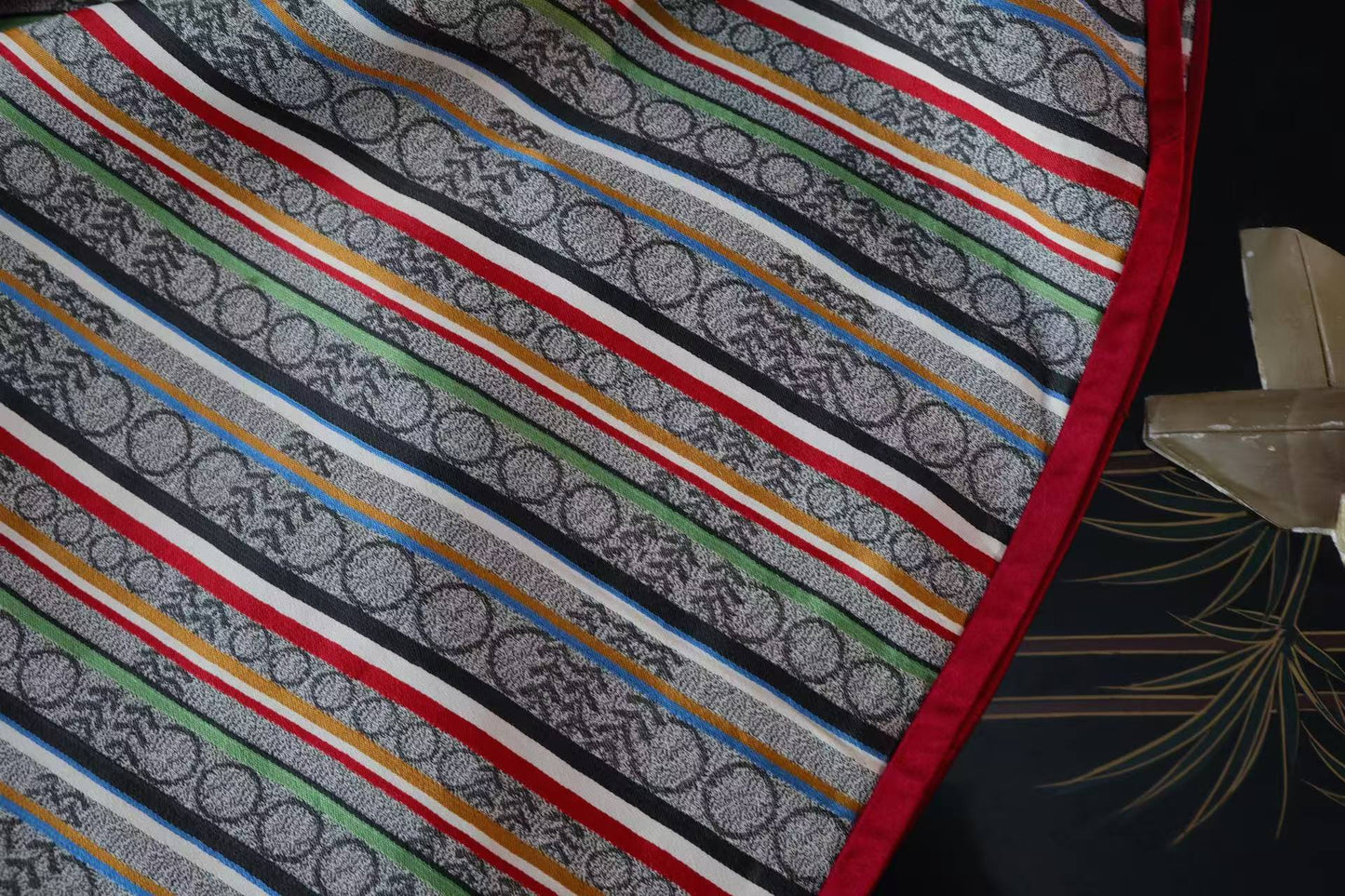
旗袍的面料采用提花工艺,将几何纹样与条纹美学演绎得淋漓尽致。细看那布面:无数细密的圆形纹样如星辰散落,在浅灰底色上勾勒出微妙的肌理;红、绿、蓝、黑等色的竖条纹则如琴弦般排列,与圆形纹样交织成和谐的韵律。这些线条并非生硬的几何切割,而是带着手工织造的温度,每一根线条的粗细变化、每一处色彩的过渡,都透着匠人指尖的呼吸。
领口与袖口的红色滚边,如同画龙点睛之笔,为整件衣裳注入了鲜活的暖意。而领口处的红色盘扣,更似一枚精致的印章,将东方美学的含蓄与雅致凝固在方寸之间。盘扣的造型婉转流畅,仿佛能让人看见当年女子在镜前细细系扣的温婉身影。
二、故事:穿在身上的时代记忆
四十年代的上海,是东西方文化碰撞的熔炉,也是旗袍艺术的黄金时代。这件旗袍诞生于那个风云际会的年代,它的身上,藏着太多关于“新”与“旧”的故事。
当时的女性,既受传统礼教的熏陶,又沐浴着现代文明的曙光。她们穿着旗袍走在外滩的街头,高开叉的裙摆露出纤细的脚踝,丝质面料在阳光下泛着温润的光泽。这件旗袍的版型,正是那个时代的缩影——它保留了传统旗袍的立领、斜襟、盘扣等经典元素,却又在剪裁上更加贴合人体曲线,展现出女性的柔美与独立。
面料的选择也暗含深意。提花工艺在当时属于较为考究的织造技术,而这种几何条纹的图案,既保留了中式纹样的雅致,又隐约透着西方现代艺术的简洁。它像是一个时代的隐喻:在传统与现代的夹缝中,寻找着属于自己的表达方式。
三、艺术与稀缺:凝固的美学标本
从艺术价值来看,这件旗袍堪称“行走的装饰艺术”。它的图案设计遵循着严格的对称与重复原则,却在细节处留有呼吸的空间。那些圆形纹样,或许源自中国传统吉祥图案中的“团花”意象,象征着圆满与和谐;而竖条纹的排列,则呼应了装饰艺术运动中对几何美学的推崇。这种中西合璧的设计,让旗袍在视觉上既有东方的含蓄,又有西方的明快。
而从稀缺性而言,历经八十余年的岁月洗礼,这样保存完好的提花古董旗袍已属凤毛麟角。当时的提花面料多为进口或手工定制,成本高昂;而旗袍的制作更是需要经验丰富的裁缝,一针一线皆是心血。如今,我们能在这件旗袍上看到的,不仅是精湛的工艺,更是一个时代的生活美学与文化记忆。
四、结语:衣香鬓影,终成绝响
张爱玲曾说:“对于不会说话的人,衣服是一种言语,随身带着的一种袖珍戏剧。”这件四十年代的提花旗袍,正是这样一部袖珍戏剧。它曾见证过舞会的霓虹、咖啡馆的低语、外滩的晚风,也曾在某个清晨,伴着女主人的胭脂香,成为一道流动的风景。
如今,它静静躺在那里,如同一本泛黄的旧书,等待着懂它的人来翻阅。当我们凝视这件旗袍,看到的不仅是布料与针线,更是一个时代的审美、一群女性的追求,以及一段永不褪色的光阴故事。
Chronicles Between the Threads: A 1940s Jacquard Qipao’s Dialogue with Time
In the folds of time, some fabrics refuse to be smoothed over by the years. This 1940s antique jacquard Qipao is a "speaking" garment—using warp and weft as its brush and silk thread as its ink to write the elegance and spirit of bygone days within its measured inches.
I. Pattern: A Fluid Geometric Poem
The fabric employs a jacquard technique to masterfully interpret geometric motifs and stripe aesthetics. Upon closer inspection, countless tiny circular patterns are scattered like stars, creating a subtle texture on the light gray base. Vertical stripes in red, green, blue, and black are arranged like harp strings, interlacing with the circles in a harmonious rhythm. These lines are not rigid; they carry the warmth of hand-weaving—the varying thickness of each thread and the transitions of color breathe with the artisan's touch.
The red piping at the collar and cuffs acts as a finishing touch, injecting a vivid warmth into the garment. The red Pankou (frog buttons) at the collar resemble exquisite seals, freezing the reserve and refinement of Oriental aesthetics. Their fluid shapes evoke the image of a woman from the past, delicately fastening her collar before a mirror.
II. Narrative: A Wearable Memory of an Era
Shanghai in the 1940s was a melting pot of East and West, and a golden age for Qipao art. This garment was born in that era of great change, concealing stories of the "old" and the "new." Women then were nurtured by tradition yet bathed in the dawn of modern civilization. The silhouette of this Qipao is a microcosm of that time—preserving classic elements like the standing collar and diagonal bodice while adopting a contoured cut that showcases both feminine grace and independence.
III. Art and Rarity: A Frozen Aesthetic Specimen
Artistically, this Qipao is "walking Art Deco." Its pattern design follows strict principles of symmetry and repetition while leaving room for "breath" in the details. The circular motifs may stem from the traditional "Tuan Hua" (medallion flower) symbolizing harmony, while the vertical stripes echo the geometric obsession of the Art Deco movement. This fusion creates a visual that is both Orientally subtle and Westernly vibrant.
In terms of rarity, surviving 1940s jacquard pieces are few and far between. Jacquard fabrics were then often imported or custom-ordered at high cost, and each Qipao required a master tailor's painstaking handiwork. Today, we see not just craftsmanship, but the living aesthetics and cultural memory of an era.
IV. Conclusion: A Century’s Echo
As Eileen Chang said: "To those who cannot speak, clothes are a language; they carry with them a pocket drama." This 1940s Qipao is precisely such a drama. It has witnessed the neon of ballrooms, the whispers in cafes, and the evening breeze of the Bund. It remains like a yellowed book, waiting for someone who understands its language to turn its pages.