深圳溯源
Couldn't load pickup availability
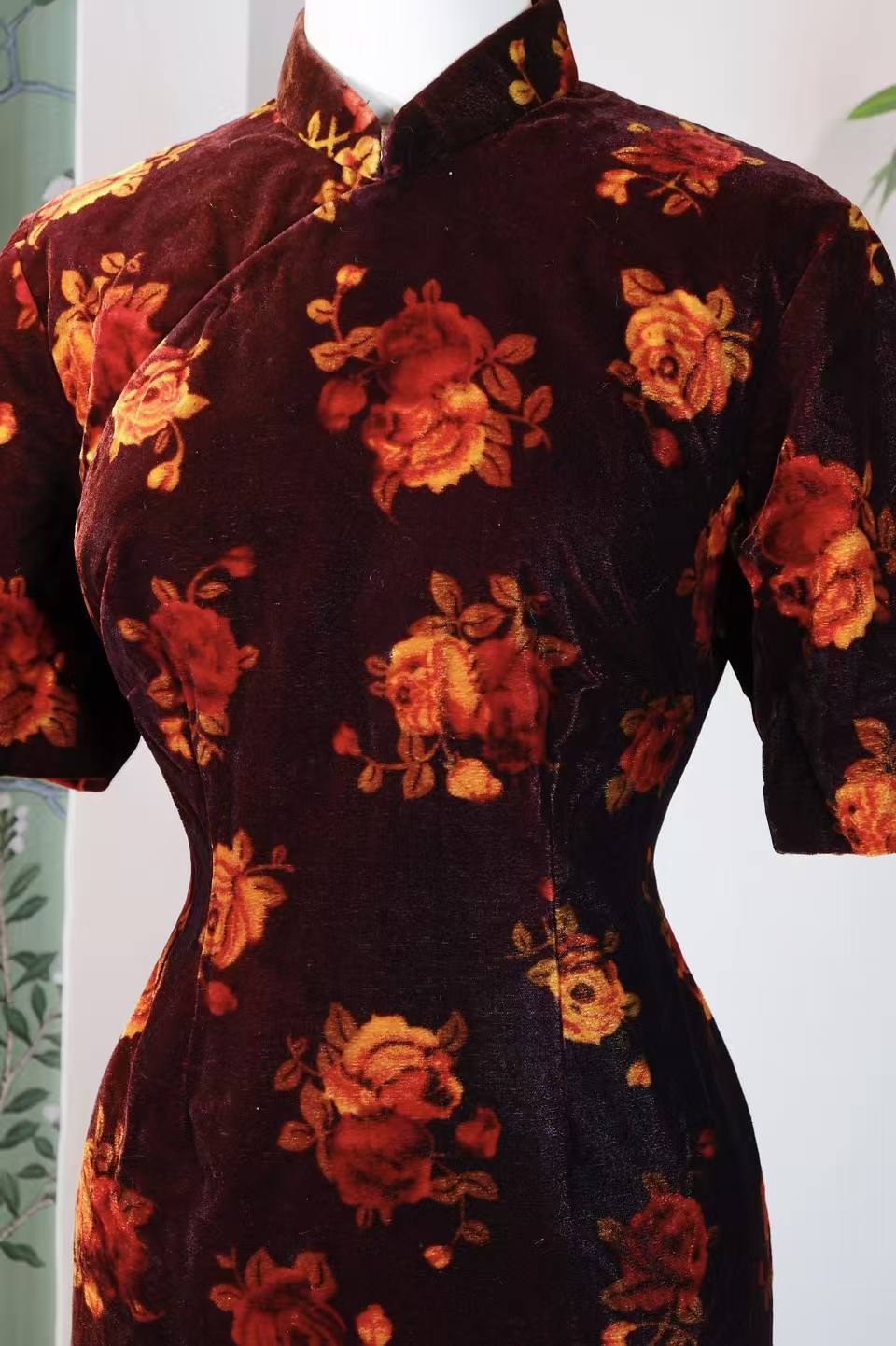
五十年代丝绒印花旗袍:岁月织就的东方诗篇
深酒红丝绒为底,橙黄与赭石色的玫瑰花簇如晚霞般铺展,
这件产自上世纪五十年代台湾的旗袍,
丝绒面料的“割绒”工艺,使得布面绒毛呈现微妙的光泽变化——
从艺术风格看,这件旗袍完美诠释了“民国遗韵,台湾新生”
这件旗袍的美学密码,可追溯至《诗经》“青青子衿,悠悠我心”
更有趣的是,玫瑰印花的选择,暗合了民国时期“中西合璧”
当您凝视这件旗袍,仿佛能看见五十年代台北街头,
Against a backdrop of deep burgundy velvet, clusters of orange-yellow and ochre roses spread like a sunset glow. The overlapping petals are suffused with warm gradients, while the stems and leaves, outlined in forest green, intertwine across the garment in a balanced dance. This "Man-Di-Jiao" (all-over floral) layout inherits the rhythmic vitality of Ming and Qing dynasty textiles while integrating the Western floral refinements of the Republican era. The realistic form of the roses meets the cadence of Chinese entwined vines, evoking Eileen Chang’s famous imagery of "splendid yet desolate" beauty, radiating a mellow warmth within the velvet’s luster.
Crafted in 1950s Taiwan, this Qipao was born in a unique fold of history. During this period, master tailors from the Jiangnan region migrated to Taiwan, fusing the exquisite "Shanghai-style" (Haipai) craftsmanship with local textile techniques. The choice of velvet continues the trend favored by 1930s Shanghai socialites for its opulence, while reflecting a longing for "refined living" during Taiwan’s early economic takeoff. The heavy drape of the velvet and the complexity of the prints epitomize the era’s fusion of old and new: retaining the traditional standing collar and side slits while adopting a more body-conscious silhouette influenced by Western aesthetics.
The "cut-pile" technique of the velvet allows the surface to shimmer with subtle light changes. As the wearer moves, the rose patterns seem to "breathe" against the crimson base—a dynamic beauty that modern machine-woven fabrics can hardly replicate.
Artistically, this piece perfectly interprets the aesthetic of "Republican Remnants, Taiwanese Rebirth." Its tailoring discards the looseness of the 1920s in favor of a "wasp waist and curved hip" cut that highlights the female form with dignity. The moderate height of the slits creates a "glimpse of grace" with every step, echoing the classical "lotus-born steps" of Dream of the Red Chamber. The color palette aligns with the traditional Chinese "Five Colors" theory—red for honor and yellow for nobility—resulting in an Oriental aesthetic that is "rich but not vulgar, brilliant but not flamboyant."
The aesthetic code of this Qipao can be traced back to the Book of Songs: "Green is your collar, deep is my longing." The standing collar and diagonal bodice frame the neck and waist into flowing lines, reminiscent of the classical "willow-waist" imagery. Meanwhile, the warmth of the velvet echoes the ritual tradition of "clothing must be embroidered" from the Book of Rites, embodying the cultural concept of "clothing as a carrier of the Way" (Yi Yi Zai Dao).
Interestingly, the rose print reflects the "East-meets-West" mindset of the time. As Lin Yutang noted, Chinese character is a blend of ancient tradition and modern baptism. These roses are neither purely Western realism nor purely Chinese abstraction; they are Western flora reorganized through Oriental compositional rules (such as the S-shaped vine), like a cross-cultural dialogue frozen in fabric.
To gaze upon this Qipao is to see a woman in 1950s Taipei, carrying a bamboo handbag through the shadows of an arcade, the rustle of her hem mingling with the distant melody of Ye Lai Xiang (Evening Primrose). This is not merely static fabric; it is a poem composed of silk and time, waiting for those who understand it to turn this page of Oriental Aesthetics.