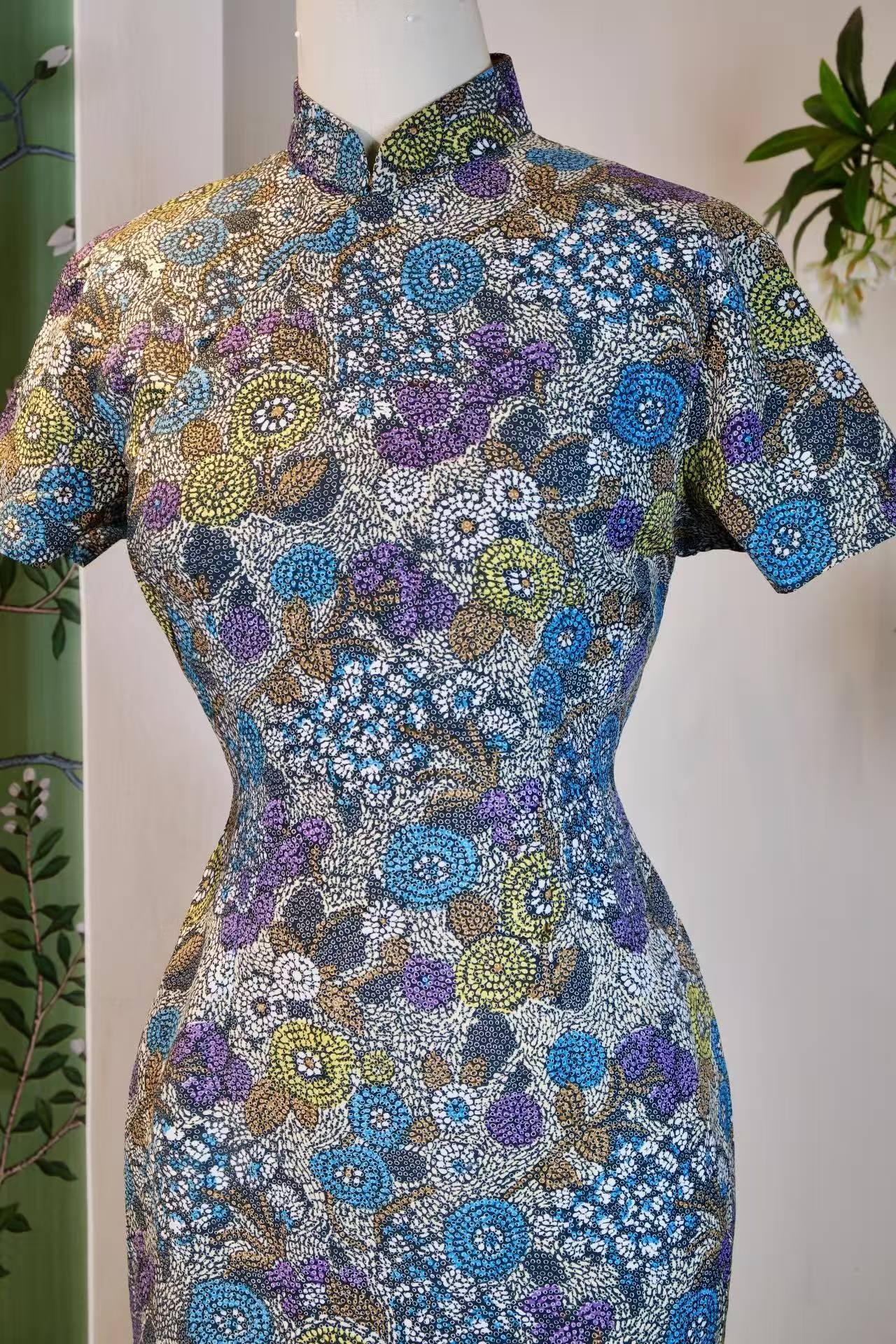
五十年代香港产抽象印花古董旗袍:穿在身上的现代主义诗篇
这件诞生于上世纪五十年代的香港产古董旗袍,堪称东方剪裁与西方现代艺术碰撞的孤品。其面料上的抽象印花,以点彩派笔触重构传统花卉意象:无数细密色点如星辰散落,蓝紫、赭黄、灰褐在米白底色上交织成流动的韵律,既似岭南庭院中繁花的朦胧倒影,又暗合抽象表现主义对“形式即内容”的哲学追求。这种突破写实传统的印花工艺,不仅彰显香港作为东西方文化熔炉的先锋性,更将旗袍从传统服饰升华为可穿戴的艺术画布。
在战后香港的霓虹与市井间,这件旗袍曾见证过怎样的故事?或许它的第一任主人是穿梭于兰桂坊的南洋归侨,以西式审美重塑东方衣装;又或是某位电影明星在夜总会的霓虹灯下,让印花随舞步流转成流动的星河。在那个旗袍从“礼教符号”向“女性自我表达”转型的年代,这件衣裳的紧身剪裁与大胆印花,恰是“新女性”挣脱束缚、拥抱现代性的无声宣言。
从工艺稀缺性而言,五十年代香港旗袍正处于“海派”余韵与本土创新的交汇期。此件作品采用全手工盘扣与滚边,面料的抽象印花需经多次套版印染,色点过渡的细腻度至今仍令现代数码印花望尘莫及。更难得的是,历经七十余载,印花未褪色、面料未脆化,每一处褶皱都凝固着时光的包浆,堪称“可触摸的服装史切片”。
正如张爱玲在《更衣记》中所言:“服装是随身带着的袖珍戏剧。”这件旗袍的抽象印花,何尝不是一场视觉的戏剧?那些看似随意的色点,实则是设计师对“留白”美学的现代诠释——不求形似,但求神韵,恰如中国水墨中的“逸笔草草”,在西方抽象艺术的语境下获得新生。它不仅是收藏家眼中的珍品,更是研究战后华人服饰文化转型的活化石,承载着香港从渔村到都会的集体记忆。
1950s Hong Kong Abstract Print Qipao: A Wearable Poem of Modernism
This antique Qipao, crafted in 1950s Hong Kong, stands as a rare masterpiece born from the collision of Oriental tailoring and Western modern art. Its abstract print reconstructs traditional floral imagery through a pointillist technique: countless fine dots of color scatter like stars. Blue-violet, ochre, and taupe intertwine on a cream-white base, creating a fluid rhythm that resembles both the hazy reflection of blossoms in a Lingnan garden and the philosophical pursuit of "form as content" found in Abstract Expressionism. This departure from realist traditions not only highlights Hong Kong's pioneering role as a cultural melting pot but also elevates the Qipao from traditional attire to a wearable artistic canvas.
Amidst the neon lights and bustling streets of post-war Hong Kong, what stories did this garment witness? Perhaps its first owner was a Southeast Asian returnee frequenting Lan Kwai Fong, reshaping Oriental dress with a Western aesthetic; or perhaps a movie star under the nightclub lights, letting the print swirl into a flowing galaxy with every dance step. In an era when the Qipao transitioned from a "symbol of ritual" to "female self-expression," the form-fitting cut and bold print of this piece served as a silent manifesto of the "New Woman" breaking free to embrace modernity.
Regarding technical rarity, 1950s Hong Kong Qipaos represent the intersection of "Shanghai-style" (Haipai) heritage and local innovation. This piece features entirely hand-fashioned frog buttons (Pankou) and piping. The abstract print required multiple rounds of block-printing and dyeing; the delicate transition of color dots remains a feat that modern digital printing struggles to rival. Remarkably, after seventy years, the colors remain vivid and the fabric intact—every fold capturing the "patina of time." It is, quite literally, a touchable slice of fashion history.
As Eileen Chang noted in Chronicle of Changing Clothes: "Clothing is a pocket drama carried with oneself." Is this abstract print not a visual drama in its own right? Those seemingly random dots are, in fact, a modern interpretation of the "leaving white" (Liubai) aesthetic—seeking spirit over literal resemblance. Like the "spontaneous brushwork" of Chinese ink painting reborn in the context of Western abstraction, this Qipao is more than a collector's prize; it is a living fossil of post-war Chinese cultural transformation, carrying the collective memory of Hong Kong’s evolution from a fishing village to a global metropolis.