深圳溯源
Couldn't load pickup availability
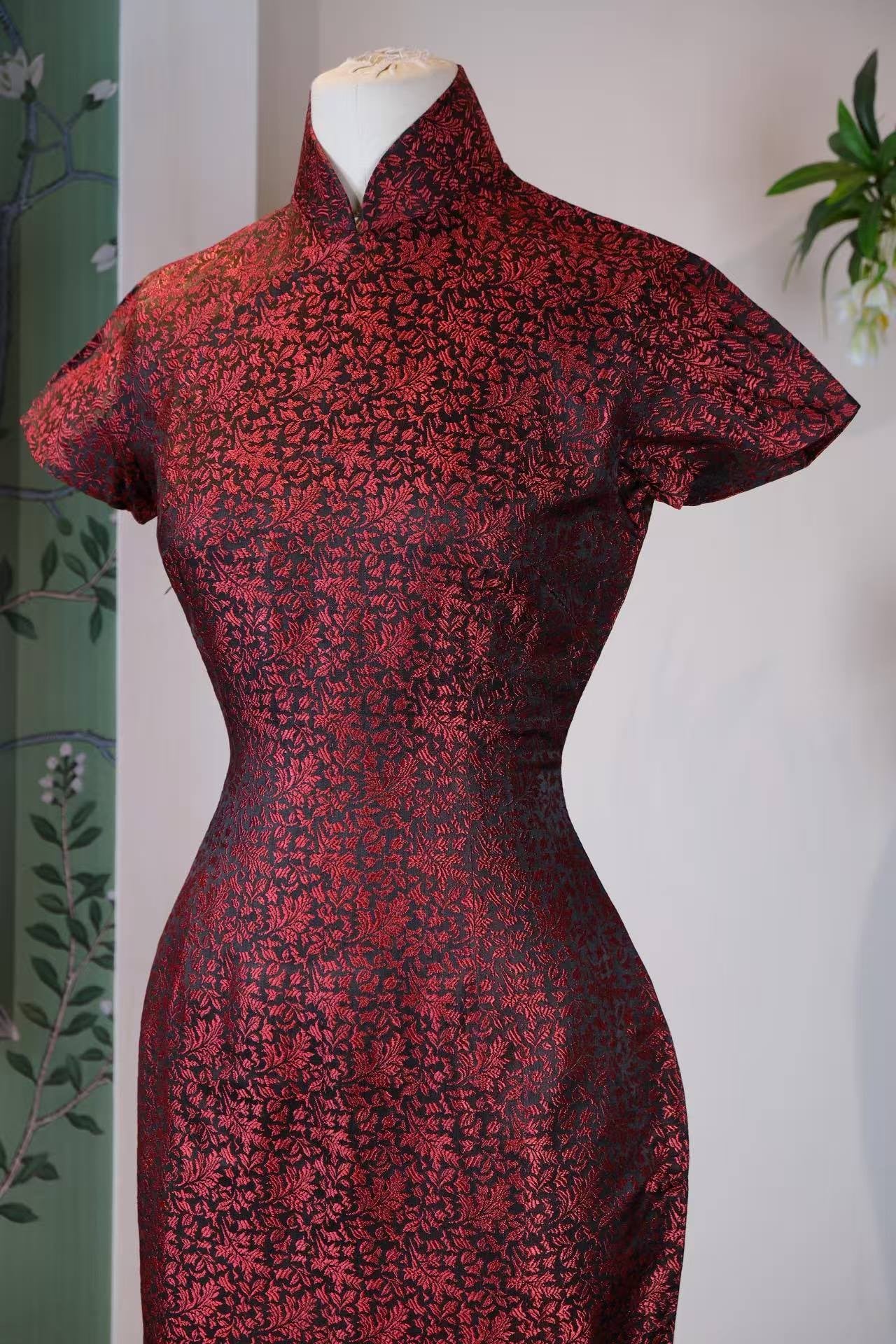
五十年代香港提花古董旗袍套装:锦纹织岁月,香云裁流年
一、器物述略:香江织造的时光标本
此套旗袍为上世纪五十年代香港制衣工坊之精品,
二、纹样考释:草木有情,锦纹载道
旗袍通体满布枝叶纹,细观之,叶脉曲直交错,形态近似“忍冬”
三、艺境阐微:织里藏真,裁月为裳
1. 织造之妙:此提花工艺属“纬起花”技法,以多综多蹑机织就,
2. 文化之脉:旗袍之红黑配色,暗合《考工记》“画缋之事,杂五色…
四、稀缺之证:沧海拾珠,吉光片羽
存世五十年代香港旗袍,多为四十年代沪工西迁之遗绪,
五、结语:衣香鬓影,香江未远
着此旗袍,恍若见五十年代香港街头:电车叮当,霓虹初上,
This suit is a masterpiece from a 1960s Hong Kong garment workshop. During the budding stage of Hong Kong's ready-to-wear industry, it inherited the techniques of Jiangnan tailors and integrated the ingenuity of Lingnan artisans, marking the initial fashion awakening of the "Pearl of the Orient." The fabric is a jacquard brocade woven from traditional mulberry silk. The red and black threads interweave to create subtle hidden patterns with a reserved luster—the red is like aged cinnabar, deep and composed; the black is like ancient ink on frost, moist yet resilient. The top features short sleeves and a standing collar with frog buttons scattered like stars, while the skirt is cinched at the knee. It preserves the grace of the Shanghai style while embodying the sleek tailoring of Hong Kong craftsmanship, serving as a microcosm of the "Neo-Traditionalist" aesthetic of post-war Chinese women.
The garment is entirely covered in leaf motifs. Upon close inspection, the veins interlace in a mix of "Honeysuckle" (Rendong) and "Scrollwork" (Juan Cao) variations. Honeysuckle, known in Sanskrit as Pundarika, is recorded in Buddhist sutras as "never withering in the cold, symbolizing the eternal Dharma body." The scrollwork carries the Han Dynasty wish for "longevity" and the celestial posture of the Wei and Jin dynasties. Woven with double-colored silk threads, the red leaves burn like flames while the black branches stand firm like iron. The three-lobed leaves are arranged in a rhythmic "wind-blown" stance. The edges of the leaves are meticulously outlined, with the centers showing a gradient transition, echoing the masterpiece of "Ink divided into five colors."
The Mastery of Weaving: This jacquard utilizes the "Weft-raised pattern" technique, woven on complex looms. The patterns are hidden beneath the surface, slightly raised to the touch but not slippery—an effect known as "Flowing Light on Hidden Patterns." With red silk as weft and black as warp, the density reaches 80 threads/cm, ensuring the garment is crisp yet draped, retaining its shape over decades—a signature of 1950s Hong Kong weaving houses like "Kam Kee" or "Shui Hing."
The Cultural Lineage: The red-and-black palette aligns with the ancient code of Kao Gong Ji: "The work of painting involves five colors... black and red together are called Xuan." Xuan represents the color of Heaven, and Crimson the color of Earth. Their intersection symbolizes "endless vitality." In 1950s Hong Kong, where East and West collided, this suit avoids the exposure of Western dress and the restriction of traditional robes. In the spirit of "Chinese essence with Western utility," it writes a "physical manifesto" for the Chinese woman.
Surviving 1950s Hong Kong Qipaos are mostly legacies of Shanghainese tailors who migrated south in the 1940s or early creations of local 1950s workshops. This set is perfectly preserved; the fabric shows no brittleness and the colors remain as new. Its pattern, tailoring, and craft are archetypal, making it a "living fossil of the Hong Kong garment industry." According to the History of Hong Kong Textiles, the annual output of jacquard brocade Qipaos in the 1950s was less than 3,000 pieces. After 70 years of vicissitudes, fewer than one in a hundred complete suits survive. As Eileen Chang said: "Clothes are a kind of memory; they hide the secrets of time."
To wear this Qipao is to see the streets of 1950s Hong Kong: the clanging of trams, the flickering neon lights, a woman holding a parasol, her heels clicking on the stone path, as the red and black brocade flows like fire. It is more than a garment; it is a fragment of history, a carrier of culture, and a poem for women. The weaver used silk as a brush and the tailor used fabric as paper to write a volume of the "Chronicles of Hong Kong Grace." Encountering this treasure today is like reading a rare annotated edition of Dream of the Red Chamber—every word is a gem, every piece a masterpiece to be collected.