深圳溯源
Couldn't load pickup availability
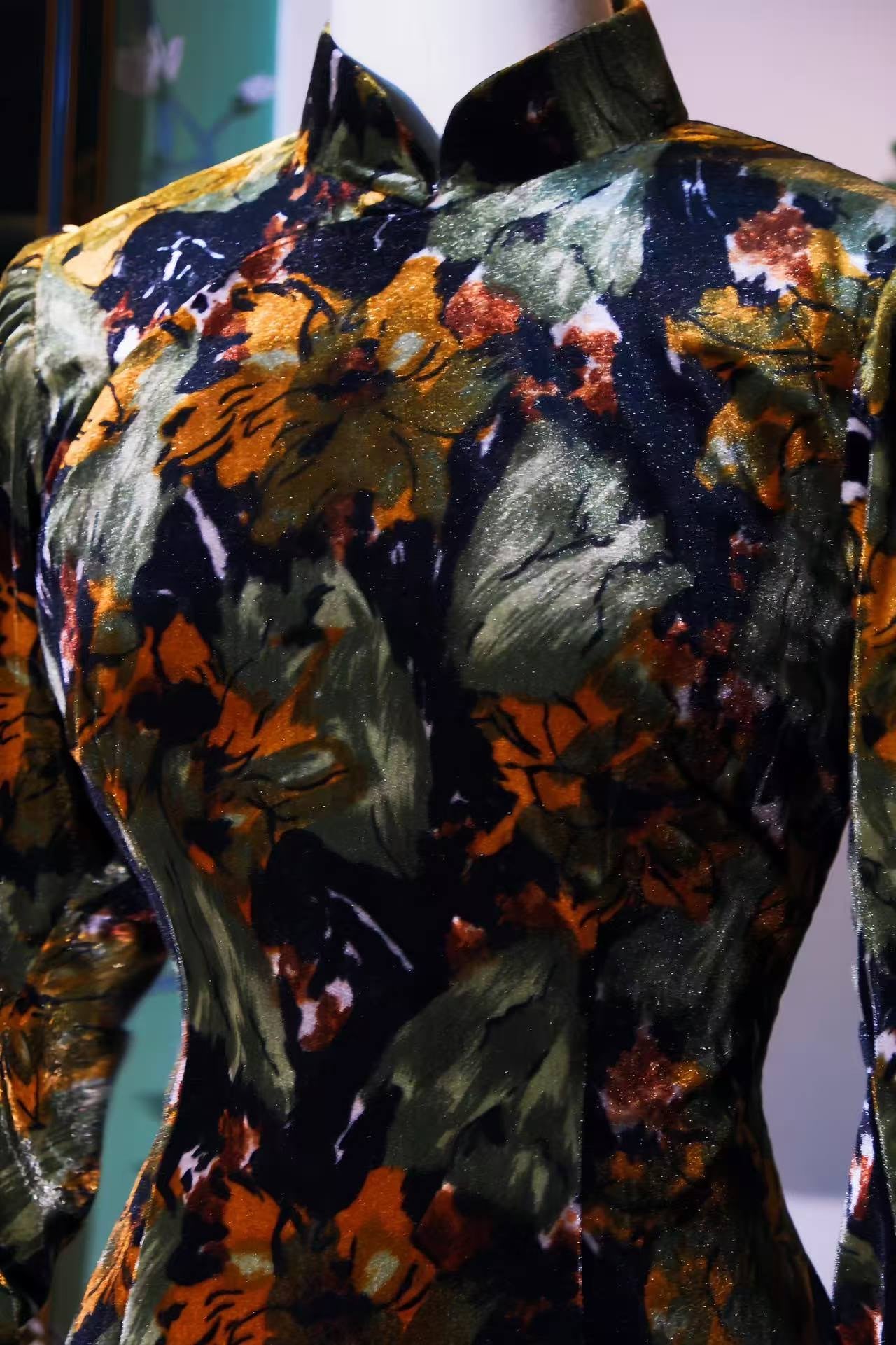
分享一件上世纪五十年代香港手绘天鹅绒旗袍:
当目光坠入这片墨绿与赭橙交织的天鹅绒画卷,
旗袍通体以天鹅绒为底,暗沉如夜雨后的芭蕉叶,
天鹅绒(velvet)作为中世纪欧洲贵族织物,
立领与收腰的剪裁,延续着民国旗袍的曲线美学;
此件旗袍的稀缺性,更在于其“双重孤品”属性:
今观此袍,如读一首写在丝绒上的现代诗:它以抽象对抗平庸,
As the gaze sinks into this velvet canvas, interwoven with moss green and ochre orange (墨绿与赭橙), one seems to glimpse the "lonely wild goose and sunset glow" (落霞与孤鹜) in a Lingnan courtyard at dusk. The elegance of 1950s Hong Kong is rendered through hand-painted abstract brushstrokes, diffusing the initial chapter of Oriental modernity within the silk velvet's warp and weft. This vintage cheongsam, produced in Hong Kong, is far more than just fabric; it is a flowing poem, a solidified, freehand spirit of the Lingnan School of painting.
The cheongsam is entirely backed in velvet, dark and deep like banana leaves after a night rain, yet possessing the ink rhyme of the "boneless landscape" (mogu mountain painting) style favored by the Lingnan School. The hand-painted pattern breaks free from concrete representation: ochre blocks are splashed like cinnabar, outlining the freehand contours of flowers; where moss green and raven blue (鸦青) merge, the texture of the "cunfa" (texture strokes described in the Mustard Seed Garden Manual of Painting) is hidden, resembling swaying orchids or dancing bamboo shadows. Every instance of color blending carries the Zen-like quality of literati painting—"similar yet not similar" (似与不似)—and is imbued with a modernistic spontaneity that surpasses the meticulous flowers of Shanghai-style cheongsams. This is precisely a microcosm of 1950s Hong Kong cultural fusion: the traditional cultural lineage achieved self-renewal through abstract brushstrokes in a colonial context.
Velvet (tian'e rong), a fabric of European medieval nobility, was introduced to China at the end of the 19th century, but it truly sparked a unique fusion with local hand-painting techniques in 1950s Hong Kong. This cheongsam employs the "dry brush hand-painting" (干刷手绘) technique: using a wolf-hair brush dipped in mineral dyes, the color is rapidly blended onto the velvet surface. The pigments seep into the velvet pile gaps, creating a unique texture of "color penetrating the fiber while the pile retains the light" (绒面留白、色入肌理). This technique demands extremely strict control over temperature, humidity, and hand speed, making every finished piece a product of the "timeliness, favorable geography, and human harmony" (天时地利人和).
The tailoring of the stand collar and the cinched waist continues the curvilinear aesthetic of Republican-era cheongsams; meanwhile, the relaxed treatment of the three-quarter sleeves (七分袖) subtly aligns with the dual needs of 1950s Hong Kong women for "workplace and daily life." The merging color blocks at the skirt hem are like the "superimposition of images" (意象叠加) in modern poetry. This design adheres to the tradition of Classic of Rites that "clothing carries the Way" (衣饰载道), while also responding to Hong Kong's self-expression as a cultural enclave in the context of "Orientalism," as discussed by Said—using abstract art to deconstruct the Western gaze and using the warmth of manual craft to resist the wave of industrialization.
The scarcity of this cheongsam is further defined by its "dual singular" status: it is both the swan song of the velvet hand-painting technique (which was replaced by chemical printing after the 1960s) and a material relic of the "Oriental Hollywood" Golden Age of Hong Kong (reference: A Century of Hong Kong Cheongsam History). As the luster of the velvet pile settles into an amber glow with age, those abstract brushstrokes transcend mere decoration, becoming a visual footnote to the "cultural identity anxiety" of 1950s Hong Kong intellectuals—weaving the artistic cutting edge unique to that era in the folds between East and West, tradition and modernity.
Viewing this robe today is like reading a modern poem written on velvet: it uses abstraction to combat the mundane, manual craft to guard warmth, and Oriental aesthetics in the wave of globalization to write the eternal question: "Who am I?"