深圳溯源
Couldn't load pickup availability
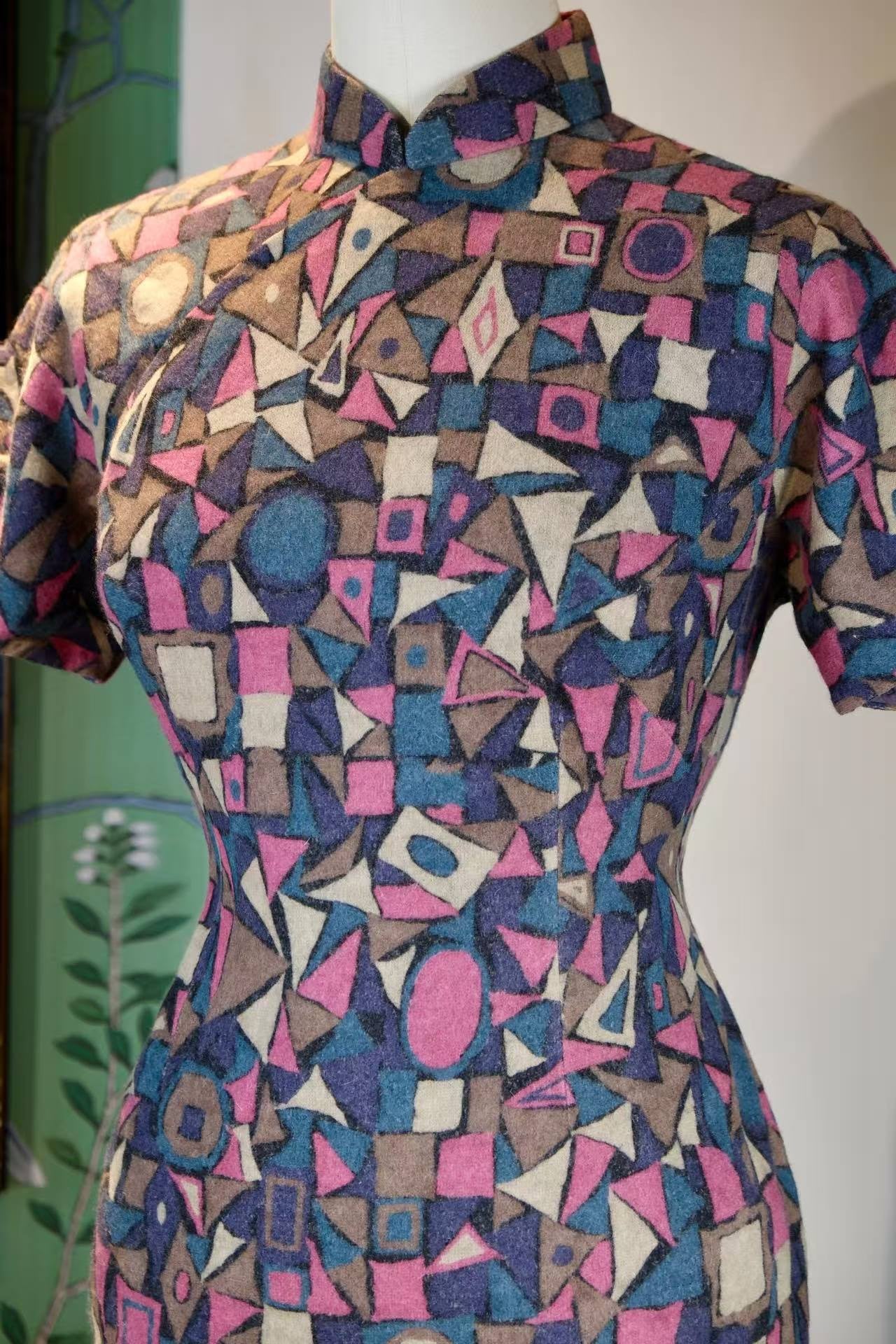
五十年代香港古董旗袍:Art Deco几何印花的东方摩登诗篇
在二十世纪中叶的香港,这座东西方文化交融的璀璨都市,
旗袍通体以紫蓝、粉玫与棕褐为基色,三角、方胜、菱形、
羊毛呢料的厚重肌理与Art Deco几何印花的利落线条形成奇妙对冲,
当这件旗袍静立于时光中,那些锐利的几何图形仿佛在诉说:
In mid-20th century Hong Kong, a dazzling city where Eastern and Western cultures converged, the cheongsam, the iconic garment of Oriental women, was undergoing a magnificent transformation between tradition and modernity. This vintage cheongsam, produced in the 1950s and featuring an Art Deco geometric print on wool flannel, orchestrates a modern symphony where Oriental aesthetics clash with contemporary art, set to a sharp and regular geometric rhythm.
The entire cheongsam is based on purple-blue, pink-rose, and brown-ochre colors, overlaid with Art Deco's signature geometric shapes—triangles, square knots (fāng shèng), diamonds, and circles—laid out like a precise, mechanical celestial map. These shapes utilize symmetry and repetition in their composition, outlined in off-white (mǐ bái) as negative space, creating a unique methodology that is "as precise as mechanical cutting, yet as dynamic as Oriental brocade." This "romance within order" is akin to the philosophy of creation stated in the Rites of Zhou: Examiner of Crafts: "Heaven has its seasons, the Earth has its vital forces, the material has its beauty, and the craftsperson has their skill" (Tiān Yǒu Shí...). It blends the Oriental pursuit of harmonious symmetry with Art Deco's tribute to industrial civilization. Examining the pattern details, the overlapping square knots resemble the steel framework of modern architecture, the cutting lines of the diamonds mirror the syncopated rhythm of jazz music, and the nesting of circles and squares subtly aligns with the I Ching's cosmic view of "Heaven is round, Earth is square" (Tiān Yuán Dì Fāng), making every geometric piece a symbol of East-West civilizational dialogue.
The heavy texture of the wool flannel fabric creates a fascinating counterpoint to the clean, sharp lines of the Art Deco geometric print. The short sleeve and stand collar tailoring retains the cheongsam's Oriental structure. This design, which is "three parts industrial coldness, seven parts Oriental warmth," precisely fits the identity of Hong Kong in the 1950s as a "hub of Chinese and Western culture"—both preserving the subtlety of Lingnan culture and embracing the openness of a modern metropolis. According to the History of Hong Kong Textiles, to penetrate European and American markets, Hong Kong manufacturers often combined traditional cheongsams with popular styles like Art Deco and Abstract Art. However, due to the complexity of printing on wool flannel and the extremely demanding nature of Art Deco geometric patterns, fewer than a hundred such pieces are estimated to survive, making each one a "living fossil" of Hong Kong's "Golden Age" of textiles.
As this cheongsam stands still in time, its sharp geometric shapes seem to whisper: true classics are never merely replicas of the past, but new branches of modern art grafted onto traditional roots. It is not just a garment; it is a historical sample carrying the modernist transformation of Oriental aesthetics, a unique flower of Art Deco art blooming on Oriental soil, worthy of being cherished by time and remembered by the world.