深圳溯源
Couldn't load pickup availability
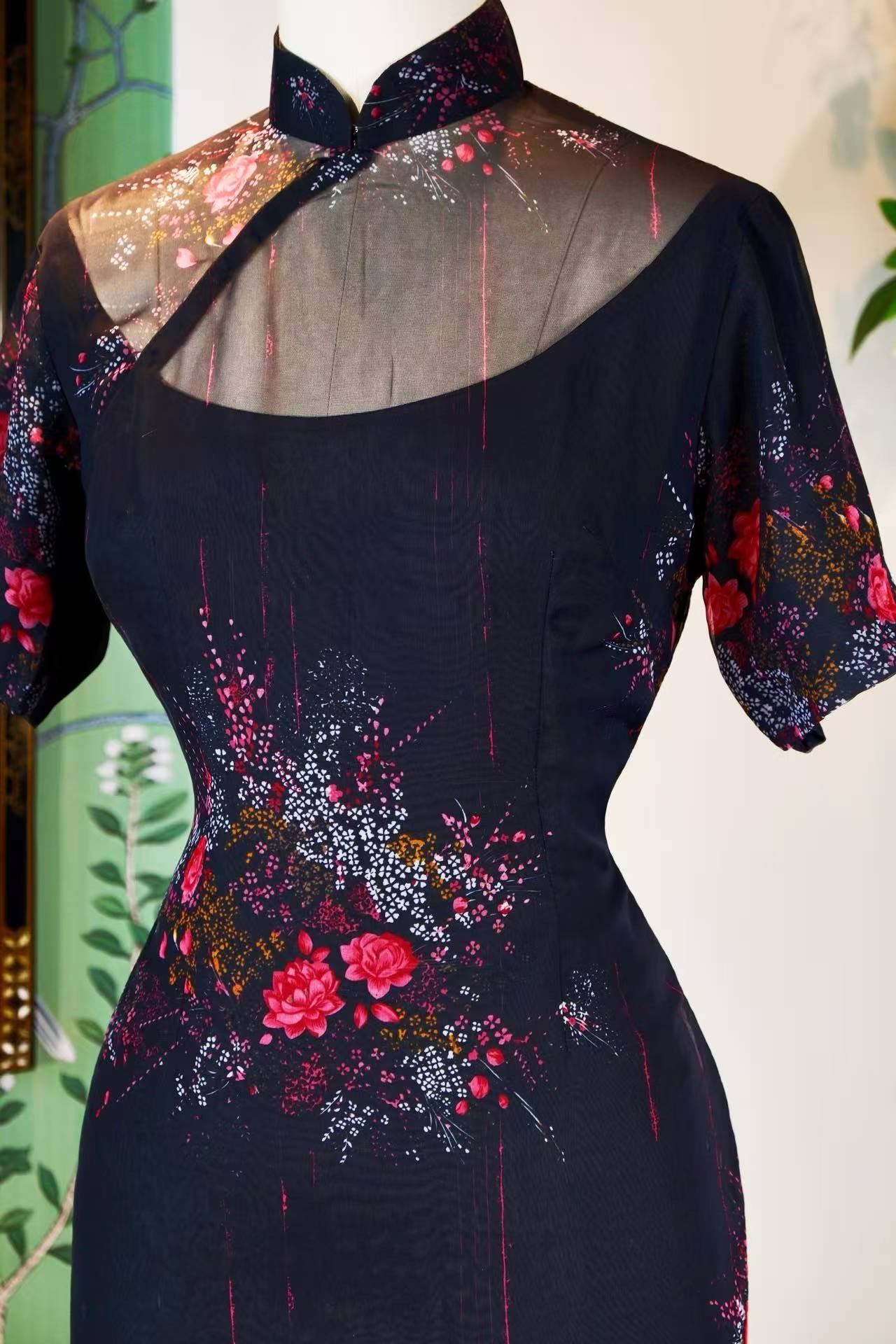
五十年代香港产印花薄纱挖胸旗袍:暗夜繁花里的东方秘语
在20世纪50年代香港的霓虹剪影中,这件古董旗袍以薄纱为纸、
旗袍以玄黑为底,如夜幕低垂,其上印花却似星雨倾落。
这种“暗底亮花”的配色哲学,恰呼应了《礼记·礼器》中“
“挖胸”设计的精妙,在于“藏露之间的度”。镂空处不过方寸,
短袖与肩部的薄纱拼接,更延伸了这种“虚实相生”的美学。
作为50年代香港生产的古董旗袍,其稀缺性不仅在于工艺,
存世量的稀少,更添其珍贵。历经七十余载,薄纱易损,印花易褪,
这件旗袍的美,是“犹抱琵琶半遮面”的含蓄,是“墨分五色”
Amidst the neon silhouettes of 1950s Hong Kong, this vintage cheongsam uses tulle as paper and blossoms as ink to compose an epic dialogue between Eastern and Western aesthetics. Its most breathtaking feature is the avant-garde "Wa Xiong" (keyhole/chest cutout) design—an elegant U-shaped bodice cutout veiled in sheer tulle. This allow a glimpse of skin while retaining the "restrained radiance" of Oriental texture, boldly absorbing the sensual DNA of Western fashion. It is a masterful fusion of Republic-era grace and modern consciousness.
The cheongsam features a mysterious black base, akin to the falling night, upon which the print descends like a rain of stars.
The Motifs: The central motif is the crimson rose. The layering of petals showcases the charm of the "Mogu" (boneless) painting technique: deep reds like cinnabar-dotted lips and pale pinks like a light sweep of rouge. These are interspersed with tiny white florets, resembling "snow foam and tea smoke," and golden fine lines like fireflies among the stamens.
Composition: It embodies the compositional tension of "sparse enough to run a horse, yet dense enough to block the wind." Particularly exquisite are the vertical pink ink-splash lines, reminiscent of Su Shi’s poetry—"ink clouds dragging rain past the western tower"—or the "flying white" brushwork of Wu Changshuo’s vines.
This "bright flowers on a dark base" philosophy echoes the aesthetic view in the Book of Rites: Li Qi: "Sweetness accommodates harmony; a white base accepts colors." The black base serves as the "pure" foundation that allows the "splendid" blossoms to shine, achieving opulence without losing elegance.
The brilliance of the "Wa Xiong" design lies in the "degree between hiding and revealing." Though the cutout is small, the transparency of the tulle transforms the skin into a "second layer of pattern." > As Eileen Chang wrote in A Chronicle of Changing Clothes: "A woman’s dress is a portable, pocket-sized drama."
The interplay here is a miniature play: the skin is the stage, and the tulle shadow is the curtain. With every movement, the shifting light creates a dynamic beauty described in the Ode to the Goddess of the Luo River: "As graceful as a startled swan, as supple as a swimming dragon." The sheer sleeves and shoulder panels extend this "interplay of void and solid," flowing with the arms like the rhythmic lines of ancient silk strings.
As a 1950s Hong Kong-made vintage piece, its scarcity lies in its unique historical coordinates. Hong Kong was the crossroads of East and West; the design preserves the gentleness of Shanghai’s "Calendar Girls" (seen in the realistic floral style) while embracing the flamboyance of Hollywood stars (seen in the sexy keyhole).
Its rarity is further enhanced by its preservation. After seventy years, while tulle is fragile and prints often fade, this piece remains as vivid as ever. It is more than a garment; it is a time capsule sealing the modern code of Hong Kong’s Golden Age. One can imagine a socialite wearing this to a Cantonese opera at the Lyceum Theatre or sipping English tea at a Repulse Bay café—the swaying shadows of tulle reflecting the "Pearl of the Orient."
The beauty of this cheongsam is the reserve of a "lute partially shielding the face," the elegance of "ink divided into five colors," and the courage of 1950s women breaking free from constraints. When one’s fingertips brush over this delicate tulle, they touch the moonlight of half a century ago—the elegant turn of Oriental aesthetics amidst the waves of time.