深圳溯源
Couldn't load pickup availability
"With pleased sounds the deer call to one another, eating the celery of the fields." — The Book of Songs
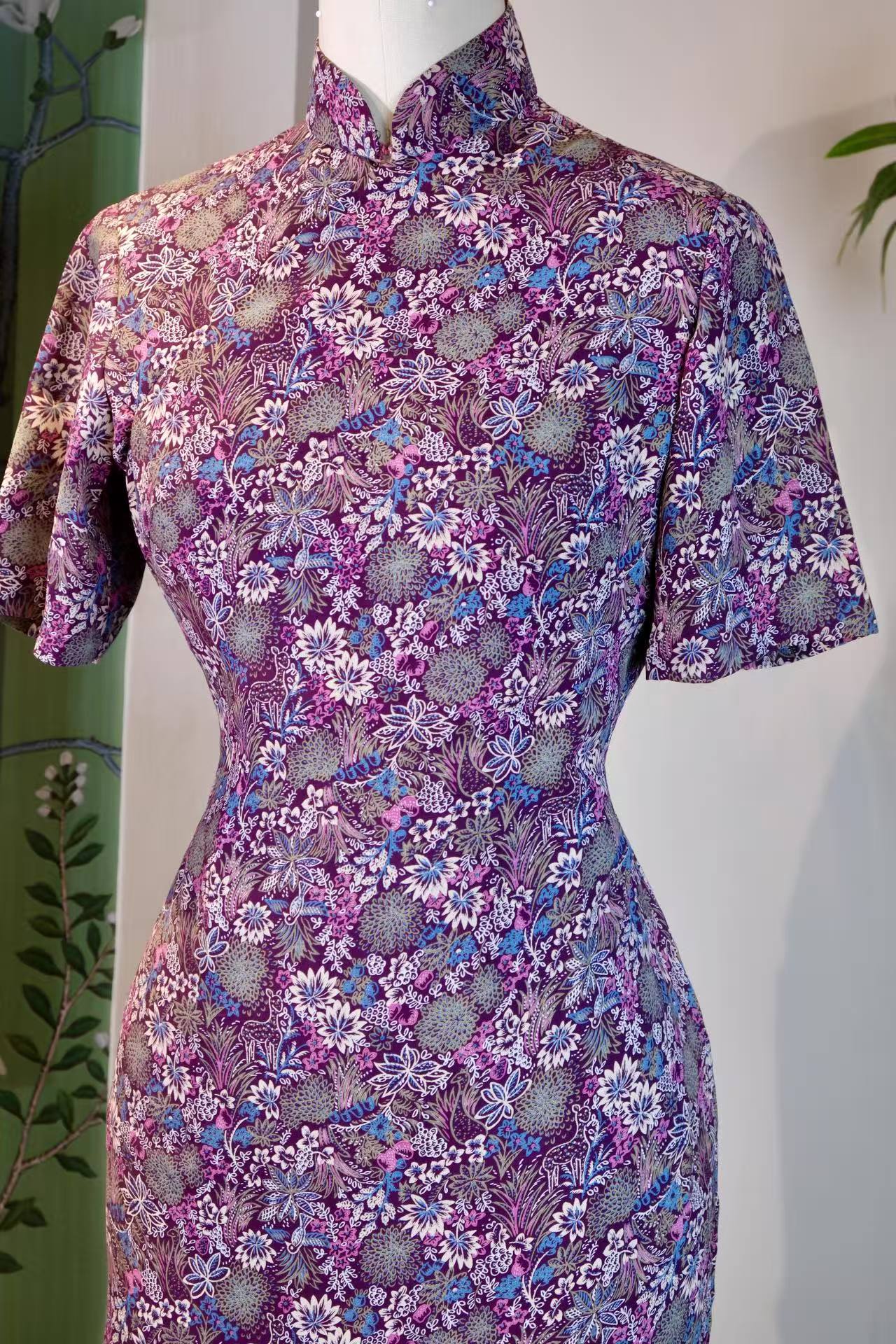
This antique abstract-print Qipao from 1950s Hong Kong appears from afar like an Impressionist oil painting, yet reveals a soul of Oriental poetry upon closer inspection. The deep purple-gray base is profound and noble, reminiscent of the sky at twilight. It is adorned with a sea of blossoms in white, blue, and pink. Hidden deep within this floral expanse are agile deer and birds—appearing and disappearing as if playing in the thickets or whispering among the branches.
The design of this Qipao is masterfully conceptualized; it is not a mere flat print, but a visual game of "hide and seek."
Blooms in Profusion: The large-scale abstract floral motifs utilize smudging and pointillist techniques to create a hazy, dreamlike atmosphere—a hallmark of the fusion between Eastern and Western aesthetics in 1950s Hong Kong.
The Grace of the Deer: Upon closer look, lines that seem to be mere branches actually delineate the silhouettes of deer. They look back with elegant poise. In Chinese culture, the word for "Deer" (Lù) is a homophone for "Prosperity/Official Salary" (Lù), symbolizing fortune and longevity.
Birdsong and Fragrance: The birds interspersed throughout break the stillness of the flowers, adding a layer of vitality. The combination of deer and birds symbolizes "Abundant Fortune and Harmony," reflecting the yearning for a beautiful life.
This philosophy of "every pattern has a meaning, and every meaning is auspicious" skillfully integrates traditional symbolism into a modern abstract style—subtle yet sophisticated.
Hong Kong in the 1950s was a melting pot of exiled literati, wealthy merchants, and a rising middle class. The owner of this Qipao was undoubtedly a woman of exceptional taste—one who understood traditional reserve while pursuing contemporary trends.
The piece utilizes what was then a highly advanced hand-painted transfer printing technique, making the pattern on every roll of fabric unique. These deer and birds may seem scattered at random, but they follow a meticulous composition, resembling a flowing Scroll of a Hundred Deer. It is more than a garment; it is a spiritual reflection of the era's women: "gentle without, resilient within, and full of inner life."
From an art history perspective, this Qipao is a perfect cross-temporal dialogue between Art Deco and Traditional Chinese Gongbi (Meticulous) Flower-and-Bird painting.
Rarity: In the 1950s, before mass industrial production became the norm, hand-painted silk Qipaos with such complex auspicious patterns were produced in very low volumes. Designs that seamlessly integrate animal figures into abstract backgrounds are particularly rare.
Cultural Value: It bears witness to the reshaping of cultural confidence in post-war Hong Kong. As Eileen Chang wrote in Chronicle of Changing Clothes: "To those who cannot speak, clothes are a language; they carry with them a pocket drama." This Qipao is the most brilliant scene in that drama, narrating a memory of beauty, hope, and the elegance of an era.