深圳溯源
Couldn't load pickup availability
衣服尺寸:
胸围/腰围/臀围:92/80/100 厘米
衣长:98 厘米
细节描述:
在时光的织锦中,总有一些衣饰,如星辰般璀璨,承载着特定时代的风华与匠心。眼前这件上世纪五十年代由法国进口织银面料、于香港精工制成的古董旗袍,便是这样一件凝结了东西方艺术精华与历史记忆的珍品。它不仅是一件衣物,更是一部穿在身上的艺术史,一段关于优雅、工艺与稀缺性的无声诗篇。
一、图案描述:暗夜中的银辉与郁金香的私语
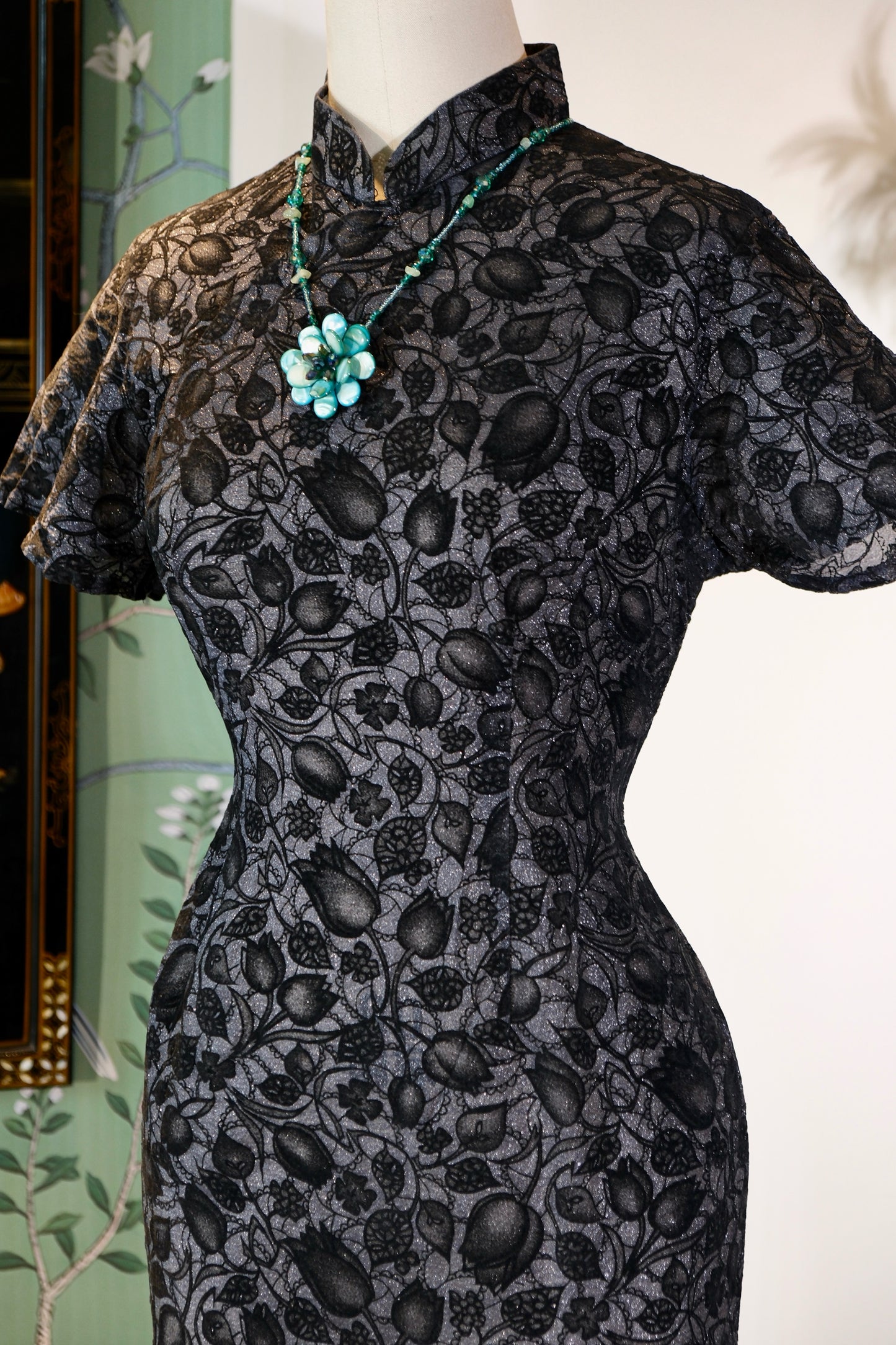
这件旗袍最摄人心魄之处,莫过于其面料上繁复而精致的图案。通体以深邃的黑色或极深的藏青色为底,仿佛静谧的夜空,其上则以织银工艺,细密地铺陈开一片“暗夜花园”。
- 郁金香的变奏:图案的主体是形态各异的郁金香。它们并非写实,而是经过了艺术化的提炼与变形,呈现出一种装饰艺术的风格。花苞饱满,或含羞待放,或微微颔首,花瓣边缘以银线勾勒,在光线下闪烁着幽微而内敛的光芒。这些郁金香并非孤立存在,而是以藤蔓、枝叶相互缠绕,形成一种连绵不绝、生生不息的视觉效果。
- 织银的辉光:“织银”工艺赋予了这件旗袍独特的质感与灵魂。银线并非平铺直叙,而是通过提花、暗纹等技法,与底布交织,使得图案在深邃的背景中若隐若现,如同月光下的银霜,低调而奢华。这种辉光并非刺眼,而是温润、内敛,随着穿着者的移动和光线的变化,流转出不同的神采,恰如“暗香浮动月黄昏”的意境。
- 整体的韵律:图案的排布疏密有致,既有大朵郁金香作为视觉焦点,又有细小的枝叶藤蔓作为填充与连接,形成一种和谐而富有韵律的视觉节奏。这种满铺的图案设计,在视觉上极具冲击力,却因色彩的克制与工艺的精湛而不显繁复,反而透出一种沉静的力量感与东方的含蓄之美。
二、古董衣的故事:东西交融的时代印记
这件旗袍的诞生,本身就是一段传奇。它诞生于上世纪五十年代的香港,一个东西方文化激烈碰撞与交融的特殊时期。
- 法国面料的东方演绎:彼时,香港作为远东的贸易与时尚之都,汇聚了全球的潮流。法国进口的织银面料,代表了当时欧洲顶级的纺织工艺与审美趣味。然而,这件旗袍并非对西方时尚的简单模仿,而是由香港本地的裁缝大师,以中国传统旗袍的形制与剪裁精髓,对这种华贵面料进行了“东方化”的再创造。立领、斜襟、收腰、开衩,每一处细节都精准地捕捉了旗袍的神韵,将西方面料的华丽与东方剪裁的含蓄完美融合。
- 五十年代的风华:五十年代的香港,社会相对稳定,经济开始复苏,上流社会与名媛淑女们对服饰的考究达到了一个新的高度。旗袍作为当时女性的主流礼服,不仅是身份的象征,更是个人品味与艺术修养的体现。这件旗袍,极有可能是为某位家境殷实、品味不凡的女士量身定制,它见证了那个时代香江畔的繁华与优雅,承载着一段属于特定阶层的精致生活记忆。
- 稀缺性的佐证:如今,能够完整保存下来的五十年代香港产、且采用法国进口织银面料的古董旗袍,已是凤毛麟角。其稀缺性不仅在于面料的珍贵与工艺的复杂,更在于它作为一个时代文化交融的“活化石”,其历史价值与艺术价值难以估量。
三、引经据典:艺术风格的溯源与阐释
这件旗袍的艺术风格,可以从多个维度进行解读,其背后蕴含着深厚的文化底蕴与美学思想。
- “错彩镂金”与“芙蓉出水”:南朝文学批评家钟嵘在《诗品》中曾言:“谢诗如芙蓉出水,颜诗如错彩镂金。”这件旗袍,恰是“错彩镂金”之美的绝佳体现。织银工艺的精雕细琢,图案的繁复华丽,无不彰显着一种人工的、极致的美。然而,这种“错彩镂金”并非堆砌,其整体色调的沉静与剪裁的流畅,又使其不失“芙蓉出水”般的自然与雅致,达到了“绚烂之极归于平淡”的艺术境界。
- “中西合璧”的装饰艺术:图案中的郁金香,虽源自西方,但其形态的处理与整体的布局,却融入了中国传统纹样的吉祥寓意与审美情趣。藤蔓的缠绕,令人联想到中国的缠枝纹,寓意生生不息、福泽绵长。这种“中西合璧”的装饰风格,与二十世纪初兴起于欧洲的“装饰艺术”运动有着异曲同工之妙,都强调几何化的线条、对称的构图与奢华的材质,但此件旗袍更添了一份东方的含蓄与内敛。
- “衣以载道”的东方哲学:在中国传统文化中,“衣”从来不仅仅是蔽体之物,更是“载道”之器。这件旗袍,以其华贵的材质、精湛的工艺与典雅的形制,承载着五十年代香港上流社会的审美趣味与生活哲学。它体现了东方女性对“曲线美”的含蓄表达,对“精致生活”的不懈追求,以及对“文化身份”的自我认同。
四、结语:穿越时光的优雅
这件五十年代法国进口织银郁金香香港产古董旗袍,是一件不可多得的艺术珍品。它以暗夜为纸,以银线为墨,绘就了一幅流动的“郁金香图卷”;它以东西方文化为经纬,织就了一段关于优雅与匠心的历史传奇。它不仅适合在重要的场合穿着,展现穿着者不凡的品味与气度,更是一件值得世代珍藏的文化遗产,其艺术价值与稀缺性,必将随着时间的推移而愈发彰显。拥有它,便是拥有了一段穿越时光的优雅,一份沉甸甸的历史馈赠。
Measurements / Size Guide:
Bust / Waist / Hips: 92/80/100 cm
Total Length: 98 cm
Detailed Description:
In the tapestry of time, certain garments shine like stars, carrying the elegance and ingenuity of a specific era. This antique cheongsam (qipao)—crafted in 1950s Hong Kong from silver-woven fabric imported from France—is a masterpiece that condenses the essence of Eastern and Western art with historical memory. It is not merely a garment, but a wearable history of art, a silent poem about elegance, craftsmanship, and scarcity.
The most soul-stirring feature of this cheongsam is the intricate and exquisite pattern on its fabric. The entire piece uses a deep black or a very dark navy blue as the base, reminiscent of a tranquil night sky, upon which a "Midnight Garden" is meticulously laid out using silver-weaving techniques.
A Variation of Tulips: The main motifs are tulips of varying forms. These are not realistic depictions but artistic extractions and transformations, presenting an Art Deco style. The buds are full—some shyly waiting to bloom, others slightly nodding—with the petal edges outlined in silver thread, shimmering with a subtle, restrained light. These tulips do not exist in isolation; they are intertwined with vines and foliage, creating a continuous, rhythmic visual effect of vitality.
The Glow of Woven Silver: The "silver-weaving" process endows this cheongsam with a unique texture and soul. The silver threads are not simply laid flat but are interlaced with the base fabric through jacquard and damask techniques. This makes the patterns appear and disappear within the deep background like silver frost under moonlight—low-key yet luxurious. This glow is not piercing but warm and introverted; as the wearer moves and the light shifts, it radiates different charms, perfectly capturing the mood of "shadows moving and dim scents floating in the twilight."
Overall Rhythm: The arrangement of the patterns is harmoniously spaced, with large tulips serving as visual focal points and delicate vines acting as fillers and connectors. This creates a visual tempo that is both balanced and rhythmic. While the all-over pattern design is visually striking, it avoids being cluttered due to the restrained color palette and superb craftsmanship, instead exuding a sense of calm power and Eastern subtle beauty.
The birth of this cheongsam is a legend in itself. It was born in 1950s Hong Kong, a unique period of intense collision and fusion between Eastern and Western cultures.
Eastern Interpretation of French Fabric: At that time, as the fashion and trade capital of the Far East, Hong Kong gathered global trends. Silver-woven fabric imported from France represented the pinnacle of European textile technology and aesthetic taste. However, this cheongsam is not a simple imitation of Western fashion. Instead, local Hong Kong master tailors took the essence of traditional Chinese qipao silhouette and tailoring to "Orientalize" this opulent material. The standing collar, diagonal bodice, cinched waist, and side slits—every detail accurately captures the spirit of the qipao, perfectly blending Western material splendor with the subtlety of Eastern cutting.
The Elegance of the 1950s: In 1950s Hong Kong, the society was relatively stable and the economy began to recover. The fastidiousness of the upper class and socialites regarding attire reached a new height. As the mainstream formal wear for women, the cheongsam was not only a symbol of status but also a manifestation of personal taste and artistic cultivation. This piece was likely custom-made for a lady of significant means and extraordinary taste, witnessing the prosperity and elegance along the Fragrant River and carrying the refined life memories of a specific class.
Evidence of Scarcity: Today, 1950s Hong Kong-made antique cheongsams using imported French silver-woven fabric that remain in perfect condition are as rare as phoenix feathers. Its scarcity lies not only in the preciousness of the fabric and the complexity of the craft but also in its role as a "living fossil" of cultural fusion, possessing immeasurable historical and artistic value.
The artistic style of this cheongsam can be interpreted through multiple dimensions, rooted in profound cultural heritage and aesthetic philosophy.
"Intricate Gold-Carving" and "Lotus Emerging from Water": The literary critic Zhong Rong of the Southern Dynasties once said in The Ranking of Poets: "Xie's poetry is like a lotus emerging from water; Yan's poetry is like intricate gold-carving." This cheongsam is a perfect embodiment of the beauty of "intricate gold-carving" (cuocai loujin). The meticulous silver-weaving and the magnificent patterns demonstrate a pinnacle of artificial, deliberate beauty. However, this splendor is not mere piling; the calmness of the overall tone and the fluidity of the cut allow it to retain the natural elegance of a "lotus emerging from water," reaching an artistic realm of "returning to simplicity after extreme brilliance."
Art Deco of "East Meets West": Although the tulips in the pattern originate from the West, their formal treatment and overall layout incorporate the auspicious meanings and aesthetic sentiments of traditional Chinese motifs. The intertwining vines recall Chinese "interlocking floral" (chanzhi) patterns, symbolizing endless life and boundless blessings. This "East-West fusion" decorative style echoes the Art Deco movement that rose in Europe in the early 20th century, both emphasizing geometric lines, symmetrical compositions, and luxurious materials, but this cheongsam adds a layer of Eastern modesty.
The Philosophy of "Clothing as a Vessel for the Dao": In traditional Chinese culture, "clothing" has never been just a way to cover the body, but a vessel for the "Dao" (the Way/Principles). With its noble materials, exquisite craft, and elegant form, this cheongsam carries the aesthetic tastes and life philosophy of Hong Kong's upper class in the 1950s. It embodies the subtle expression of the "beauty of curves" by Eastern women, their unremitting pursuit of a "refined life," and their self-identification with cultural roots.
This 1950s Hong Kong-made antique cheongsam of French silver-woven tulip fabric is a rare artistic treasure. Using the night as paper and silver thread as ink, it paints a flowing "Scroll of Tulips." With East and West as the warp and weft, it weaves a historical legend of elegance and craftsmanship. It is not only suitable for important occasions, showcasing the wearer’s extraordinary taste and poise, but also a cultural heritage worthy of being passed down through generations. Its artistic value and scarcity will only become more prominent as time passes. To possess it is to own a piece of elegance that transcends time—a profound gift from history.