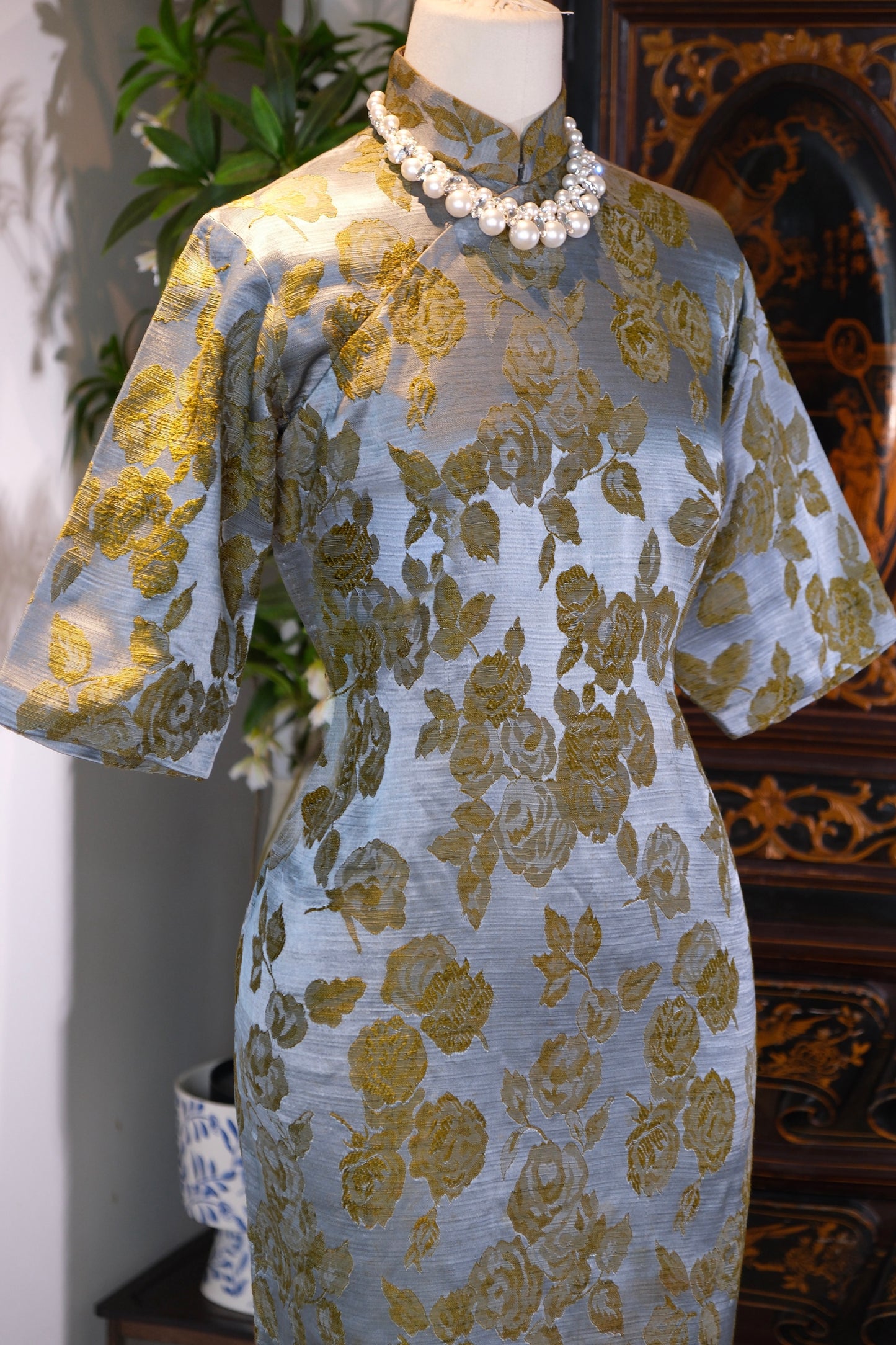
银蓝金绣:五十年代港产肌理提花缎旗袍
衣服尺寸:
胸围/腰围/臀围:92/92/100 厘米
衣长:97 厘米
细节描述:
这件五十年代港产旗袍,是凝固的东方美学史诗。以银蓝为底,如月光浸染的江南绸缎,其上金线提花如流金岁月,以缠枝牡丹为主体纹样,间以忍冬藤蔓蜿蜒,暗合《长物志》“花宜瘦不宜肥”的审美意趣。牡丹花型饱满,花瓣层叠如云,金线在肌理缎面游走,似有若无地勾勒出“金屑酒”般的华贵质感,恰似李商隐“镂金作胜传荆俗,剪彩为人起晋风”的盛世遗韵。
五十年代的香港,是东西方文化碰撞的熔炉。彼时上海裁缝南迁,将海派旗袍的精致剪裁与港岛特有的洋场风情相融,造就了这一“黄金时代”的服饰传奇。这件旗袍采用当时罕见的肌理提花缎——面料经特殊织造工艺,呈现出微妙的凹凸质感,既保留了丝绸的柔滑,又增添了雕塑般的立体感,堪称纺织技术与艺术审美的双重结晶。
其稀缺性在于:一为面料绝版,五十年代港产提花缎因工艺复杂、成本高昂,存世量极少;二为工艺失传,手工扞边、斜襟归拔等细节,皆是老裁缝“一针一线总关情”的匠心体现;三为时代印记,它见证了香港从渔村到国际都会的蜕变,是殖民文化与本土传统交融的活化石。
正如张爱玲所言:“旗袍是女人的第二层皮肤。”这件古董旗袍,不仅是一件服饰,更是一段流动的历史,一曲银蓝与金线交织的东方咏叹调。当指尖抚过那凹凸有致的肌理,仿佛触摸到五十年代港岛的霓虹与海风,听见了旧时光里旗袍摇曳的窸窣声。
Silver-Blue Golden Embroidery: A 1950s Hong Kong-Made Textured Jacquard Satin Qipao
Measurements / Size Guide:
Bust / Waist / Hips: 92/92/100 cm
Total Length: 97 cm
Detailed Description:
This 1950s Hong Kong-made Qipao stands as a frozen epic of Eastern aesthetics. Set against a silver-blue backdrop—reminiscent of Jiangnan silk drenched in moonlight—its golden thread jacquard flows like the passage of time. The primary motif features scrolling peonies intertwined with meandering honeysuckle vines, subtly echoing the aesthetic preference of The Treatise on Superfluous Things (Chang Wu Zhi) that "flowers should be slender rather than stout." The peony blooms are full, with petals cascading like clouds; the golden threads wander across the textured satin surface, faintly outlining a regal quality akin to "gold-dusted wine," evoking the prosperous remnants of Li Shangyin’s verse: "Gold is carved into ornaments following Jing customs; colored silks are cut into figures as in the Jin style."
Hong Kong in the 1950s was a melting pot where East met West. During this era, Shanghainese tailors migrated south, blending the exquisite tailoring of the Haipai (Shanghai-style) Qipao with the unique cosmopolitan flair of the island, creating this sartorial legend of the "Golden Age." This Qipao utilizes the textured jacquard satin that was rare even then—a fabric woven through a specialized process to create a subtle embossed texture. It preserves the smoothness of silk while adding a sculptural dimensionality, representing a dual crystallization of textile technology and artistic sensibility.
Its rarity is defined by three factors: First, the fabric is "extinct"—1950s Hong Kong jacquard satin is extremely scarce due to its complex craftsmanship and high cost. Second, the techniques are lost to time; details such as hand-rolled edging and the professional "Gui-Ba" (stretching and shrinking) of the diagonal bodice are manifestations of an old master tailor’s soul in every stitch. Third, it bears the mark of an era; witnessing Hong Kong's transformation from a fishing village to an international metropolis, it serves as a living fossil of the fusion between colonial culture and local tradition.
As Eileen Chang once said, "The Qipao is a woman's second skin." This antique Qipao is not merely a garment but a segment of flowing history—an Eastern aria woven from silver-blue and golden threads. When your fingertips brush across the embossed texture, it is as if you are touching the neon lights and sea breezes of 1950s Hong Kong, hearing the rustle of a Qipao swaying through the echoes of olden days.