深圳溯源
Couldn't load pickup availability
衣服尺寸:
胸围/腰围/臀围:88/74/94 厘米
衣长:102 厘米
细节描述:
一、纹样:流动的银色诗篇
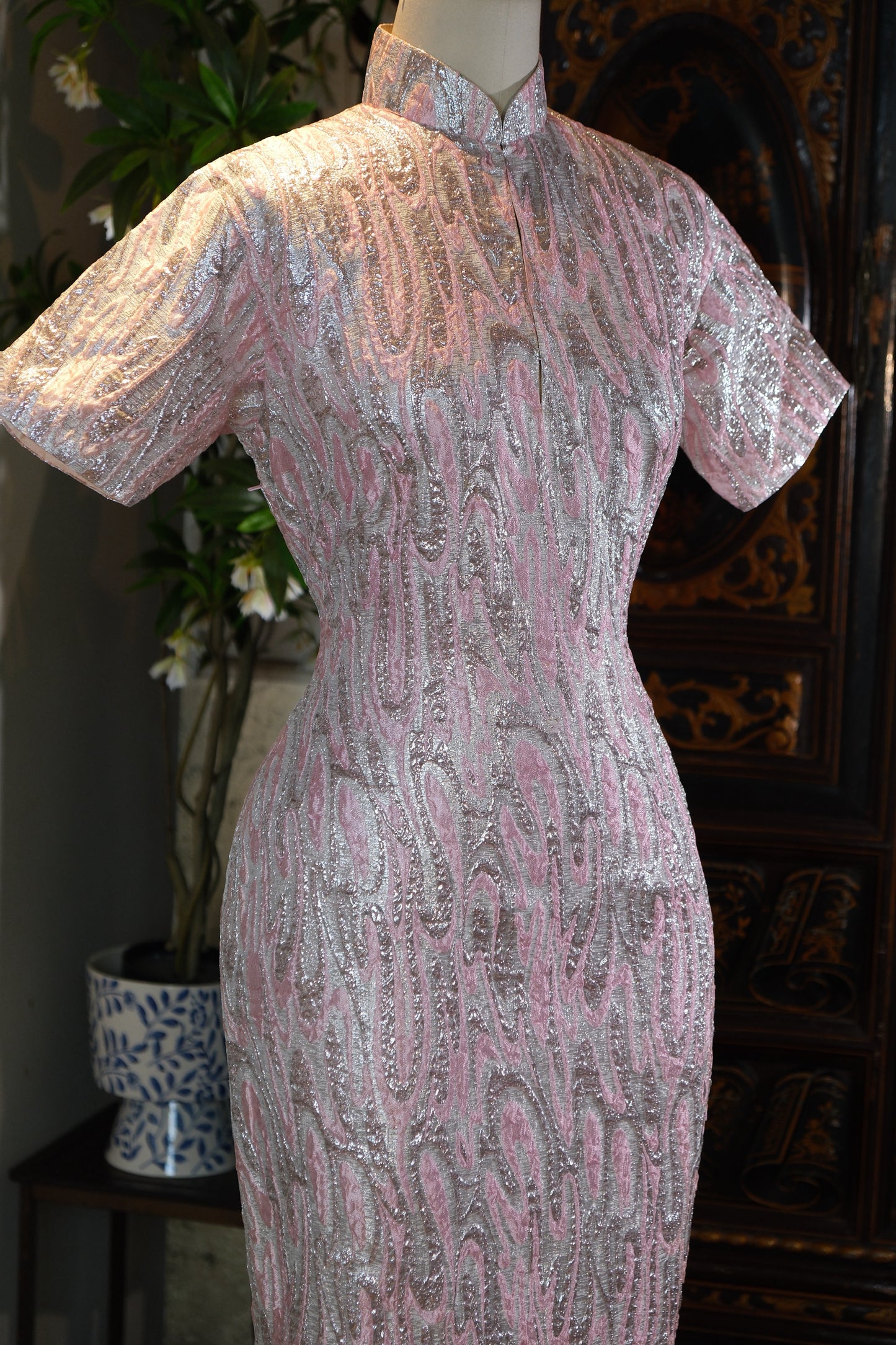
这件旗袍的面料,是一场视觉的盛宴。它并非简单的“织银”,而是一种名为“流云锦”的复杂提花工艺。银线并非平铺直叙,而是以“缠枝卷草”为骨,幻化出抽象的云纹与水波纹。
- 缠枝纹的变奏:传统的缠枝纹象征着生生不息,而这件旗袍上的纹样则更为写意。银线勾勒出的枝蔓,如同被海风吹拂的柳条,又似维多利亚港夜晚的粼粼波光,充满了动态的韵律感。
- 水波纹的隐喻:在缠枝纹的间隙,隐约可见细密的水波纹。这不仅呼应了香港作为海岛城市的地理特征,更暗合了《诗经》中“河水清且涟漪”的古典意境,为这件现代感十足的旗袍注入了文人的雅致。
- 光影的魔术:这种织银面料的精妙之处在于其“随光易色”。在自然光下,它呈现出柔和的珍珠白;而在灯光下,则会爆发出璀璨的银辉,如同月光洒在雪地上,清冷而高贵。
二、故事:黄金时代的回响
这件旗袍诞生于上世纪五十年代的香港,那是一个东西方文化激烈碰撞、又奇妙融合的黄金时代。
- 时代的注脚:1950年代的香港,是逃离战乱的名门闺秀、是怀揣梦想的南洋商人、是驻港英军军官的交汇之地。这件旗袍,很可能是为一位出身书香门第、又接受过西式教育的年轻女子所制。她穿着它出席舞会,在爵士乐的伴奏下翩翩起舞,银色的裙摆随着舞步旋转,成为舞池中最耀眼的风景。
- 工艺的绝唱:这种“流云锦”织银面料,对工艺要求极高。它需要将极细的银线(通常是银箔包裹丝线)与真丝交织,稍有差池便会前功尽弃。随着工业化生产的普及,这种费时费力的手工织造技艺已近乎失传。因此,这件旗袍不仅是一件衣物,更是一段凝固的历史,一种无法复制的工艺绝唱。
三、艺术风格:海派遗风与港岛新潮
这件旗袍完美体现了1950年代香港旗袍的风格特征,既有海派旗袍的遗韵,又开启了港式旗袍的新风。
- 剪裁的革新:它采用了当时流行的“立体剪裁”,腰身收得极细,完美勾勒出女性的S型曲线。这与1940年代上海旗袍的宽松风格形成鲜明对比,体现了战后女性对自我身体的自信展示。
- 细节的考究:立领高度适中,既保留了东方的含蓄,又不会显得拘谨。袖口是经典的“小喇叭袖”,长度及肘,既凉爽又增添了几分俏皮。盘扣则采用了与面料同色的“琵琶扣”,简洁而精致。
四、稀缺性:孤品中的孤品
古董旗袍本就稀有,而像这样保存完好、面料独特的织银旗袍,更是凤毛麟角。
- 面料的稀缺:如前所述,“流云锦”织银面料的织造工艺已近乎失传,存世的完整面料极为罕见。
- 保存的难度:银线容易氧化变黑,真丝也容易脆化。这件旗袍历经近70年,依然银光熠熠,真丝部分也未见明显脆化,其保存状态堪称奇迹。
- 文化的价值:它不仅是一件衣物,更是一件承载着时代记忆、工艺美学和文化交融的艺术品。它见证了香港的黄金时代,也见证了旗袍这一东方服饰的巅峰时刻。
拥有这件旗袍,便如同拥有了一段流动的、闪耀的、不可复制的黄金时代。
备注:微瑕特价
Measurements / Size Guide:
Bust / Waist / Hips: 88/74/94 cm
Total Length: 102 cm
Detailed Description:
I. Patterns: A Fluid Poem in Silver The fabric of this Qipao is a visual feast. It is not merely "silver weaving" but a complex jacquard technique known as "Flowing Cloud Brocade" (Liuyun Jin). The silver threads are not laid flat but follow the structure of "intertwining vines and scrolled grass," transforming into abstract cloud and ripple motifs.
Variations of Intertwining Vines: While traditional vine patterns symbolize eternity, the motifs on this Qipao are more impressionistic. The silver-outlined tendrils resemble willow branches swayed by sea breezes or the shimmering ripples of Victoria Harbour at night, full of dynamic rhythm.
The Metaphor of Ripples: Between the vines, fine water ripples are faintly visible. This not only echoes Hong Kong’s geography as an island city but also aligns with the classical poetic imagery of "clear river water and its ripples" from the Book of Songs, injecting literati elegance into this modern Qipao.
The Magic of Light and Shadow: The subtlety of this silver-woven fabric lies in its "color-shifting with light." Under natural light, it appears as a soft pearl white; under artificial light, it erupts into a brilliant silver glow, like moonlight on snow—cool, aloof, and noble.
II. The Story: Echoes of the Golden Age This Qipao was born in 1950s Hong Kong, a golden era where Eastern and Western cultures collided fiercely and merged miraculously.
A Footnote to the Era: Hong Kong in the 1950s was a crossroads for noble ladies escaping war, ambitious Southeast Asian merchants, and British military officers. This Qipao was likely made for a young woman from a scholarly family who also received a Western education. She might have worn it to a ball, dancing to jazz music as the silver hem swirled with her steps, becoming the most dazzling sight on the floor.
A Swan Song of Craftsmanship: This silver-woven "Flowing Cloud Brocade" demands peak craftsmanship. It requires interlacing ultra-fine silver thread (usually silk wrapped in silver foil) with real silk; a single mistake ruins the entire piece. With the rise of industrial production, this time-consuming hand-weaving technique has nearly vanished. Thus, this Qipao is not just a garment, but a frozen slice of history—a swan song of irreplaceable artistry.
III. Artistic Style: Haipai Legacy and Hong Kong Trends This piece perfectly embodies the stylistic characteristics of 1950s Hong Kong Qipaos, carrying the legacy of the Shanghai (Haipai) style while pioneering the new Hong Kong look.
Innovation in Tailoring: It adopts the "3D tailoring" popular at the time, with an extremely narrow waist that perfectly outlines the female S-curve. This stands in sharp contrast to the looser 1940s Shanghai style, reflecting the post-war woman’s confident display of her body.
Exquisite Details: The standing collar is of moderate height, preserving Oriental modesty without appearing stiff. The sleeves are classic "small bell sleeves," elbow-length, both cool and playful. The frog buttons are "Pipa buttons" in the same color as the fabric—simple and refined.
IV. Rarity: A Unique Find Among Rarities Antique Qipaos are rare enough, but a well-preserved silver-woven piece with such unique fabric is truly one in a million.
Scarcity of Fabric: As mentioned, the weaving technique for this fabric has nearly been lost, and surviving intact pieces are extremely rare.
Difficulty of Preservation: Silver threads oxidize and turn black easily, and real silk becomes brittle over time. After nearly 70 years, this Qipao still shines with silver light, and the silk remains strong—a preservation status that is nothing short of a miracle.
Cultural Value: It is an artwork carrying the memory of an era, the aesthetics of craft, and the fusion of cultures. It witnessed the golden age of Hong Kong and the peak of the Qipao as an Oriental garment.
To own this Qipao is to own a fluid, shining, and irreplaceable segment of the Golden Age.
PS: ‘AS IS’ condition - Special Offer