深圳溯源
Couldn't load pickup availability
百蝶穿花:五十年代香港织锦缎旗袍的艺术叙事与工艺绝响
在二十世纪中叶的东方衣饰谱系里,香港作为中西文化交汇的“
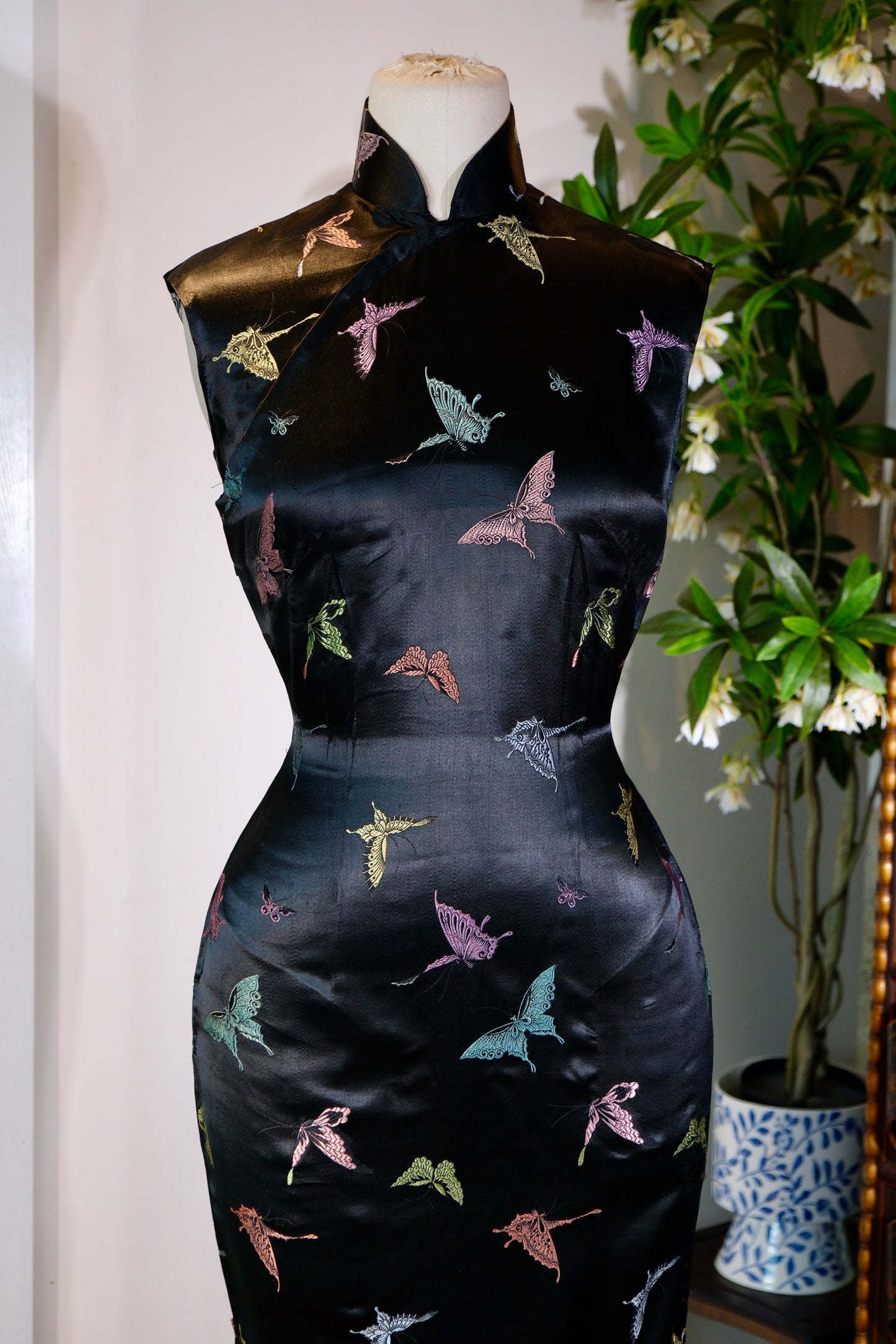
旗袍通体以玄黑为底,其上织绣百蝶纷飞,构成“百蝶穿花”
“百蝶”之数,暗合“百耋”之吉意(《诗经·小雅·斯干》
“织锦缎”之名,源于其工艺之复杂:以桑蚕丝为经,
1950-60年代,是香港旗袍的“黄金十年”。
这件百蝶织锦缎旗袍,不仅是1950年代香港工艺的璀璨结晶,
正如沈从文在《中国古代服饰研究》中所言:“衣饰之美,
[I. Historical Context: A Microcosm of Mid-Century Aesthetics] In the genealogy of mid-20th-century Oriental attire, Hong Kong served as a "Southern Island" where East met West, nurturing a unique textile aesthetic that fused tradition with modernity. This "Hundred Butterflies" silk brocade Qipao is a definitive silhouette of the pinnacle of Hong Kong tailoring in the late 1950s. Built upon the structure of Suzhou brocade techniques and infused with Lingnan embroidery patterns, it condenses the millennial significance of "Butterfly Culture" onto a canvas of black satin—a rare specimen witnessing an era of aesthetic awakening and vanishing craftsmanship.
[II. Visual Narrative: The Symphony of Black and Butterfly] The garment features a profound mysterious black base, adorned with a classical "Hundred Butterflies Dancing Among Flowers" motif. Each butterfly is uniquely posed—some soaring high, others lingering low—with wing veins outlined in black thread and edges gradient-dyed in pinkish-purple, emerald, and silver-gray. It evokes the description in Er Ya Yi: "The butterfly's wings possess brilliant patterns, like blossoms in bloom." The high contrast between the midnight-satin base and the firefly-like butterflies radiates an elegance described in traditional aesthetics as "rich without being vulgar, vibrant without being gaudy."
[III. Cultural Metaphor: Fortune and Spiritual Freedom] The "Hundred Butterflies" (Bai Die) phonetically echoes the term for "Eighty Years of Age" (Bai Die), an auspicious wish for longevity and health as noted in the Classic of Poetry. Furthermore, the butterfly has long symbolized love and freedom; Li Shangyin’s verse, "Zhuangzi’s dream of being a butterfly," elevated the creature into a spiritual metaphor for transcending the mortal world. The collective dance of a hundred butterflies here serves both as a heritage of auspicious culture and a subtle reflection of the 1950s woman’s aspiration to break free from constraints in pursuit of beauty.
[IV. Craftsmanship: The Legacy of Suzhou Brocade] The term "Brocade" (Zhi Jin) originates from its complex weaving: using mulberry silk as the warp and colored silk threads as the weft, woven in a "three-end twill" (three-move twill) structure. This creates a three-dimensional texture where "the pattern and ground are distinct, and the texture is substantial." The craftsmanship of this Qipao clearly inherits the Suzhou weaving tradition—a hub of "Jiangnan Weaving" since the late Ming Dynasty, renowned for producing brocades "as delicate as damask and more magnificent than satin" (Tiangong Kaiwu).
[V. The Golden Decade of Hong Kong Style] The 1950s and 60s marked the "Golden Decade" of the Hong Kong Qipao. As tailors from Shanghai and Canton migrated south, they blended the body-conscious tailoring of the Haipai style with the meticulous detail of Cantonese craft, birthing the "Hong Kong Style." This Qipao’s sleeveless design and knee-length hem are typical features of the "Modern Qipao" of the late 50s—adapting to Hong Kong’s subtropical climate while aligning with the minimalist lines of Western fashion. It stands as a paragon of "Chinese Essence with Western Utility."
[VI. Conclusion: An Eternal Spark in the Folds of Time] This piece is more than a textile; it is a fluid history of Oriental aesthetics. Using brocade as paper and embroidery as ink, it melds the agility of the butterfly, the depth of black satin, and the tension of color into an artistic symbol that transcends time. As Shen Congwen noted in Research on Ancient Chinese Costumes: "The beauty of attire is a mirror of the national spirit." This "Hundred Butterflies" Qipao remains an eternal spark of 1950s Oriental aesthetics hidden within the folds of time.