深圳溯源
Couldn't load pickup availability
衣服尺寸:
胸围/腰围/臀围:96/80/104 厘米
衣长:112 厘米
细节描述:
这件诞生于上世纪六十年代的香港产古董旗袍,
一、图案:花影流金,手绘晕染的诗意美学
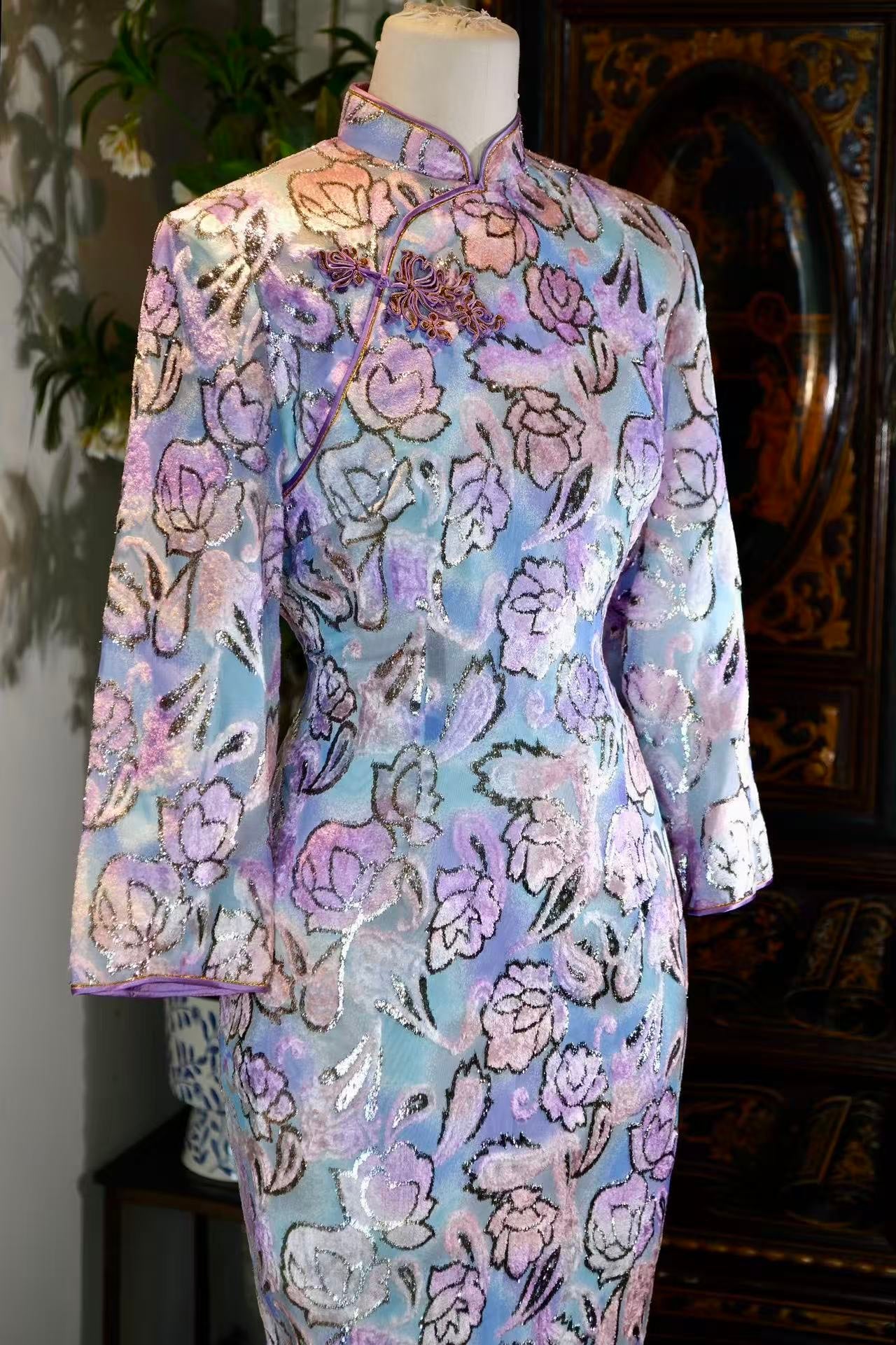
旗袍的图案以大朵花卉为主体,花瓣轮廓以金银线勾勒,
二、故事:香港旗袍的黄金时代与匠人精神
上世纪六十年代,香港是东方时尚的交汇点。彼时,上海裁缝南下,
“织金烧花”是当时极为考究的工艺:先以金线银线织出底纹,
三、引经据典:从《红楼梦》到张爱玲,解码旗袍的文化基因
旗袍上的花卉图案,暗合中国传统文化中“花语”的隐喻。《
四、稀缺性:时光淬炼的孤品价值
时至今日,六十年代的织金烧花丝绒旗袍已成凤毛麟角。一方面,
它静立于时光中,蓝紫的底色如夜空深邃,鎏金的花影似星辰闪烁,
Measurements / Size Guide:
Bust / Waist / Hips: 96/80/104 cm
Total Length: 112 cm
Detailed Description:
Born in the 1960s, this antique Hong Kong qipao is a sublime crystallization of Oriental aesthetics and era-defining craftsmanship. Utilizing a base of gold-woven devoré velvet (burn-out velvet) and enhanced by hand-painted ombre techniques, it transforms floral totems into a flowing poem. Every inch of its texture is etched with the elegance and ingenuity of a bygone era.
The motifs are dominated by grand blossoms, their silhouettes outlined in gold and silver threads that shimmer with a metallic luster, as if moonlight and morning dew were woven directly into the velvet. The floral forms are full and sprawling, possessing both the majesty of the peony and the delicacy of the herbaceous peony. The foliage transitions through an ombre technique—bleeding from deep violet to pale blue, then fading into a powdery white.
This "Hand-Painted Ombre" process requires artisans to use brushes and natural dyes to repeatedly dab and diffuse colors onto the velvet. The depth of color and the direction of the grain in every flower are unique, entirely devoid of the rigidity of mechanical reproduction. Fine gold threads are scattered like stardust between the blooms, allowing the qipao to scintillate under shifting light—exuding opulence without losing the refined grace of a literati painting.
In the 1960s, Hong Kong was the crossroads of Oriental fashion. During this time, Shanghainese tailors migrated south, merging the form-fitting cuts of the Haipai (Shanghai-style) qipao with Lingnan culture. This gave birth to the unique "Hong Kong Qipao"—retaining the traditional mandarin collar, frog fasteners, and diagonal closure while incorporating Western 3D tailoring and bold fabric innovations, of which gold-woven devoré velvet was a prime example.
"Devoré gold-weaving" was an extremely sophisticated process: first, a base pattern was woven with gold and silver threads, then chemical agents were used to "burn away" portions of the velvet pile to make the floral patterns stand out, and finally, the colors were hand-painted. This process was labor-intensive, often requiring months of work by senior artisans. Because of this, such qipaos were typically custom-made for socialites or as formal gowns for momentous occasions, and very few have survived to this day.
The floral patterns harmonize with the metaphors of "Flower Language" in traditional Chinese culture. In Dream of the Red Chamber, the peony-like character of Xue Baochai echoes the majestic floral forms on this garment, while the fluid ombre colors mirror the "beauty of impermanence" found in the poetic descriptions of falling blossoms.
As Eileen Chang wrote in Chronicle of Changing Clothes: "The function of the qipao is nothing more than to faithfully outline the human silhouette." This garment's tailored fit is the ultimate interpretation of that philosophy—the high slits reveal the leg line, the mandarin collar accentuates the neck, and the softness of the velvet complements the rigidity of the gold weave, perfectly portraying the "strength within softness" of the Oriental woman.
Today, 1960s gold-woven devoré velvet qipaos are exceptionally rare. Velvet is difficult to preserve, being prone to moisture and wear. Furthermore, the high cost and complexity of hand-painting and devoré techniques have long been replaced by industrial production. This piece is a "living fossil" of Oriental aesthetics, condensing the spirit of the artisan's "slow work for fine results."
It stands silently in time—its indigo and violet base as deep as the night sky, its gilded floral shadows flickering like stars, narrating an elegant story of beauty, craftsmanship, and an unforgettable era.