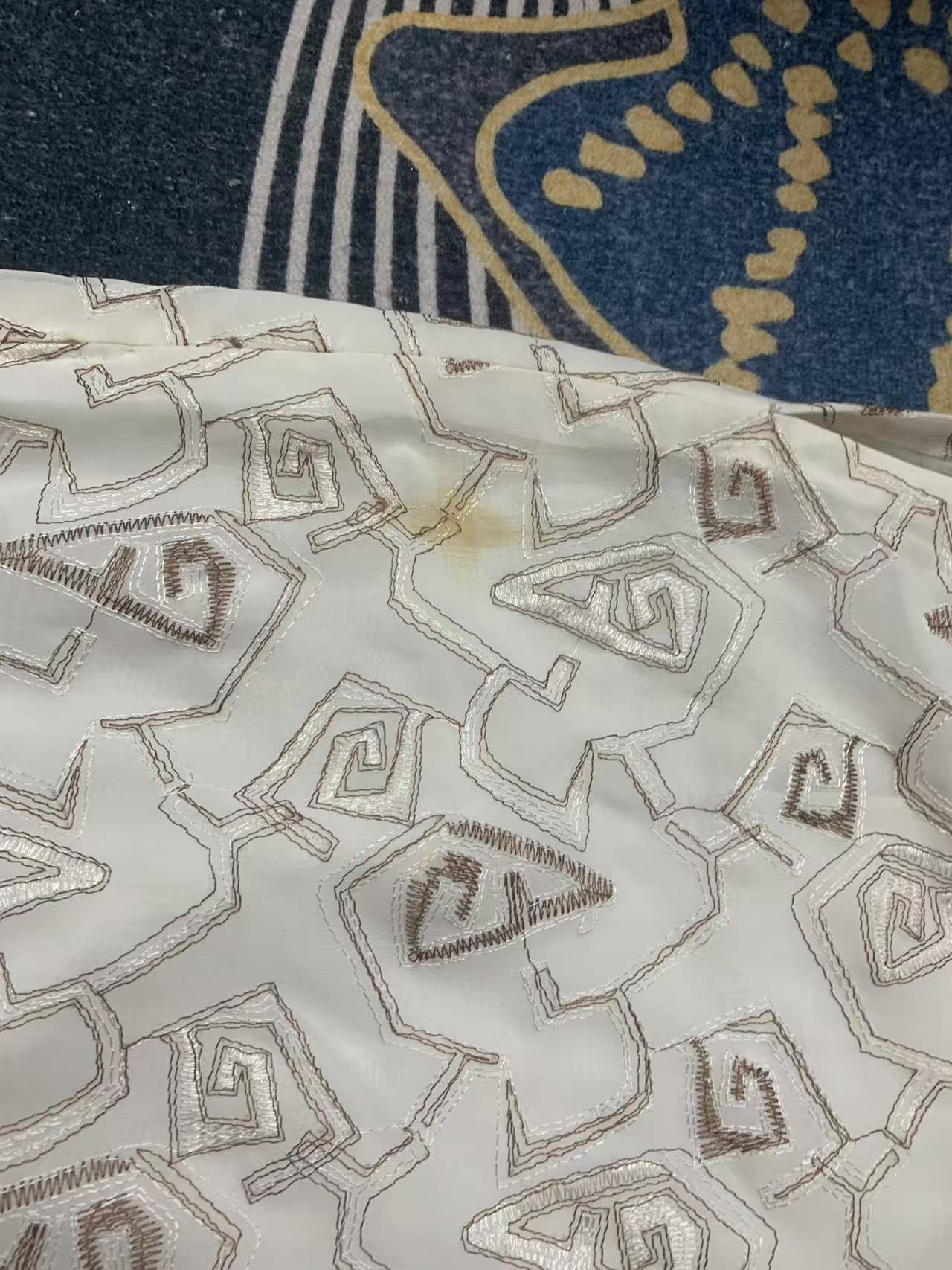
上世纪六十年代台湾产机绣抽象几何古董旗袍
衣服尺寸:
胸围/腰围/臀围:98/88/106 厘米
衣长:105 厘米
细节描述:
一、图案解析
此旗袍以素白为底,通体铺陈机绣抽象几何纹样,线条如游龙走蛇,勾勒出错落有致的菱形、回纹与折线组合。刺绣以浅金与米褐双色丝线交织,既似青铜器上的饕餮纹解构重组,又暗合宋代瓷器冰裂纹的疏密韵律。每一组图案皆以“破形”手法打破传统对称,菱形中心的螺旋纹如漩涡凝滞,边缘折线则似书法飞白,在规整中透出灵动,堪称“以针为笔,以线为墨”的现代主义解构实验。
二、古董衣的故事
1960年代的台湾,正处于传统与现代的交汇点。彼时西方抽象艺术思潮涌入,本土工匠以机绣技艺回应时代——这台老式缝纫机在布面上“书写”的,不仅是几何图案,更是一个岛屿对现代性的想象。旗袍的立领与开衩保留着东方含蓄,而满幅抽象纹样则如张光宇先生的装饰画般大胆,恰似《诗经》“如切如磋,如琢如磨”的当代演绎:传统工艺的“切磋”与先锋设计的“琢磨”在此碰撞,成就了这件“穿在身上的文化宣言”。
三、艺术风格与稀缺性
此衣的艺术价值,在于将“复古”与“先锋”熔于一炉。其几何纹样既非纯粹的装饰艺术风格,亦非简单的传统纹样复刻,而是如贡布里希所言“秩序感”的东方变奏——以理性线条构建视觉节奏,又以刺绣的肌理打破机械感,形成“工而不匠”的独特气质。稀缺性更体现在:六十年代台湾机绣旗袍存世量不足千件,而如此完整保留抽象设计且刺绣无脱落的,堪称凤毛麟角。它不仅是衣物,更是一件可穿着的“纺织艺术品”,承载着冷战时期东亚现代设计的隐秘脉络,正如柯律格在《中国艺术》中所言:“物质文化是最沉默的历史证人。”
四、结语
这件旗袍,是六十年代台湾匠人用针线写就的“现代诗”——每一道绣线都是韵脚,每一组几何都是意象。它静静诉说着:真正的经典,从不在潮流中沉浮,而是在时光里沉淀为永恒。
Modernist Deconstruction: A 1960s Taiwan-Made Machine-Embroidered Abstract Geometric Antique Qipao
Measurements / Size Guide:
Bust / Waist / Hips: 98/88/106 cm
Total Length: 105 cm
Detailed Description:
I. Pattern Analysis: A Geometric Experiment in Thread
Set against a pristine white base, this qipao features all-over machine-embroidered abstract geometric motifs. The lines move with the fluidity of dragons and snakes, sketching a staggered composition of diamonds, fretwork (Huiwen), and broken lines.
-
Interplay of Color and Line: The embroidery utilizes dual-tone silk threads in pale gold and beige. The patterns resemble a deconstructed reorganization of the taotie motifs found on ancient bronzes, yet they also echo the sparse and dense rhythms of ice-crackle glazes on Song Dynasty porcelain.
-
Deconstructive Technique: Each group of patterns employs a "form-breaking" method to disrupt traditional symmetry. The spiral patterns at the center of the diamonds are like frozen whirlpools, while the jagged edges mimic the "flying white" (Feibai) stroke of Chinese calligraphy. This is a modernist experiment where the needle acts as a brush and the thread as ink.
II. Antique Narrative: An Island’s Imagination of Modernity
In the 1960s, Taiwan stood at the crossroads of tradition and modernity. As Western abstract art trends swept in, local craftsmen responded through the medium of machine embroidery.
-
Cultural Dialogue: The old-fashioned sewing machines "writing" across the fabric captured more than just geometry; they captured an island's imagination of a new era. While the standing collar and side slits maintain Eastern modesty, the full-width abstract patterns are as bold as the decorative paintings of Zhang Guangyu.
-
Craftsmanship: It is a contemporary interpretation of the Classic of Poetry: "As thing cut, as thing filed, as thing chiselled, as thing polished." The "cutting and filing" of traditional craft meet the "chiseling and polishing" of avant-garde design, resulting in a "wearable cultural manifesto."
III. Artistic Style and Scarcity: The Silent Witness of Design
The artistic value of this garment lies in its fusion of "vintage" and "pioneer" spirits.
-
Sense of Order: The geometric patterns are neither pure Art Deco nor simple traditional replicas. Instead, they represent an Oriental variation of the "sense of order" described by E.H. Gombrich—building visual rhythm through rational lines while using the texture of embroidery to break mechanical rigidity.
-
Rare Specimen: Scarcity is defined by the numbers: fewer than a thousand machine-embroidered qipaos from 1960s Taiwan are estimated to survive. Finding one that retains such a complete abstract design with no missing stitches is exceptionally rare. As Craig Clunas notes in Chinese Art: "Material culture is the most silent witness of history." This piece is an invisible link in the secret pulse of East Asian modern design during the mid-20th century.
IV. Conclusion: A Modernist Poem in Silk
This qipao is a "modernist poem" written with needle and thread by Taiwanese artisans of the 1960s—every embroidered line is a rhyme, and every geometric set is an image. It quietly declares that true classics do not drift with the tides of fashion; instead, they settle into eternity through the passage of time.