深圳溯源
Couldn't load pickup availability
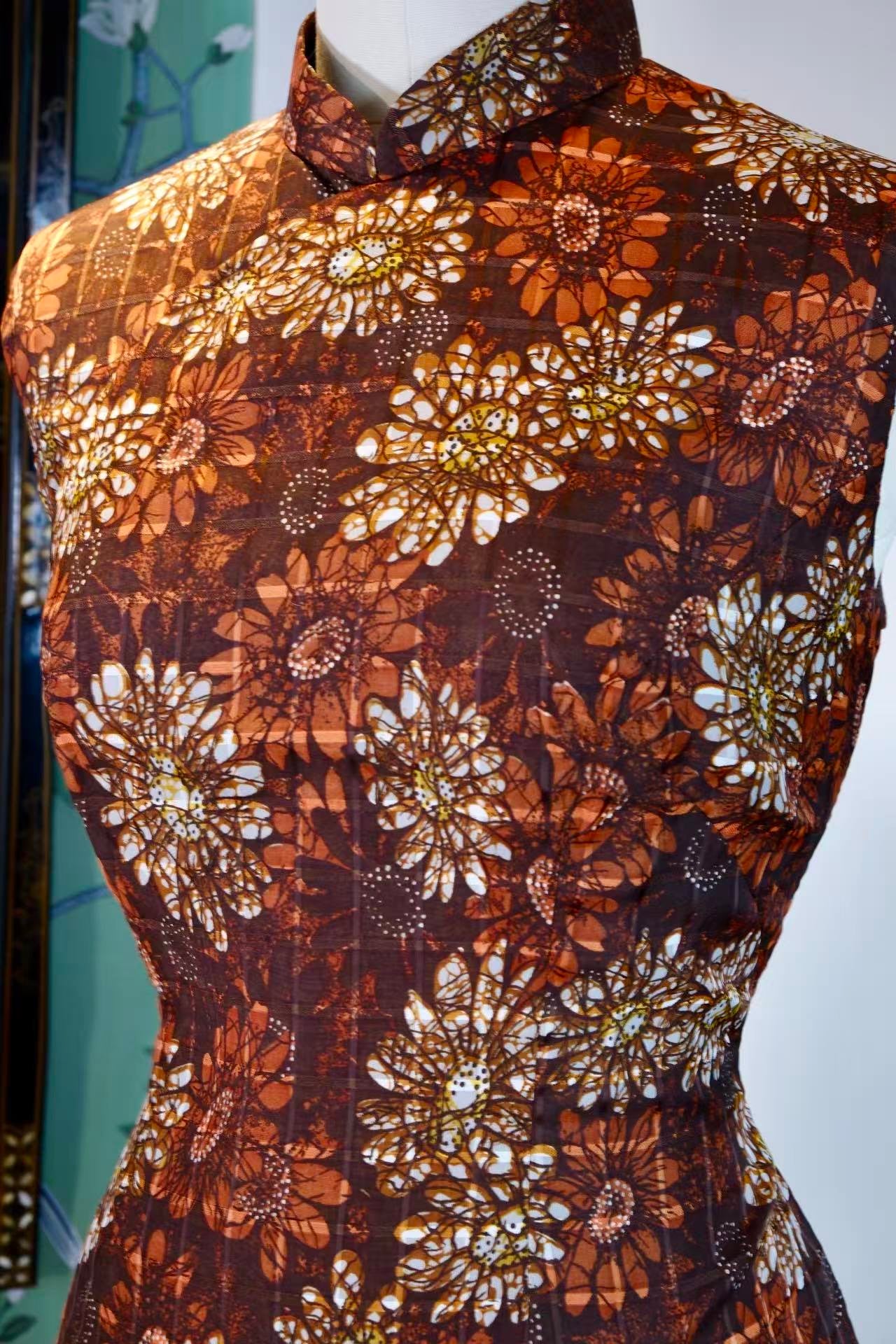
这是一件极具时代韵味与工艺价值的上世纪六十年代暗纹提花抽象几
作为一位深耕服装史与文学研究的学者,当我凝视这件衣物时,
这件旗袍最迷人的部分,无疑是其面料上的图案设计。
仔细观察,我们可以看到无数朵抽象化的“菊花”或“向日葵”
主色调采用了浓郁的焦糖色、咖啡色与赭石色,
这件旗袍是六十年代(1960s)时尚的一个典型切片。
尽管身处一个强调集体主义与朴素的社会环境,
六十年代的中国,时尚开始受到西方波普艺术与几何美学的影响,
在文学与历史的长河中,
“对于不会说话的人,衣服是一种言语,随身带着的一种袖珍戏剧。
张爱玲的这句话,用在这件古董旗袍上再合适不过。
从服装史的角度看,这种“抽象几何花卉”
这件古董旗袍,是一件“可穿着的艺术品”。
它记录了六十年代的纺织工艺巅峰,
This is an antique cheongsam (qipao) from the 1960s, possessing immense period charm and artisanal value, featuring dark-patterned jacquard with abstract geometric floral motifs.
As a scholar deeply immersed in fashion history and literary research, gazing upon this garment feels like observing a microcosm of that unique era. It is more than just clothing; it is a precious historical document carrying a distinct aesthetic language and reflecting the social landscape of its time.
The most captivating element of this cheongsam is undoubtedly its textile design. It eschews the meticulous, realistic florals common in traditional qipaos, opting instead for abstract geometric floral patterns—a bold and avant-garde artistic endeavor for that period.
Upon closer inspection, one can see countless abstracted "chrysanthemums" or "sunflowers" blooming across the deep brown ground. The petals are not natural curves but are composed of radial geometric lines and stippled elements. This design draws from the structural sensibilities of modernist painting, deconstructing and reorganizing natural flora to create a semi-transparent, lace-like visual effect.
The palette is dominated by rich caramel, coffee, and ochre, interwoven with warm cream and gold. This warm-toned composition preserves the steady introversion of Oriental aesthetics while exuding a cozy, vintage luxury. Under the light, the jacquard patterns shift with the shadows, as if the flowers are breathing, manifesting a dynamic beauty.
This cheongsam serves as a quintessential slice of 1960s fashion—a decade defined by the tension between upheaval and innovation.
The Silhouette: Despite a social environment that emphasized collectivism and austerity, this piece retains a tailored, slim fit. While the side slits are modestly restrained, the fluid lines still trace the natural curves of the female form. This is the pinnacle of the "subtle sensuality" found in Oriental aesthetics.
Global Influence: In the 1960s, Chinese fashion began to feel the ripples of Western Pop Art and geometric aesthetics, even while adhering to local stylistic norms. These abstract flowers are the progeny of cultural collision: they possess the geometric structure of Western modernism alongside the auspicious symbolism of traditional Chinese "flourishing blossoms" (huatuan jinchu).
In the long river of literature and history, the cheongsam has always been a witness to the awakening of female consciousness and the shifting tides of time.
"For those who cannot speak, clothes are a kind of language—a pocket drama one carries with them." — Eileen Chang, Chronicle of Changing Clothes
Chang’s words are perfectly suited for this antique piece. The abstract geometric blooms act as the inner voice of women from that era: though they could not cry out loud, they expressed their longing for beauty and desire for freedom through patterns, colors, and tailoring.
From the perspective of textile history, such "abstract geometric floral" patterns were rare in the 60s. At that time, most textile mills were limited by technology to producing simple stripes or solid fabrics. A fabric with such complex craftsmanship and strong artistic design was typically reserved for high-end exports or bespoke luxury. Consequently, the survival rate of such pieces is extremely low, giving it immense archival and collector value.
This antique cheongsam is a "wearable work of art." Having traversed more than half a century, it still radiates a mesmerizing luster. It records the peak of 1960s textile craftsmanship, witnesses the fusion of Eastern and Western cultures, and carries the persistent pursuit of beauty by a generation of women amidst the torrents of history.
To wear it is to don more than a garment; it is to wear a heavy slice of history and a unique memory of Oriental aesthetics.