深圳溯源
Couldn't load pickup availability
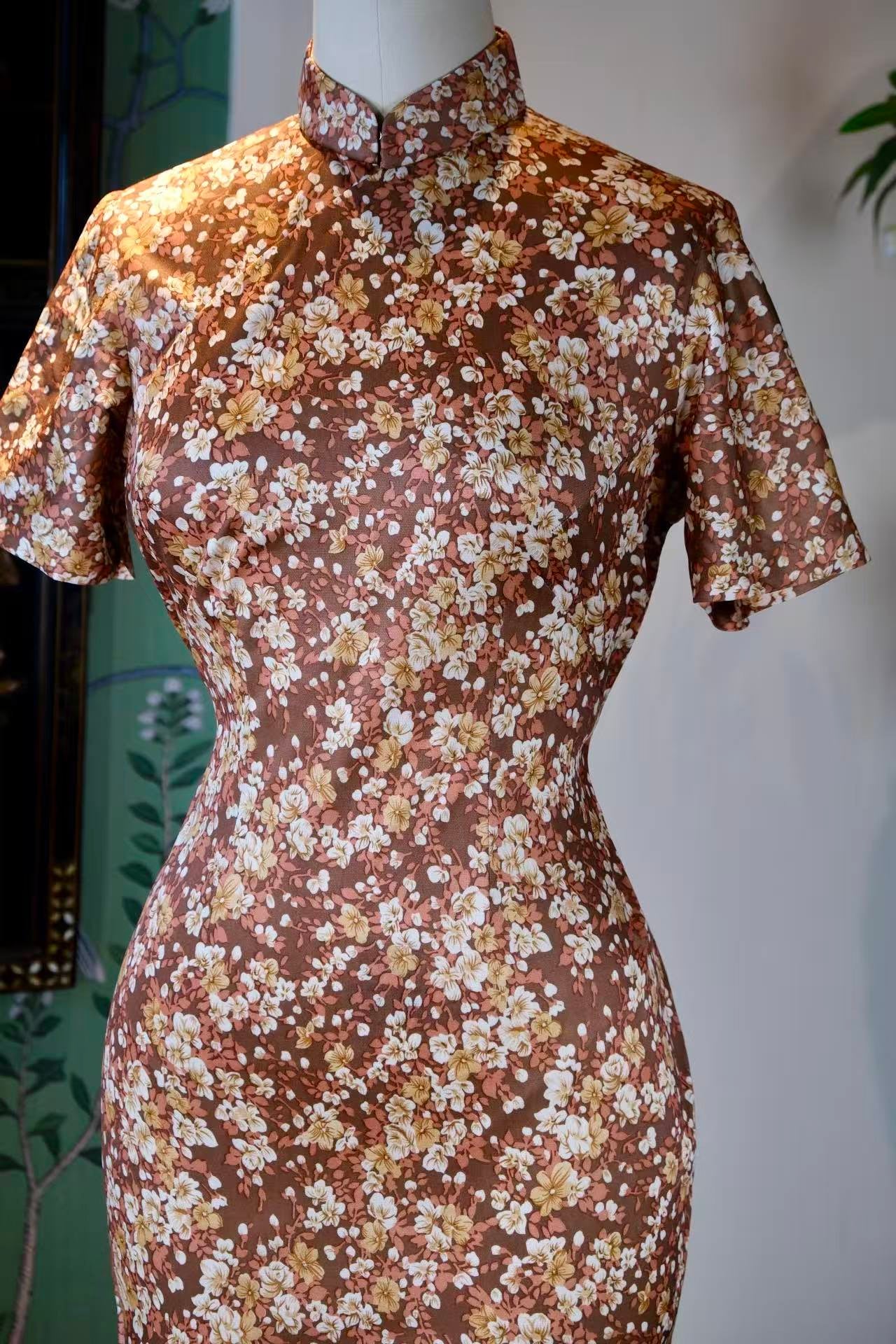
六十年代台湾印花横纹缎旗袍:椒粉棕褐间的视觉史诗
当“月移花影动”的宋词意境邂逅“横纹缎”的织造密码,
旗袍面料以“椒粉棕”为底,其色如《本草纲目》所载“椒红”:“
花枝的分布暗合《园冶》中“虽由人作,宛自天开”的造园法则——
“横纹缎”作为民国时期盛行的丝绸变体,
六十年代台湾纺织业正值“传统工艺现代化”转型期,
旗袍上的碎花纹样暗合了六十年代台湾文学中的“闺阁美学”——
当现代快时尚以“季度潮流”为标尺时,这件古董旗袍却以“
如今,它静卧于衣架之上,却仿佛在低吟:“罗衣何飘飘,
"When the Song Dynasty poetic imagery of 'shifting moonlit flower shadows' meets the weaving codes of cross-ribbed satin, this 1960s Taiwanese Qipao transforms fabric into Xuan paper and peppercorn-brown into ink."
The base of this Qipao is dyed in "Peppercorn Brown" (Jiao Fen Zong), a hue described in the Compendium of Materia Medica as having the power to "ward off evil spirits" with its warm, pungent undertones. Upon this grounded canvas lies a "Full-coverage Floral" (Man Di Sui Hua) motif. Tiny white petals with yellow pistils—reminiscent of jasmine or winter plum—intertwine with dark brown vines, creating a visual rhythm akin to the classic verse: "Sparse shadows lean slanting across the clear, shallow water."
The distribution of floral sprays adheres to the principles of classical garden design from Yuanye: "Though created by human hands, it appears as a work of nature." There is an underlying order within the randomness—clusters gathered like "a thousand pear trees in bloom," or scattered like "wild flowers confusing the eye." The luminosity of the white petals and the deep brown base create an "Yin-Yang" contrast, while the warm yellow pistils act as the "intermingled colors" described in Kao Gong Ji, adding vitality to the steady palette.
Cross-ribbed Satin (Heng Wen Duan), a popular silk variant during the Republican era, features a denser weave than standard satin. Its surface presents a subtle horizontal sheen, feeling as cool as "darkly dripping dew" to the touch and appearing as fluid as "rippling sunlight on water."
The 1960s marked a pivotal era for Taiwan’s textile industry, transitioning from traditional crafts to modernization. This Qipao utilizes "Roller Printing" technology introduced from Japan, allowing for a sophisticated "bleeding" effect on the petal edges. This mirrors the "Fucai" (color layering) method found in Emperor Huizong’s paintings: the white petals transition softly into the brown base, and the varying depths of the yellow pistils evoke the "five shades of ink" characteristic of Gongbi (fine-brush) painting.
The floral patterns also resonate with the "Boudoir Aesthetics" of 1960s Taiwanese literature—evoking the image of "jasmine tucked behind the ear" in Lin Hai-yin’s Memories of Peking, or the warmth of "osmanthus steaming" in Qi Jun’s essays. This symbolic language of "using flowers as a metaphor for people" continues the "Bi-Xing" (allusive and metaphorical) tradition of The Classic of Poetry, carrying the collective memory of an elegant life in post-war Chinese society.
While modern fast fashion measures worth by seasonal trends, this antique Qipao interprets the eternal value of "Slow Aesthetics." It is more than a stitching of cloth; it is a suturing of culture. The stability of the brown base is like the earth, the elegance of the white flowers like drifting clouds, and the warmth of the yellow pistils like passing time—weaving together the Oriental philosophy of "Harmony between Heaven and Humanity."
Today, as it rests upon the hanger, it seems to hum the ancient lines of Cao Zhi: "How fluttering are her silken robes; her light skirt follows the wind." Every inch of the surface is a slice of history; every pattern a cultural cipher. To touch it is to feel the temperature of a 1960s Taiwanese weaver’s fingertips and hear the thousand-year echo of "flowers blooming to stir the capital." This is the rarest quality of an antique Qipao—an artistic vitality that transcends time.