深圳溯源
60年代 - 六十年代台湾压花丝绒旗袍:时光里的东方绮梦 | 1960s - Embossed Velvet Cheongsam of 1960s Taiwan: An Oriental Dream Within Time
60年代 - 六十年代台湾压花丝绒旗袍:时光里的东方绮梦 | 1960s - Embossed Velvet Cheongsam of 1960s Taiwan: An Oriental Dream Within Time
Couldn't load pickup availability
六十年代台湾压花丝绒旗袍:时光里的东方绮梦
衣服尺寸:
胸围/腰围/臀围:88/74/100 厘米
衣长:100 厘米
细节描述:
一、纹样考据:浮雕般的东方诗学
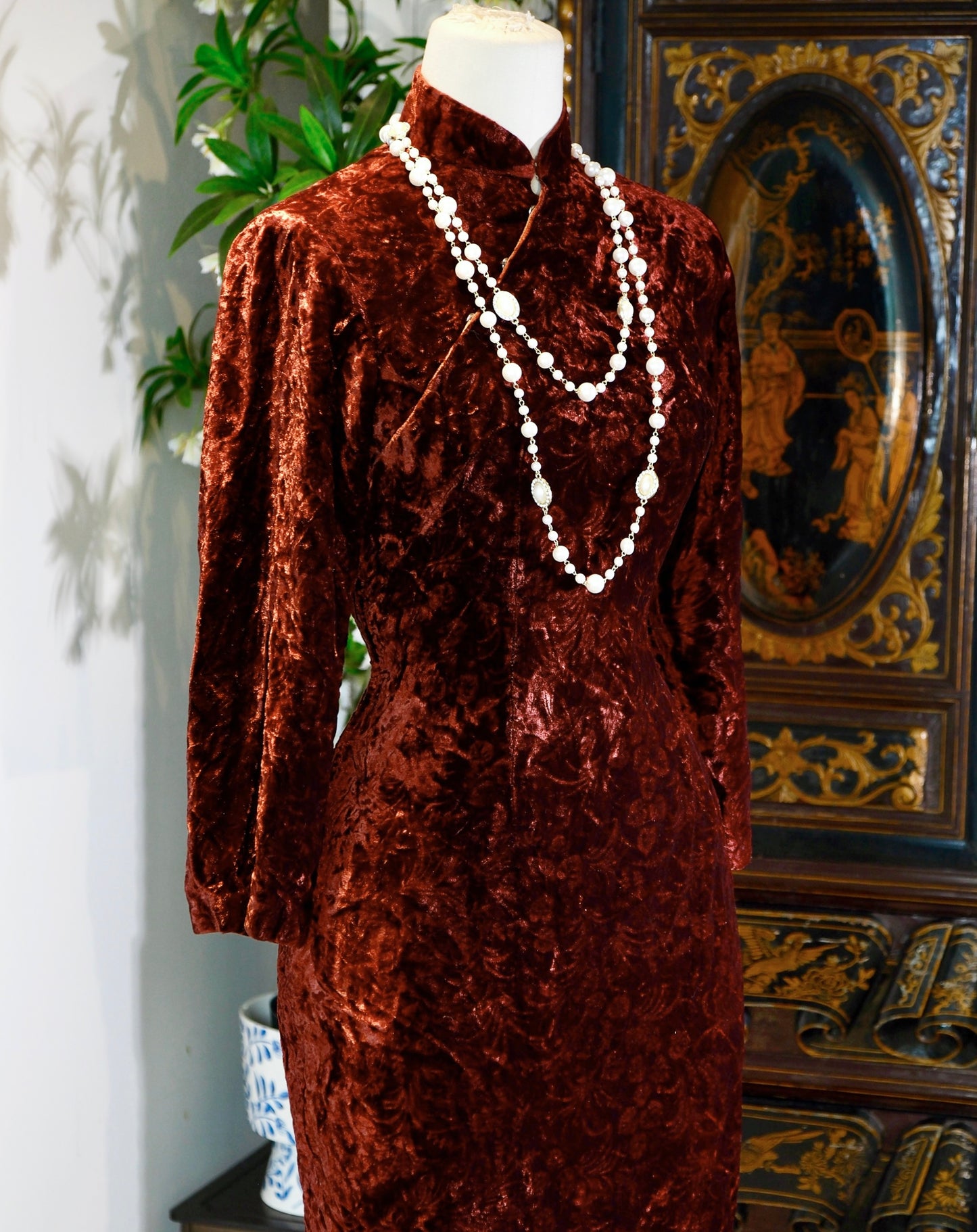
这袭旗袍以深棕红色压花丝绒为骨,面料上的纹样并非寻常印染,而是通过“压花”工艺将花卉肌理立体镌刻于丝绒之上。细观其纹,牡丹与缠枝莲纹交错层叠——牡丹取“富贵”之意,缠枝莲则暗合“生生不息”的东方哲学,纹样以S形曲线延展,既承袭了明代《天工开物》中“锦工巧夺天工”的织造智慧,又融入六十年代台湾纺织业对西方立体浮雕技法的吸收。丝绒的绒毛在光线下形成明暗渐变,让花卉仿佛在布料上呼吸,正如《考工记》所言“天有时,地有气,材有美,工有巧”,这种“材”与“工”的交融,正是古董旗袍的灵魂所在。
二、时代叙事:海岛上的文化坚守
1960年代的台湾,正处于传统与现代的碰撞期。彼时,上海旗袍的剪裁技艺随迁台工匠传入宝岛,与本土丝绸工艺结合,催生出这批“台湾产旗袍”的独特风貌。这袭旗袍的立领高约4.5厘米,领口微收的弧度暗合《礼记·深衣》“袂圜以应规”的含蓄美学;收腰设计则借鉴了西方立体剪裁,却以中式斜襟收束。
据《台湾纺织史》记载,1965年台湾丝绒年产量仅300万米,其中用于旗袍的高端压花丝绒不足5%,且多供出口或官眷定制。这袭旗袍的保存完整度(无褪色、无虫蛀)与工艺精度(压花纹样无磨损),使其成为研究六十年代台湾纺织技术与文化认同的“活化石”。
三、艺术风格:复古与摩登的二重奏
从艺术史维度看,这袭旗袍堪称“东方巴洛克”的典范。深棕红色丝绒的厚重质感,与巴洛克艺术追求的“戏剧性光影”不谋而合;而压花花卉的繁复层次,则与洛可可风格的“纤巧华丽”形成对话。但设计师巧妙以中式立领与斜襟“破局”,让西方技法服务于东方意境,正如美学家宗白华所言:“中国艺术意境的创成,既须得屈原的缠绵悱恻,又须得庄子的超旷空灵。”
其稀缺性更体现在“不可复制性”:六十年代台湾压花丝绒旗袍多采用手工压模,每匹布的纹样深浅皆有微妙差异,加之当时缝纫机针距密度(约8针/厘米)与现代工业生产的差异,使得每件古董旗袍都成为“孤品”。如今,这类旗袍在国际古董衣市场的存世量不足千件,且多为博物馆级收藏。
四、故事余韵:衣香鬓影里的时光切片
想象1967年的台北某场晚宴,一位身着此旗袍的女子走过雕花屏风,丝绒的暗纹在烛光下流转,珍珠项链的温润与丝绒的华贵相映成趣——这不仅是服饰,更是一个时代的文化切片:它承载着迁台文人的乡愁,见证着海岛经济的崛起,也凝固了东方女性对“美”的永恒追求。
正如本雅明在《机械复制时代的艺术作品》中所说:“原作的‘光韵’(Aura)在于其独一无二的存在。”这袭旗袍的“光韵”,正是六十年代台湾纺织工匠的指尖温度,是东方美学在时代浪潮中的倔强绽放,更是穿越半世纪仍能打动人心的——时光里的东方绮梦。
Embossed Velvet Cheongsam of 1960s Taiwan: An Oriental Dream Within Time
Measurements / Size Guide:
Bust / Waist / Hips: 88/74/100 cm
Total Length: 100 cm
Detailed Description:
I. Pattern Research: The Oriental Poetics of Relief
This cheongsam is structured from deep brownish-red embossed velvet. The patterns are not mere prints but are three-dimensionally carved into the velvet through an "embossing" process. Upon close inspection, peonies and intertwining lotus motifs are layered together—the peony signifying "prosperity" and the lotus echoing the Oriental philosophy of "endless life." The patterns extend in S-curves, inheriting the weaving wisdom of "craftsmanship that rivals nature" from the Ming Dynasty’s Tiangong Kaiwu, while integrating the 1960s Taiwanese textile industry's absorption of Western relief techniques. The velvet pile creates light-and-shadow gradients, making the blossoms appear to breathe upon the fabric. As the Artificers' Record suggests: "When materials and craft merge, the soul of the object is born."
II. Era Narrative: Cultural Persistence on the Island
The 1960s in Taiwan was a period of collision between tradition and modernity. During this time, the tailoring skills of Shanghai-style qipaos were brought to the island by migrating craftsmen, merging with local silk industries to create the unique "Taiwan-made Qipao." This garment’s standing collar reaches approximately 4.5 cm, with a subtle curvature that aligns with the understated aesthetics of the Book of Rites. The cinched waist borrows from Western three-dimensional tailoring yet remains anchored by the Chinese diagonal bodice (Pipa front).
According to the Textile History of Taiwan, the annual production of velvet in 1965 was only 3 million meters, with high-end embossed velvet for qipaos accounting for less than 5%, mostly reserved for export or bespoke orders for officials' families. The pristine condition of this piece—free from fading or wear—makes it a "living fossil" for studying 1960s Taiwanese textile technology and cultural identity.
III. Art Style: A Duet of Vintage and Modernity
From the dimension of art history, this qipao is a paragon of "Oriental Baroque." The heavy texture of the deep brownish-red velvet coincides with the "dramatic chiaroscuro" pursued in Baroque art, while the complex layers of embossed flowers engage in a dialogue with the "delicate opulence" of Rococo. However, the designer skillfully breaks this with the Chinese standing collar and diagonal front, making Western techniques serve Eastern artistic conception. As the aesthetician Zong Baihua said: "The creation of Chinese artistic conception requires both the lingering melancholy of Qu Yuan and the transcendent emptiness of Zhuangzi."
Its scarcity is further manifested in its "irreproducibility." In 1960s Taiwan, embossed velvet was often made using manual molds, resulting in subtle differences in pattern depth for every bolt of cloth. Coupled with the stitch density of that era (approx. 8 stitches/cm), every antique qipao becomes a "unique specimen." Today, there are fewer than a thousand such pieces in the international antique market, mostly held in museum-level collections.
IV. Story Echoes: A Slice of Time Amidst Fragrance and Shadows
Imagine a banquet in Taipei, 1967. A woman in this cheongsam walks past a carved screen, the dark patterns of the velvet shifting under candlelight, the warmth of a pearl necklace complementing the opulence of the fabric. This is more than a garment; it is a cultural slice of an era: carrying the nostalgia of literati, witnessing the rise of the island's economy, and freezing the eternal pursuit of "beauty" by Oriental women.
As Walter Benjamin noted in The Work of Art in the Age of Mechanical Reproduction: "The 'Aura' of the original lies in its unique existence." The "Aura" of this cheongsam is the temperature of the 1960s Taiwanese craftsman’s fingertips, the stubborn blooming of Eastern aesthetics amidst the tides of time—an Oriental dream that remains heart-stirring half a century later.
Share