六十年代台湾暗纹提花古董旗袍:碧瓯浮玫的时光笺谱
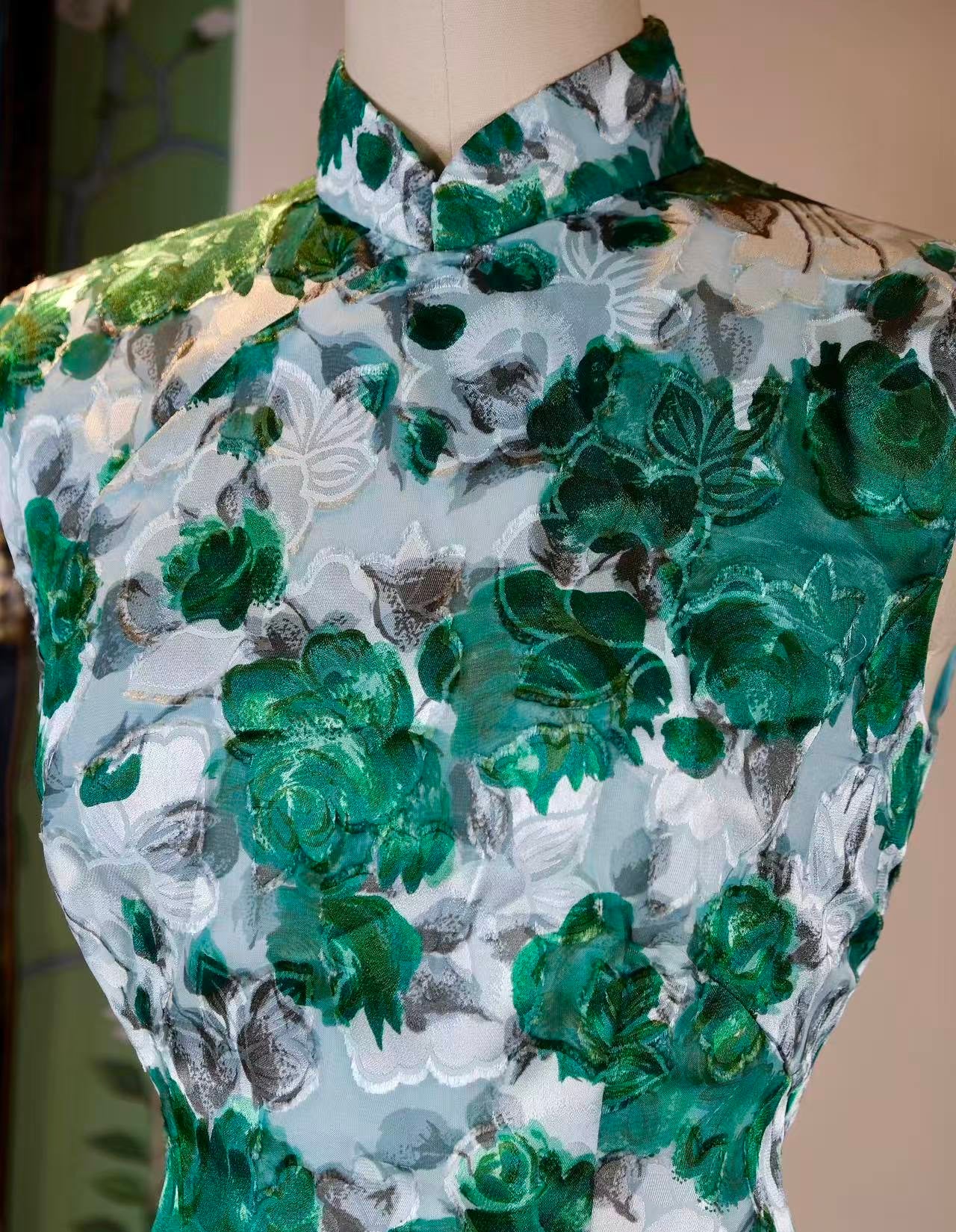
此件上世纪六十年代台湾产古董旗袍,以月魄色暗花绸为帛笺,暗纹提花与渗透印花技法交缠成韵,摹写出「翠浥玫瑰魄」的绮梦长卷。深碧绿玫瑰簇拥绽放,花瓣以西洋晕染法过渡墨绿至湖绿,边缘泛起珍珠光泽;浅翠色玫瑰含苞垂露,蕊心缀银灰丝线如凝霰,叶脉以铂金灰经纬勾勒,在光线流转间呈「折枝蘸露」的鲜活态势。面料选用闽台特有的桑蚕暗花绸,地纹隐现缠枝莲暗纹,与显性玫瑰花枝形成「暗纹托明花」的复调结构——此乃台湾战后纺织业融汇闽南织造古法、东瀛型染技艺,又吸纳西洋装饰美学的独特创造。
其形制存四开衩与立领斜襟遗意,腰身收束至26英寸,契六十年代台湾 摩登女性「柳腰绾云」的风仪。玫瑰纹样未受后期裁改,且以「西式花卉」入「中式袍身」,恰是战后台湾时尚界「中体西用」的先锋实践——彼时上海「金星」、台北「丽星」等织造厂,正以玫瑰、郁金香等洋花入锦,暗合《清稗类钞》「洋货入华,衣饰先变」之载,却在旗袍形制中完成了「西学东渐」的美学转译。
《群芳谱》云「玫瑰,美如红玉」,此袍之玫,却以碧色打破传统,似将闽南红砖古厝的热烈、日式町屋的幽寂、西洋花园的浪漫熔铸一绸。六十年代台湾纺织业处「华丽岛」风格嬗变期,此袍以玫瑰为骨、暗纹为肌、提花为魂,既是海峡彼岸对华夏衣冠的创造性延续,更是全球化浪潮下东西方美学共振的活化石——每一缕提花纹路皆藏时代密码,每一朵玫瑰皆作时光信使,诉说那段「绮罗香忆台湾云」的工艺史诗。
The Chronogram of Emerald Roses: A 1960s Taiwanese Jacquard Cheongsam
This 1960s antique cheongsam, crafted in Taiwan, utilizes a moon-white jacquard silk as its canvas. Through a rhythmic interplay of hidden jacquard weaves and permeation printing, it composes a visual epic described as "Emerald-Drenched Rose Spirits." Clusters of deep emerald roses bloom across the fabric, their petals transitioning from ink-green to lake-green via Western-style gradient shading, with edges that shimmer with a pearlescent luster. Pale jade buds appear heavy with dew, their hearts stitched with silver-grey silk like frozen mist, while leaf veins are traced in platinum-grey threads. Under shifting light, the blossoms take on the vivid vitality of "freshly plucked stems dipped in morning dew."
The fabric is a mulberry silk damask unique to the Fujian-Taiwan region. It features a "polyphonic" structure where a subtle, hidden pattern of scrolling lotuses serves as a base for the prominent rose motifs—a technique known as "Hidden Veins Supporting Manifest Flowers." This piece stands as a unique creation of Taiwan’s post-war textile industry, synthesizing ancient Minnan weaving techniques and Japanese Katazome (stencil dyeing) with Western decorative aesthetics.
Form and Philosophy
The silhouette retains the traditional essence of the four-sided vents, high standing collar, and diagonal closure (pankou). The waist is cinched to a slender 26 inches, epitomizing the "willow-waist" grace of the modern Taiwanese woman of the 1960s. The rose patterns remain untouched by later alterations; by integrating "Western flora" into a "Chinese robe," the garment serves as a pioneer of the "Chinese Essence, Western Application" (Zhong Ti Xi Yong) movement in post-war Taiwanese fashion. During this era, renowned mills such as "Jinxing" (Venus) in Shanghai and "Lixing" (Lucky Star) in Taipei began incorporating exotic flowers like roses and tulips into brocades. This mirrored the records in the Qingbai Leichao stating that "when foreign goods enter China, clothing and adornments are the first to change," yet here, the aesthetic "Westernization" was seamlessly translated within the traditional framework of the cheongsam.
A Living Fossil of Aesthetic Resonance
As the Qunfangpu (Treatise on Flowers) notes, "The rose is as beautiful as red jade." This garment, however, breaks tradition by rendering the rose in shades of green—fusing the fiery warmth of Minnan red-brick courtyards, the quietude of Japanese machiyas, and the romanticism of Western gardens into a single bolt of silk.
Created during the transformative "Ilha Formosa" (Gorgeous Island) period of Taiwan’s textile history, this cheongsam uses the rose as its bone, the hidden patterns as its skin, and the jacquard weave as its soul. It is both a creative continuation of Chinese sartorial lineage from across the Strait and a living fossil of East-West aesthetic resonance in the age of early globalization. Every thread of the jacquard hides a code of the era; every rose acts as a messenger of time, reciting a textile epic of "fragrant silks recalling the clouds of Taiwan."
Key Terminology Used:
-
Moon-white (月魄色): A traditional color term referring to a very pale blue or silvery white.
-
Jacquard (提花): The technical term for patterns woven directly into the fabric.
-
Zhong Ti Xi Yong (中体西用): A historical philosophy of adopting Western practical knowledge while maintaining Chinese cultural foundations.
-
Minnan (闽南): Referring to the southern Fujian region, which shares deep cultural and textile roots with Taiwan.